- Machinery research institute develops compact electrostatic module based on 'Air Five' platform
- Technology cuts filter clogging and fits directly into existing train ventilation systems
- After India field trials, expansion planned to airports, hospitals and Southeast Asian markets
South Korean air purification technology is heading to India's railway market, which has long struggled with extremely high levels of fine dust. The technology maintains performance over long periods even in heavily polluted environments and can be installed directly into existing train ventilation systems without major modifications.
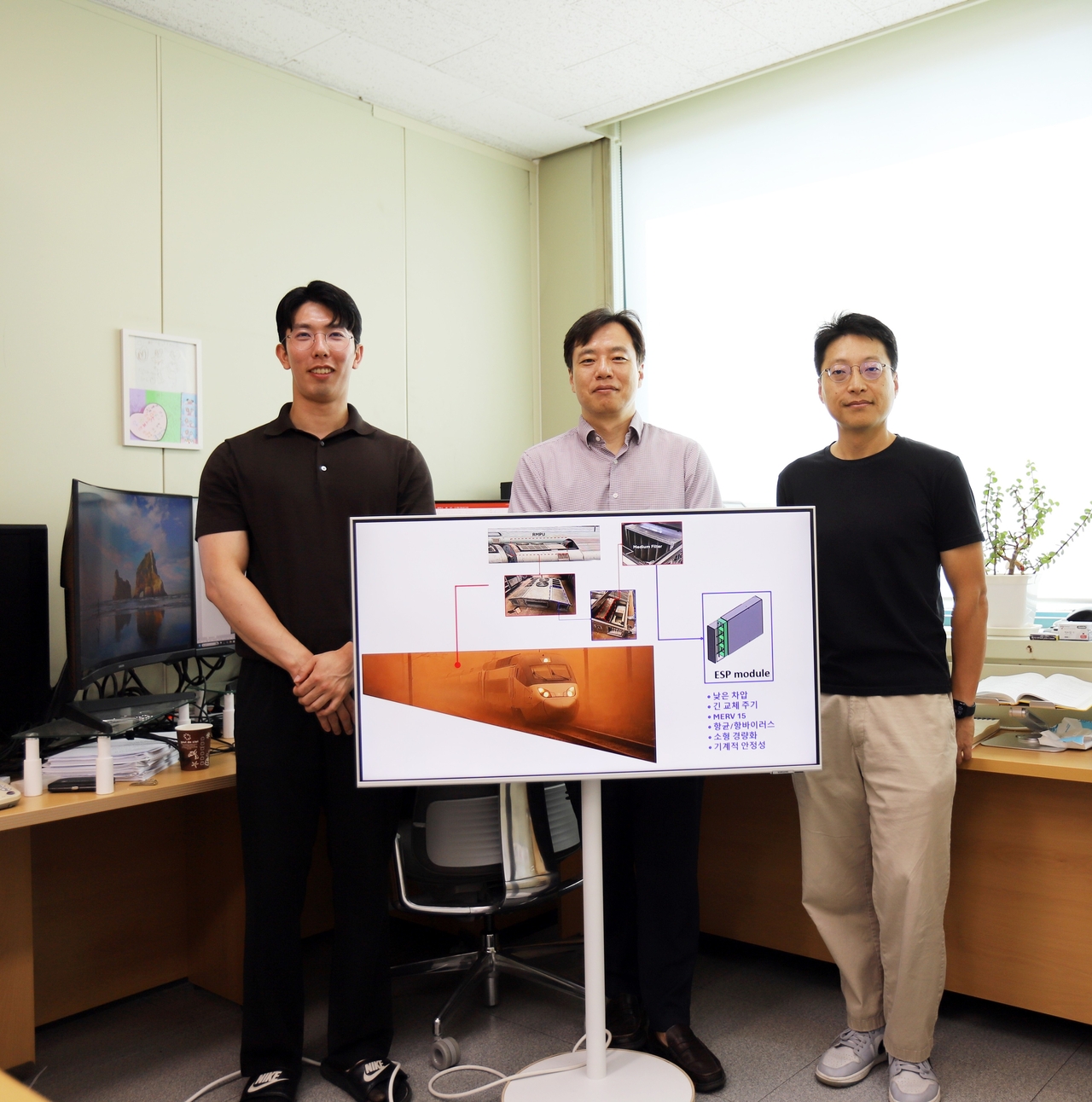
The Korea Institute of Machinery and Materials said Thursday that its research team has begun developing a compact electrostatic precipitation module for Indian trains, in partnership with affiliate company THN. The team, from the institute's Department of Environmental and Energy Systems Research, is led by Principal Researchers Kim Sang-bok and Park In-yong and Senior Researcher Kim Young-hoon.
The technology is being developed under Air Five, the institute's flagship air purification brand.
The electrostatic precipitation method charges fine dust particles in the air before collecting them on a precipitation plate. Conventional filters that rely on filtration tend to clog quickly and generate greater air resistance as dust concentration rises. Electrostatic precipitation, by contrast, keeps the air passage from clogging easily, allowing it to reliably purify large volumes of air even in highly polluted environments.
The research team is designing the module in a compact form that can be installed without altering the structure of existing train ventilation systems. The goal is to achieve fine dust reduction performance at the MERV 15 level, comparable to high-performance filtration-based air purification technology. MERV is an index that measures a filter's ability to remove fine particles, with higher numbers indicating better removal performance.
The project began after an Indian railway company proposed developing air purification technology for train cabins. The research team plans to install the developed module on actual trains in India to verify its dust removal performance, durability and energy efficiency. It will also confirm whether the purification performance remains stable over long periods of operation.
The team is also incorporating technology that removes infection-transmitting substances in addition to fine dust. In cooperation with Chonnam National University, the researchers plan to apply a function to the electrostatic precipitator that treats airborne infection-transmitting substances.
Once field trials in India are complete, the institute plans to expand the technology's application beyond railways to airports, hospitals, and government and public institutions with high foot traffic. Following India, the institute is also pursuing entry into railway and public facility markets in Southeast Asian countries with high fine dust levels, including Thailand and Vietnam.
"It is meaningful that we are directly applying domestically developed air purification technology to Indian trains, where fine dust concentration is high, to verify its performance and reliability," said Kim Sang-bok, principal researcher. "We plan to expand the scope of application beyond railways to various ventilation markets, including hospitals, airports and public facilities, contributing to the overseas expansion of Korean air purification technology."
nbgkoo@heraldcorp.com