IBS study finds snowfall and cloud cover significantly curb ice sheet loss in East Antarctica
Even if global average temperatures rise by more than 10 degrees Celsius, the vast ice sheet covering East Antarctica could remain largely intact, new research shows. The key reason: increased snowfall and cloud cover triggered by rising temperatures actually slow the rate at which the ice melts.
The Institute for Basic Science said Friday that a research team led by Axel Timmermann, director of the IBS Center for Climate Physics and a distinguished professor at Pusan National University, confirmed the unexpected resilience of the East Antarctic Ice Sheet through 100,000-year long-term simulations combining a global climate model with an ice sheet model.
The research team set varying atmospheric carbon dioxide concentrations and simulated the interplay between the climate and the Antarctic and Greenland ice sheets over 100,000 years. Unlike earlier studies that applied predetermined atmospheric and oceanic conditions to ice sheet models, this approach incorporated the two-way interaction between climate and ice sheets.
The analysis revealed stark regional differences in how ice sheets respond to warming.
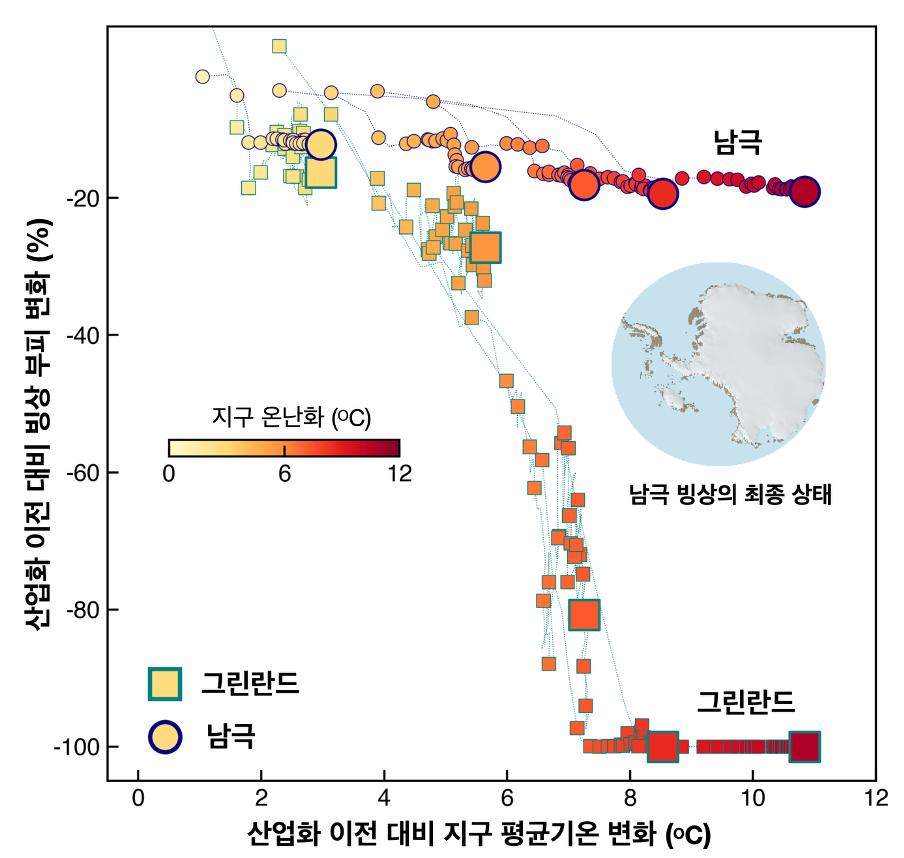
When global average temperatures remain more than 2 degrees Celsius above pre-industrial levels over the long term, the West Antarctic Ice Sheet is projected to suffer substantial ice loss. The Greenland Ice Sheet was also found to shrink gradually with warming and could disappear entirely once temperatures exceed roughly 6 degrees above pre-industrial levels.
The East Antarctic Ice Sheet told a different story. It remained relatively stable even under extreme warming conditions where global average temperatures surpassed 10 degrees above pre-industrial levels.
Snow and clouds were the critical factors behind this difference.
As atmospheric temperatures rise, the amount of water vapor in the air increases. Combined with shifts in Southern Hemisphere atmospheric circulation, more water vapor is transported toward Antarctica, where it accumulates as snow over the high-altitude interior of East Antarctica, replenishing ice that would otherwise be lost.
Clouds also played a protective role. As cloud cover increased, less solar radiation reached the ice sheet surface, suppressing melting.
In fact, under the most intense warming conditions, Antarctic ice sheet volume fell by about 70 percent when changes in precipitation and solar radiation were not accounted for. When those atmospheric responses were incorporated into the coupled model, however, the decline shrank to about 20 percent.
However, the research team said the findings should not be taken to mean the Antarctic ice sheet is safe from climate change. Significant ice loss can still occur in West Antarctica, and ice sheets are already retreating in some parts of East Antarctica as well.

"This research shows that the long-term future of ice sheets cannot be understood through temperature alone," said Yoon Kyung-sook, a researcher at the IBS Center for Climate Physics. "Snowfall, clouds, wind and changes in ocean temperature interact with the ice sheet surface in complex ways."
Timmermann said accurately predicting long-term climate instability and sea level rise requires accounting for the interaction between climate and ice sheets. "Relying solely on simplified climate conditions risks missing the critical regional processes that determine ice sheet retreat and stability," Timmermann added.
The research team plans to reconstruct climate and ice sheet changes during past glacial and interglacial periods and compare the results against paleoclimate observational data to improve the model's reliability.
The findings are scheduled for publication in the international journal Nature Climate Change at 7 p.m. Friday (Korean Standard Time).
nbgkoo@heraldcorp.com