Incheon spent 1.27 trillion won over the past five years, all from city funds
This year's subsidy topped 300 billion won for the first time
Nine private equity-owned bus companies received 382.1 billion won
Not a single administrative penalty issued in six years over dividends or stake sales
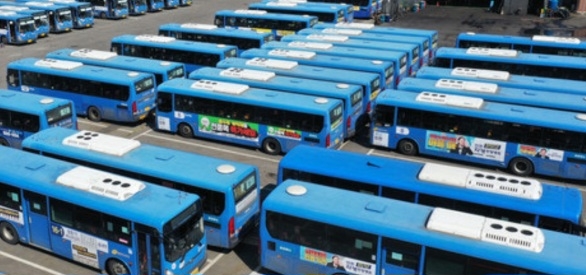
Incheon's financial support for its semi-public bus system, funded by taxpayers, exceeded 300 billion won ($224 million) for the first time this year.
A significant number of the city's bus companies are owned by private equity funds, and these companies alone received 382.1 billion won in subsidies over the past five years, fueling controversy over whether public finances are being managed appropriately.
The semi-public system's agreement includes oversight rules on dividends and stake sales by private equity-owned companies, but actual administrative penalties have been virtually nonexistent over the past six years, raising questions about whether taxpayer money is being properly monitored.
According to data submitted by Incheon to Jeon Jae-woon, a lawmaker on the Incheon City Council's Environment and Transportation Committee, and analyzed Thursday, this year's subsidy for the semi-public bus system totals 311.8 billion won — the original budget of 258.2 billion won plus a second supplementary budget of 53.6 billion won. It marks the first time the figure has exceeded 300 billion won since the system's introduction.
Over the past five years, subsidies have totaled 1.27 trillion won, all covered by Incheon.
Although the city raised bus fares to shift more of the burden onto riders, the reduction in financial support did not last, and the fiscal burden from the subsidy system is once again growing.
Incheon raised bus fares from 1,250 won to 1,500 won in October 2023.
As a result, subsidies fell by 50.9 billion won in 2024 compared with the previous year, but rose again by 41.9 billion won the following year.
Including this year's supplementary budget, subsidies have actually increased by 30.3 billion won compared with 2023, before the fare hike, according to Jeon's analysis.
A bigger problem is that bus companies owned by private equity funds account for a substantial share of the subsidy structure.
Of Incheon's 34 city bus companies, nine are owned by private equity funds and operate 624 vehicles combined. These nine companies received 382.1 billion won in subsidies over the past five years — about 30 percent of the total.
The semi-public system uses public funds to cover bus companies' transport deficits in order to guarantee citizens' access to transportation services.
The concentration of subsidies among companies with a particular ownership structure cannot, by itself, be deemed a problem.
But the real question is whether oversight mechanisms commensurate with the scale of public funding are actually functioning.
Jeon also cited a remark made by Incheon's transportation bureau director at an earlier extraordinary council session. When asked about the source of dividend payments, the director said, "It could be seen that the dividend amount comes out of the money we provide as support."

A 'dividend restriction' rule exists, but zero penalties in six years
Incheon's implementation agreement for the semi-public bus system defines categories of poor management and sets corresponding penalty-point standards.
According to administrative penalty records submitted by the city, however, over the past six years there have been zero penalties for three categories directly tied to private equity ownership: violations of dividend restriction rules, failure to consult with the city before the largest shareholder or management sold stakes, and the use of retreaded tires on front or rear wheels.
Of 12 total administrative penalties issued, only one involved actual penalty points — 15 points assessed in 2024 for an executive's personal use of a company vehicle.
Moreover, comparing the implementation agreement revised in September last year with the previous version shows that the key provisions governing private equity dividends and stake sales, along with the penalty-point standards, remained unchanged.
The city said in December last year that it would include a ban on selling stakes to foreign capital and a cap on dividends within total profit as part of its reform plan, but about nine months later those measures had still not been reflected in the actual implementation agreement.
The result is a structure in which financial support keeps growing while the agreements and administrative penalties meant to control it remain frozen in place.
Incheon: 'Same standards for all companies' — but acknowledges regulatory limits
In response, Incheon said the subsidies under the semi-public system are meant to cover bus companies' transport deficits and provide transportation services to citizens, adding that it applies the same standard transport cost criteria to all companies regardless of whether they are owned by private equity funds.
Regarding this year's 53.6 billion won supplementary budget, the city said it reflected shortfalls in financial support: 11.3 billion won for last year's wage increase, 10.5 billion won for higher transport costs from adding 30 vehicles this year, and 1 billion won reflecting inflation in vehicle-holding costs.
With this year's wage negotiations settled at a 4.5 percent increase, however, the city projected an additional 11.8 billion won in financial burden.
On oversight, the city said that when Myeongjin Transportation was sold in 2024, it followed proper procedures under relevant laws, including required reporting, a letter of commitment to maintain financial soundness, and prior consultation with the city over the change of representative.
After confirming that private equity-owned companies had an average dividend payout ratio of 157 percent last year — higher than the overall average of 117 percent — the city said it plans to factor appropriate dividend levels into future management and service evaluations, share investment plans and letters of intent to encourage sales to actual bus operators, and pursue measures restricting sales to foreign private equity funds.
In the end, the key is plugging fiscal leaks, not raising fares
The core of this controversy is not simply that private equity funds own bus companies.
Since the semi-public system uses public funds to cover bus companies' deficits, the central question is how far public control should extend over profit distribution, dividends, stake sales and management soundness.
Incheon is also considering raising bus fares to ease its financial burden.
That is precisely why calls are growing to first examine whether the existing system is leaking money and whether oversight authority is being properly exercised, before fares are raised.
"It is not that Incheon lacked the authority to control this — rather, the requirements were designed so that authority could never be triggered, and the power was simply never exercised," Jeon said. "If we raise fares while leaving the leaks in place, we will be having the same discussion in the same place three years from now."
"The purpose of the semi-public bus system is not to guarantee bus companies' profits but to guarantee citizens' right to safe and convenient transportation," he added, urging reforms to the system.
gilbert@heraldcorp.com