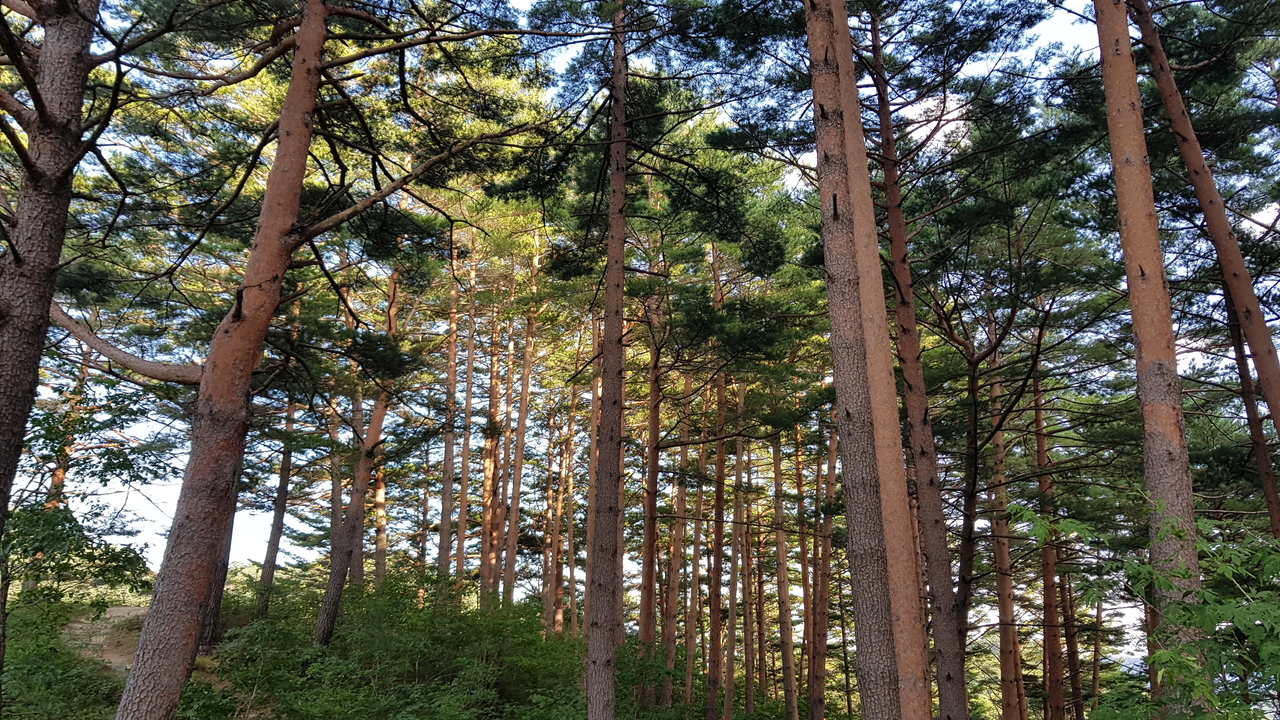
Uljin-gun's renowned "geumgangsong" pine forest — a prized variety of Korean red pine — in North Gyeongsang Province is under threat from pine wilt disease, a forest disaster affecting the entire nation.
According to Uljin-gun, pine wilt disease first appeared in the region in December 2020. After continuous eradication efforts, the area was declared disease-free in December 2023, only for the disease to resurface in October 2024, just 10 months later.
So far, 195 infected trees have been confirmed, and the pine transport-ban zone has expanded to cover 36 villages across nine towns, totaling 30,864 hectares. That accounts for about 36 percent of Uljin-gun's total forest area.
Compounding the problem, the affected area contains forest ecosystem and landscape resources of high national conservation value. These include Uljin's signature geumgangsong colony, Wolsongjeong and the Wangpi River area.
Concerns are growing that if the disease spreads into the geumgangsong forest, the damage could go beyond simple forest loss. It could threaten not only Uljin's ecology and scenery but also South Korea's forest heritage.
Uljin-gun is shifting from reactive measures that only remove infected trees to proactive efforts aimed at blocking the disease's spread routes. With the consent of forest landowners, the county is clear-cutting small areas and clusters around infected trees while also administering tree injections within about 100 meters of the affected sites.
In particular, the county is building a "tree injection defense belt" across the state-designated priority zone stretching from Wolsong-ri in Pyeonghae-eup to Ongjeong-myeon, administering combined-formula injections effective for up to four years to prevent further spread of the disease.
Uljin-gun stresses, however, that there are clear limits to protecting such vast forests and nationally important geumgangsong stands with only local budget and manpower.
Pine wilt disease has already become a nationwide forest disaster. According to the Korea Forest Service, about 1.77 million infected trees have died across 166 cities, counties and districts nationwide. When trees suspected of infection are included, about 3.09 million trees have been removed.
As the government carries out a national eradication strategy from 2026 to 2030, Uljin-gun argues that authorities should move away from distributing budgets uniformly across all affected regions. Instead, the county calls for a "selection and concentration" approach.
Rather than responding after the fact to areas where damage is already severe, the county says budgets and specialized personnel should be preemptively directed toward high-quality pine forests that must be preserved for the nation. Funding should also go to areas where damage remains minor enough to prevent further spread.
Uljin-gun plans to continue its own eradication efforts for the geumgangsong colony and major pine forests. The county will also continue urging the central government and the Korea Forest Service to designate the area as a core zone of a national eradication belt and to concentrate state funding and specialized personnel there.
"Uljin-gun will fulfill its given responsibility in combating pine wilt disease," said Hwang I-ju, magistrate of Uljin-gun. "The government, too, should recognize Uljin, home to the largest geumgangsong colony in the country, as the last line of defense for protecting South Korea's pine trees, and the state should take responsibility for building a strong defense line starting now."
kbj7653@heraldcorp.com