Overseas-listed leveraged products tracking Samsung Electronics and SK hynix are emerging as a fresh source of volatility for Korea's stock market, even as financial regulators tighten entry barriers for domestic single-stock leveraged products to cool overheated demand. The overseas market for such products has expanded, with several SK hynix single-stock leveraged offerings listed one after another in the United States. Analysts say growing leveraged demand abroad flows through global financial institutions' hedging trades, ultimately amplifying supply-demand imbalances and volatility in Korea's spot and futures markets.
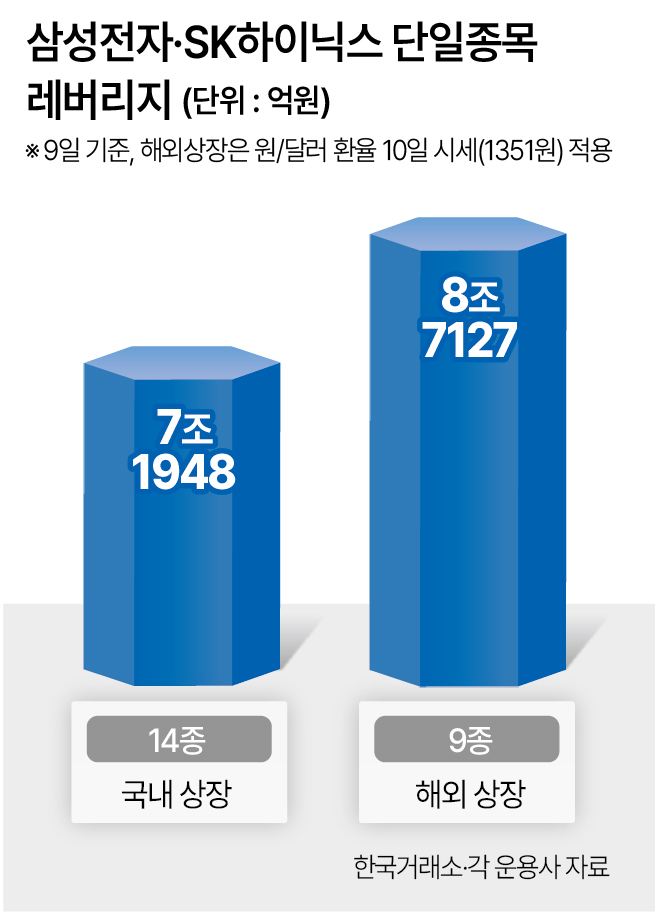
The combined net asset value of nine overseas-listed single-stock leveraged exchange-traded funds tracking Samsung Electronics and SK hynix stood at $6.45 billion as of Sept. 8. Converted at an exchange rate of 1,351 won per dollar, that amounts to about 8.71 trillion won ($6.51 billion).
That figure exceeds the scale of domestically listed products. According to the Korea Exchange, the combined net asset value of 14 domestically listed single-stock leveraged products tracking Samsung Electronics and SK hynix stood at 7.19 trillion won as of Sept. 9. The asset scale of overseas-listed products is about 1.5 trillion won larger than their domestic counterparts.
Among individual products, Hong Kong-listed ETFs dominate in scale. The CSOP SK hynix Daily (2x) Leveraged Product had $4.9 billion in net assets, the largest among overseas products, while the CSOP Samsung Electronics Daily (2x) Leveraged Product held $1.02 billion.
The two products were the world's first single-stock leveraged ETFs tracking Samsung Electronics and SK hynix. In May, the CSOP SK Hynix 2X Daily Leveraged Product also became the world's largest single-stock leveraged ETF.
After Korea listed its first single-stock leveraged products in May, several US asset managers began rolling out similar offerings starting in July. Among them, GraniteShares 2x Long SK Hynix Daily ETF had the largest net assets among US-listed products, at $232.37 million.
It was followed by ProShares Ultra SK Hynix ($94.3 million), Leverage Shares 2X Long SK Hynix Daily ($92.01 million), T-Rex 2X Long SK Hynix Daily Target ETF ($46.16 million), Direxion Daily SK Hynix Bull 2X Shares ($42.51 million), Kogi SK Hynix 2X Daily ($27.64 million), and Tradr 2X Long SK Hynix Daily ETF ($580,000).
In Korea, the launch of single-stock leveraged ETFs has produced a so-called "wag the dog" effect, in which derivatives trading influences the spot market. As shares of Samsung Electronics and SK hynix rose sharply, retail money poured into leveraged products, intensifying the imbalance in supply and demand.
Financial regulators have moved to cool the overheated demand by raising the minimum deposit required for single-stock leveraged products from 10 million won ($7,300) to 30 million won, and by requiring new investors to complete mock trading before participating.
The problem is that leveraged investment growing overseas can also affect supply and demand in Korea's stock market. Overseas asset managers use derivatives such as total return swaps with global financial institutions to run products that track twice the daily returns of Samsung Electronics or SK hynix. The counterparty financial institutions then buy and sell Korean spot shares, futures and options to hedge their risk. In this structure, leveraged demand generated overseas flows through such hedging trades into Korea's own stock market supply and demand.
This effect can intensify particularly during periods of sharp share price swings, when rebalancing to meet leveraged products' daily target multiples — and the accompanying hedging trades — can expand. The larger the scale of overseas-listed products grows, the more such trading amplifies price movements and volatility in the domestic market.
The Bank of Korea also flagged the ripple effects of expanding overseas leveraged investment. In its monetary and credit policy report released Thursday, the central bank said, "In global financial markets, the expansion of leveraged investment in domestic shares has led to unexpected ripple effects, including an increase in hedge-related spot and futures trading in Korea."
"When a company running a single-stock leveraged product enters into a swap with a global investment bank such as Morgan Stanley or Goldman Sachs, the bank matches the leverage ratio by buying Korean shares," said an official at a securities firm. "Given how significant an impact foreign investor flows have on Korean shares, overseas products likely have a greater effect on the domestic stock market than domestic products do."
"Volatility in semiconductor shares has eased recently, and the market appears to have calmed, but demand through overseas leveraged products remains just as strong," said a division head at an asset management firm. "It is questionable how much raising entry barriers only for domestic products can actually lower overall market volatility."
On Wall Street, meanwhile, so-called ultra-short-term leveraged ETFs that adjust their leverage ratio every hour are preparing to launch. According to Reuters and other foreign media, US asset manager Defiance recently filed with the US Securities and Exchange Commission to launch 16 leveraged ETFs that track twice the hourly return of their underlying assets.
Among them is a product based on DRAM, a memory chip ETF. DRAM holds Samsung Electronics and SK hynix at weightings of 19 percent and 16 percent, respectively, making the two companies its largest and second-largest holdings. While existing 2x leveraged products match their target multiple on a daily basis, this new product treats each hour as if it were a trading day, tracking twice the hourly return.

moon@heraldcorp.com