From North Gyeongsang Province to Seoul, starting out in a studio in Eunpyeong-gu
Delayed residency registration cost him his entire deposit in a foreclosure
Years of studio-hopping ended when he met a girlfriend who saved nearly everything she earned
For 15 years I bounced around studios and one-and-a-half-room flats in Seoul. It felt completely hopeless. You want to know how I finally found a way out?

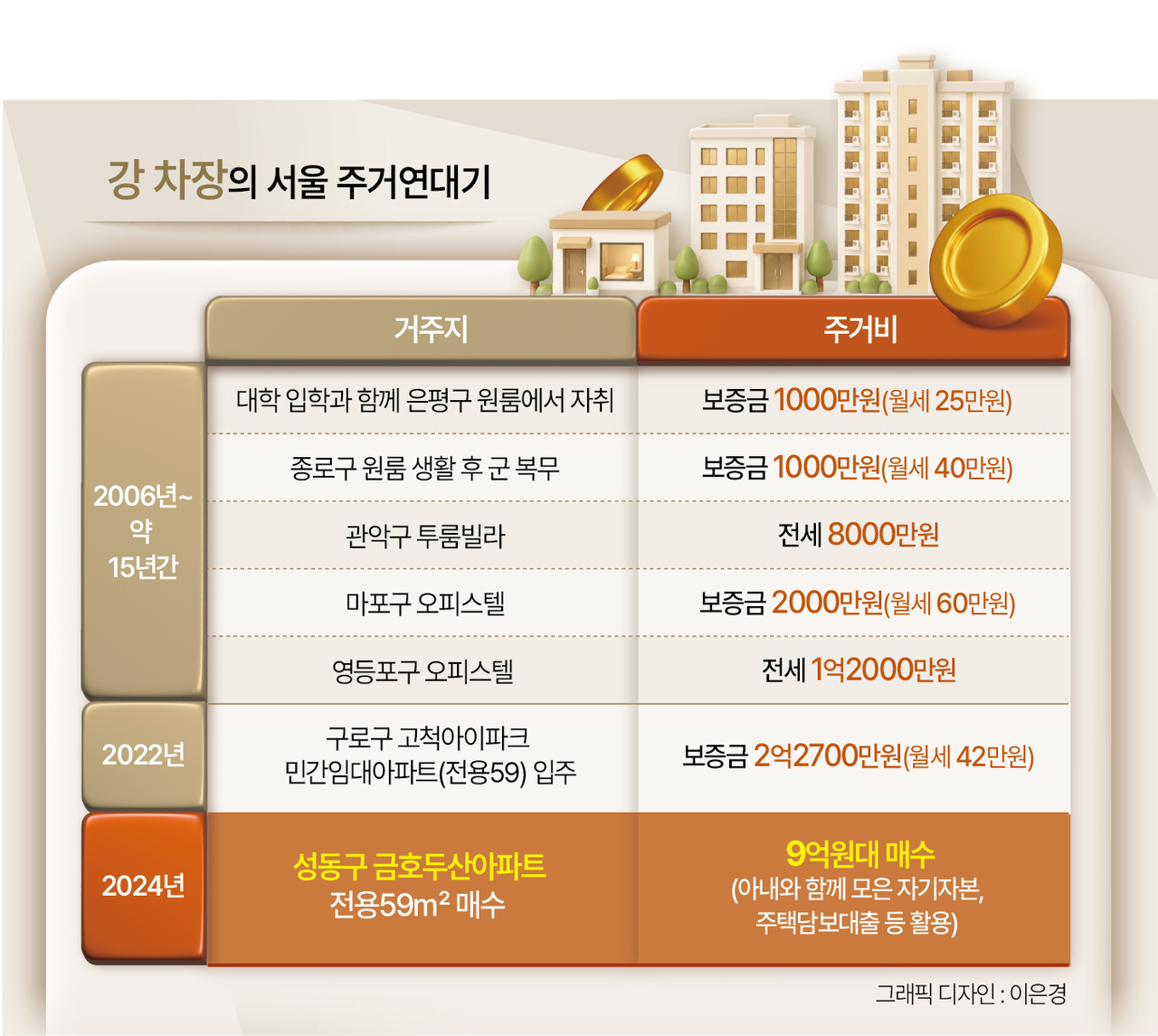
Kang Jae-hyuk (a pseudonym), a deputy manager living in an apartment in Seoul's Seongdong-gu, moved to the capital 20 years ago after graduating from high school in North Gyeongsang Province to attend university. He began his Seoul life in a studio on the city's outskirts and, two years ago, finally bought a home of his own, where he now lives with his wife and son. How did a young man who arrived in Seoul alone manage to purchase an apartment now worth around 1.7 billion won ($1.27 million)?
When Kang enrolled in university in 2006, his first home was a studio near Nokbeon Station in Eunpyeong-gu — a 10 million won deposit with 250,000 won in monthly rent. Despite being in a transit-oriented area, the place was cheap for a reason: it was under foreclosure proceedings. Kang's father, who had a keen interest in real estate, knew this and deliberately had his son sign the lease — on the condition that Kang register his residency without fail.
Absorbed in university life, Kang kept putting it off, telling himself he could always do it later. "My parents scraped together the deposit and monthly rent for me, and I was still completely careless about it," he said. "In the end, it blew up in my face."
![A 20-year-old Kang lost his entire deposit after failing to register his residency. [ChatGPT]](https://wimg.heraldcorp.com/news/cms/2026/09/11/news-p.v1.20260909.df3b837736bc40eb97de4b594d030746_P1.png)
A 20-year-old college student who skipped residency registration — and lost everything
A winning bidder eventually emerged from the foreclosure auction. "You'll need to vacate the unit."
As a tenant, Kang had no choice but to leave.
Under Korea's Housing Lease Protection Act, a tenant who meets both the occupancy and residency-registration requirements can protect their deposit. Kang had never registered his residency, which meant he lacked the legal standing to assert his rights against the new owner. He was also ineligible for the small-tenant priority repayment scheme — a protection that allows tenants to reclaim their deposit ahead of creditors such as banks — and so lost the 10 million won his parents had struggled to put together.
It was, by his own account, the worst scolding of his life. Along with the reprimand, his father left him with a piece of advice he would never forget: "You have to understand the rules to protect what you have."
"Son. From what I've seen, you have no sense of money. If you can't develop that yourself, you need to keep someone by your side who does. Don't forget that."
Kang moved out and into another studio, this time in Jongno-gu — a 10 million won deposit and 400,000 won a month. It was a quiet, 26-square-meter space near Gyeongbokgung Palace.
After living there for about a year, he completed his military service and had to find a new place again. His younger brother happened to be moving to Seoul around the same time, so in 2010 the two moved together into a two-room villa in Gwanak-gu on an 80 million won jeonse. Their parents helped out once more.
The living conditions left much to be desired — the walls were so thin that the neighbors' arguments came through as if broadcast live.
Having grown up in relative comfort in an apartment back home, Kang missed that kind of life more with every passing year in studios and villas. But the reality was unforgiving. His best option was to focus on his studies and hold onto the hope that landing a job after graduation would finally let him live somewhere bigger and more comfortable.
![A photo of the studio in Mapo-gu where Kang once lived. [Provided by Kang]](https://wimg.heraldcorp.com/news/cms/2026/09/11/news-p.v1.20260909.4d4ef1b5564e4547aa0f30d198be4d00_P1.jpg)
Jongno, Mapo, Yeongdeungpo — the studio years go on
In 2014, Kang landed his first job and moved into an officetel in Mapo-gu — a 20 million won deposit and 600,000 won a month in rent. He had chosen a transit-oriented location to cut down on his commute, and the price reflected it. For the first time, he was paying his own rent.
His starting salary was about 2.8 million won a month. With management fees on top of rent eating up nearly 30 percent of his income, saving more than 1 million won a month was a stretch.
"This isn't working. I need to switch to jeonse."
When his Mapo officetel lease expired in 2016, Kang found a 120 million won jeonse studio in Yeongdeungpo-gu and moved in. He used the 40 million won his parents had contributed during his university years and took out an additional 80 million won loan to cover the deposit.
His housing costs fell by nearly half, but Kang was still spending close to 70 percent of his paycheck. "The cost of living in Seoul is just so high, and I was never the type to scrimp," he recalled. "I couldn't even imagine a life without a credit card. Bitcoin was all the rage at the time, so I tried all sorts of investments — but nothing ever accumulated in my account."
![Kang in his 30s, still single, around the time he moved into the officetel. [ChatGPT]](https://wimg.heraldcorp.com/news/cms/2026/09/11/news-p.v1.20260909.afe82b3e8f2e46f19e266acb464a0e57_P1.png)
The turning point came in 2019, with the onset of COVID-19.
In March 2020, the Bank of Korea slashed its benchmark interest rate in response to the pandemic, ushering in what became known as the near-zero-rate era. Borrowing 400 million won cost as little as 250,000 won a month in interest — cheaper than renting a studio — and suddenly it was possible to live in a brand-new apartment on jeonse for less than the price of a one-room rental.
People around Kang began making the move to jeonse in newly built apartments.
"I can't keep living in studios. I want to live in an apartment too."
But having once lost a deposit, Kang approached the situation differently from those around him.
He had been through a foreclosure, a lease expiry and five moves. What mattered to him more than cutting his immediate housing costs was finding a lease that would let him stay put for at least four years.
"I started studying systems like apartment subscriptions and came across publicly supported private rental apartments — where rent increases are capped at 5 percent and you can stay for up to eight years," Kang said. "People around me told me I was crazy to pay monthly rent when interest rates were basically zero, but I believed that if you use the right systems well, you eventually get the chance to build real assets."
![Kang applied for and won a spot in a private rental apartment through the subscription system. [ChatGPT]](https://wimg.heraldcorp.com/news/cms/2026/09/11/news-p.v1.20260909.3683f73108ed47eaa8d0d7f478d2e929_P1.png)
Armed with that knowledge, Kang applied for a publicly supported private rental unit at Gochuk Ipark in Guro-gu — a 64-square-meter apartment — and was selected. The complex, built by Ipark Hyundai Development on the former site of Seoul Southgate Detention Center, rises up to 45 stories and contains 2,205 units. The special supply quota for young applicants — just nine units of the 64-square-meter Type A — drew a competition ratio of 29.89 to 1.
In October 2022, Kang moved in under a contract requiring a 227 million won deposit and 420,000 won in monthly rent. He put together the funds using 40 million won from his parents, about 70 million won he had saved over seven years of working, and a jeonse loan at around 2 percent interest for the remainder.
"I've got a place to live for eight years!"
Even at that point, Kang had no intention of buying a home. "After paying housing costs, living expenses, transportation and all the other fixed costs, I couldn't save more than 30 percent of my income," he said. "I was just so happy that 15 years of studio living was finally over — I was basically in 'YOLO' mode, buying expensive appliances and getting ready to settle in."
Kang's plan to stay in the private rental apartment for nearly eight years would change about two years later.
He met someone who would alter the course of his life: the woman who is now his wife, Park Bo-ram (a pseudonym). Park was living with her family and had been channeling more than 70 percent of her income into savings and investments.
"My girlfriend at the time said, 'Performance bonuses are just irregular savings,' and it hit me like a truck. When I got a bonus, I'd go shopping or take a trip abroad — she was living a life that was the complete opposite of mine."
![Kang resolved to propose to his financially disciplined girlfriend. [ChatGPT]](https://wimg.heraldcorp.com/news/cms/2026/09/11/news-p.v1.20260909.4c10519fafc14feea0447336b14cd10c_P1.png)
"When I suggested we go to a pool villa, she would talk me into a cheaper, more sensible place to stay," Kang said. "She was my ideal type in terms of looks, but she also fit my father's advice to a T — find someone with a solid sense of money."
The following year, Kang proposed to Park. She accepted with a smile — and then said something he had not expected. "Oppa, bring me a sheet of A4 paper and a pen. There are some things we need to go over."
It was the moment Kang's life changed once again.
Kang, who once did not even know when his Netflix subscription renewed, found himself dreaming of marriage after meeting a girlfriend with an iron grip on her finances. Kang, who leaned heavily on loans, and Park Bo-ram, a dedicated saver, would divide up their roles and set their sights on buying a home together — to be continued in Part 2.
hope@heraldcorp.com