Seoul housing property tax reaches 3.9 trillion won, up 15%
Tax on homes valued below 900 million won falls 11%
Rising prices push heavier burden onto high-end properties
![A property tax payment notice is posted at the entrance of an apartment complex in Seoul. [Yonhap]](https://wimg.heraldcorp.com/news/cms/2026/09/11/rcv.YNA.20260723.PYH2026072312550001300_P1.jpg)
Seoul homeowners paid more than 500 billion won ($374 million) more in property taxes this year, with the bulk of the increase concentrated among homes with a publicly assessed value exceeding 1.2 billion won. Tax revenue from that high-end segment jumped more than 40 percent in a single year, while collections from lower-valued properties actually declined — a shift driven by a sharp rise in apartment assessed values following last year's surge in Seoul home prices.
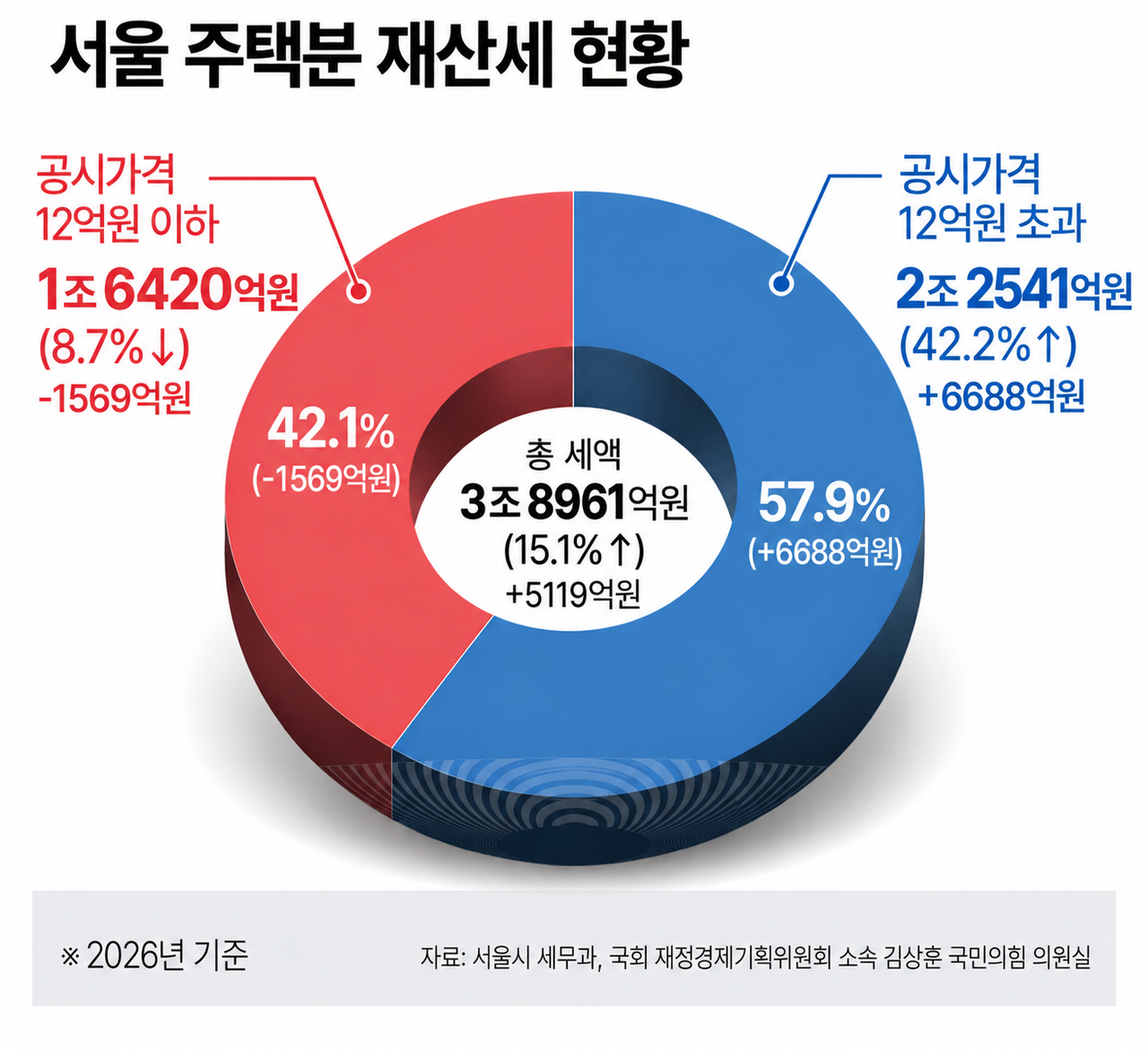
Data submitted by the Seoul Metropolitan Government's tax division to People Power Party lawmaker Kim Sang-hoon of the National Assembly's Finance and Economy Planning Committee showed that total housing property tax revenue in Seoul reached 3.9 trillion won this year, up 511.9 billion won, or 15.1 percent, from 3.38 trillion won last year.
The figure combines the base property tax, the urban area levy, the local resource facility tax and the local education tax. Of those, the base property tax alone rose 319.3 billion won, or 17.6 percent, from 1.82 trillion won last year to 2.14 trillion won this year.
High-end homes with a publicly assessed value above 1.2 billion won accounted for a disproportionate share of the increase. Tax collected from that segment rose 668.8 billion won, or 42.2 percent, from 1.59 trillion won last year to 2.25 trillion won this year. The 1.2 billion won threshold is the standard basic deduction for the comprehensive real estate holding tax for single-home households; applying this year's apartment assessment realization rate of 69 percent, it corresponds to a market price of roughly 1.74 billion won.
By contrast, tax collected from homes assessed at 1.2 billion won or below fell 156.9 billion won, or 8.7 percent, from 1.8 trillion won to 1.64 trillion won over the same period. The share of total tax revenue attributable to properties above the 1.2 billion won threshold also rose 11.0 percentage points, from 46.8 percent last year to 57.9 percent this year.
The same pattern appeared in the number of taxable cases. The total number of Seoul housing property tax assessments edged up just 56,554 cases, or 1.5 percent, from about 3.87 million last year to about 3.93 million this year. Assessments on properties above 1.2 billion won, however, jumped 204,645 cases, or 43.9 percent, from 465,663 to 670,308.
The share of all assessments accounted for by properties above 1.2 billion won climbed from 12.0 percent to 17.1 percent. Conversely, assessments on properties at or below 1.2 billion won fell 148,091 cases, or 4.3 percent, from about 3.41 million to about 3.26 million.
The shift reflects the rise in publicly assessed values that followed last year's climb in Seoul apartment prices. The Ministry of Land, Infrastructure and Transport finalized and published official assessed values for apartments nationwide in April, showing an average increase of 9.13 percent, with Seoul posting the steepest gain among all cities and provinces at 18.60 percent.
The three Gangnam-area districts of Gangnam, Seocho and Songpa recorded an average assessed-value increase of 24.7 percent. Eight Han River-adjacent districts — Seongdong, Yangcheon-gu, Yongsan, Dongjak, Gangdong, Gwangjin, Mapo and Yeongdeungpo — rose an average of 23.13 percent. Analysts say the surge pushed a significant number of homes previously assessed below 1.2 billion won into the higher bracket, swelling the count of high-end taxable properties.
"Last year, ultra-high-end homes in Gangnam and Seocho saw the biggest price gains, while mid- and lower-priced homes on the outskirts of Seoul rose comparatively little," said Woo Byung-tak, a senior specialist at Shinhan Premier Pathfinder. "With a progressive tax-rate structure on top of that, the assessed-value increases for high-end homes stood out sharply in this year's property tax revenue."
Property tax is levied each year on homeowners as of June 1. The tax base is calculated by applying a fair market value ratio to the publicly assessed price, and the applicable rate is then determined by the tax-base bracket. This year's fair market value ratio is 60 percent for general housing; single-home households receive a ratio of 43 to 45 percent depending on their assessed value.
Single-home households are also eligible for a separate preferential tax rate. Under current local tax law, homes assessed at 900 million won or below receive a rate 0.05 percentage point lower than the standard rate in each bracket. Homes assessed above 900 million won are excluded from that preferential rate. The reduced fair market value ratio benefit is separate, however, meaning single-home households with an assessed value above 900 million won still receive the 45 percent ratio.
Adding up the figures for properties assessed at 900 million won or below, tax revenue in that segment fell 146.8 billion won, or 10.8 percent, from 1.36 trillion won last year to 1.22 trillion won this year. The number of assessments in that bracket also dropped 177,299 cases, or 5.6 percent, from about 3.14 million to about 2.96 million.
Some analysts expect the pattern to shift next year as this year's Seoul price gains have spread to outlying areas and mid- to lower-priced neighborhoods. "High-end homes will still carry a heavier tax burden next year, but rather than being as heavily concentrated at the top as this year, mid- and lower-priced homes are likely to account for a larger share of the property tax increase," Woo said.
quq@heraldcorp.com