Corporate tax revenue to surge 113.9% from this year
National tax receipts to top 500 trillion won for first time
Growing reliance on cyclical corporate tax raises fiscal stability concerns
![[Yonhap]](https://wimg.heraldcorp.com/news/cms/2026/09/14/news-p.v1.20260831.b59ef9e70bb54eb0a8001f69a4cbe6b8_P1.jpg)
Corporate tax revenue is projected to exceed 200 trillion won for the first time next year, driven by a semiconductor boom. It would also mark the first time since 2012 that corporate tax receipts surpass income tax collections. Analysts warn, however, that deepening reliance on semiconductor industry cycles could heighten uncertainty in fiscal management.
According to the Ministry of Economy and Finance's "2027 National Tax Revenue Budget" released Monday, corporate tax revenue next year is forecast at 216.7 trillion won ($162 billion) — a jump of 115.4 trillion won, or 113.9%, from the 101.3 trillion won projected under this year's supplementary budget.
The more-than-doubling of corporate tax revenue reflects expectations of sharply higher operating profit at chipmakers, led by Samsung Electronics and SK hynix. Crossing the 200 trillion won threshold would be a first since the government began compiling the relevant statistics.
Next year's corporate tax forecast also exceeds the income tax projection of 180 trillion won by 36.7 trillion won. The last time corporate tax outpaced income tax was in 2012, when corporate tax revenue stood at 45.9 trillion won against income tax revenue of 45.8 trillion won.
Corporate tax revenue has historically swung sharply with corporate earnings and the broader economic cycle. It fell to 55.5 trillion won in 2020 amid the COVID-19 shock, then crossed the 100 trillion won mark for the first time in 2022 at 103.6 trillion won. A downturn in the semiconductor sector pushed it back down to 80.4 trillion won in 2023 and 62.5 trillion won in 2024, before a recovery brought it to 84.6 trillion won last year and 101.3 trillion won this year.
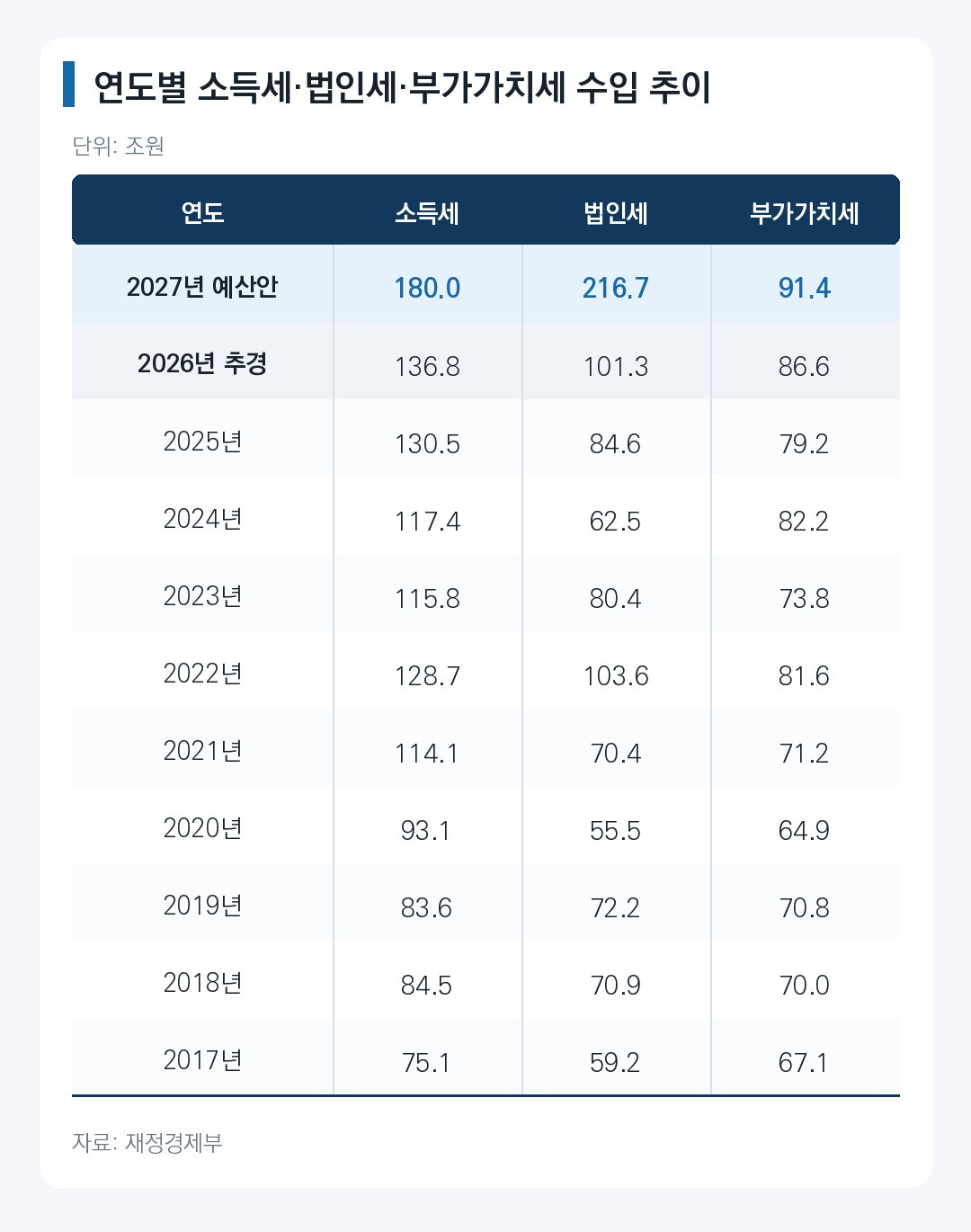
Income tax revenue, by contrast, has followed a relatively steady upward path, supported by inflation, wage growth, rising employment and higher asset prices. Income tax receipts are projected to grow from 130.5 trillion won last year to 136.8 trillion won this year and 180 trillion won next year. Value-added tax revenue next year is forecast at 91.4 trillion won, up 5.5% from this year.
The surge in corporate tax is set to push total national tax revenue to a record high. The government projects national tax receipts of 584.4 trillion won next year, up 169 trillion won, or 40.7%, from the 415.4 trillion won in this year's supplementary budget. Topping 500 trillion won in national tax revenue would also be a first.
The concern is that corporate tax — highly sensitive to economic conditions — now accounts for a rapidly growing share of total tax revenue. As the semiconductor-driven export and growth model is increasingly reflected in the government's revenue base, a downturn in the chip industry could trigger another large-scale shortfall. When corporate tax revenue fell well short of forecasts in 2023 and 2024, the government was forced to significantly revise its revenue estimates.
The flip side is that policymakers will need to decide what to do when tax receipts come in higher than expected. Expanding spending on the back of a temporary boom could force sharp spending cuts or heavier government bond issuance if the economy slows later.
The government plans to use a newly established future-response fund as a fiscal stabilization mechanism to buffer against swings in tax revenue. The fund is intended to shield multi-year investment projects from revenue volatility and to prevent sudden spending cuts or a surge in government bond issuance during downturns.
Lee Tae-seok, head of the fiscal and social policy research division at the Korea Development Institute, said at a recent forum that the scale and uncertainty of this year's corporate tax increase were beyond typical levels. He said a new fiscal mechanism was needed to manage changes in fiscal conditions, given a revenue structure heavily dependent on the semiconductor industry's performance.
fact0514@heraldcorp.com