Korea Employment Agency for Older Persons releases September infographic from 'Korean Seniors' Work and Life Panel'
Regions with high aging rates score below national average on age-friendly environment perception
![Senior employment programs [Yonhap]](https://wimg.heraldcorp.com/news/cms/2026/09/14/news-p.v1.20260914.1f06fb4e12054f29ac3e702e8c883fe9_P1.jpg)
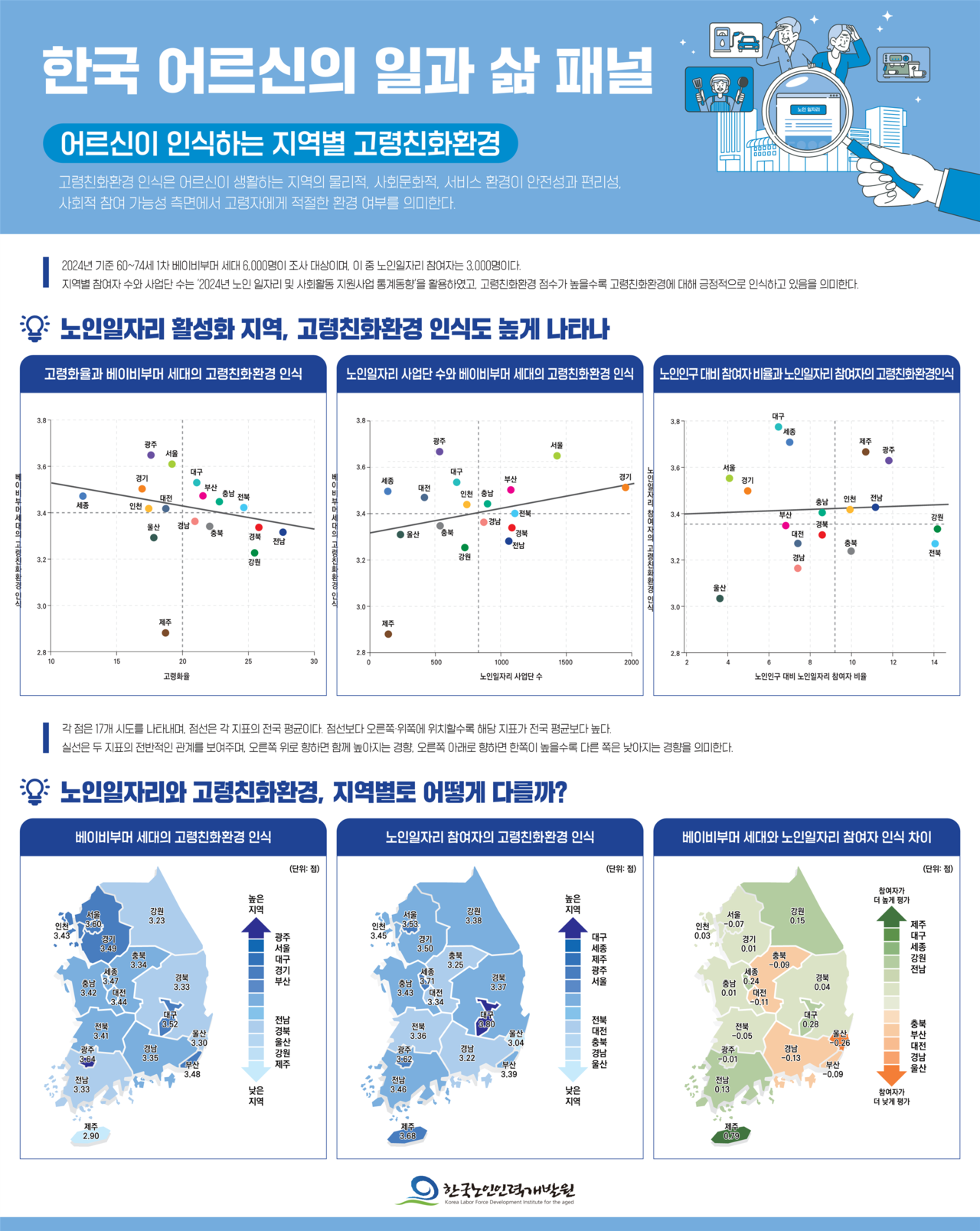
Regions with higher aging rates tend to score lower on perceptions of age-friendly environments, but areas with more active senior employment programs show relatively higher awareness, according to new data released Monday.
The Korea Employment Agency for Older Persons released its September infographic from the "Korean Seniors' Work and Life Panel," comparing age-friendly environment perceptions between first-wave baby boomers aged 60 to 74 and senior employment program participants as of 2024.
An age-friendly environment refers to local conditions that allow older adults to maintain their health and independence while continuing to participate in society. It encompasses physical, sociocultural and service-related conditions.
The data showed that regions with the highest aging rates — South Jeolla Province at 27.2 percent, North Gyeongsang Province at 26.0 percent and Gangwon Province at 25.4 percent — recorded the lowest age-friendly environment scores, at 3.3, 3.3 and 3.2 points, respectively.
"While aging is progressing rapidly, insufficient supply relative to demand and accessibility issues can be considered contributing factors," the agency said. "It is necessary to secure accessible infrastructure while also improving community awareness of older adults and increasing the receptiveness of related policies."
By contrast, regions with a stronger base of participating institutions, organizations and businesses in senior employment programs — Gyeonggi Province with 1,958, Seoul with 1,373 and Busan with 1,002 — tended to record higher age-friendly environment scores of 3.5, 3.6 and 3.5 points, respectively.
Regions with relatively fewer program units, including Gangwon Province (72), North Chungcheong Province (43), Ulsan (29) and Jeju (11), scored 3.23, 3.25, 3.30 and 2.90 points, respectively — all below the national average of 3.45.
Particularly notable were regions where a high proportion of the senior population participates in employment programs relative to the overall baby boomer population — Gangwon Province and North Jeolla Province at 14.6 percent each, Gwangju at 11.4 percent and South Jeolla Province at 10.3 percent. Among senior employment program participants in those areas, age-friendly environment scores were 3.38 in Gangwon Province, 3.62 in Gwangju and 3.46 in South Jeolla Province, all above the national average.
"Given that baby boomers in these regions score below the national average on age-friendly environment perception, this suggests that participation in senior employment programs is an important factor in shaping differences in community awareness," the agency said.
Kim Su-young, president of the Korea Employment Agency for Older Persons, said senior employment policy serves as "an important foundation for social participation that allows older adults to remain continuously active within their communities and connects people with services." Kim added that the agency would "contribute to creating age-friendly local environments by expanding opportunities for social participation among older adults and strengthening connections with diverse community resources."
The "Korean Seniors' Work and Life Panel" infographic is available on the Korea Employment Agency for Older Persons website.
thlee@heraldcorp.com