Government monitors weather outlook and water supply conditions as drought management continues
![A rice paddy in Dangwol-ri, Seokgok-myeon, Gokseong-gun, South Jeolla Province, lies cracked and parched on Aug. 12. [Yonhap]](https://wimg.heraldcorp.com/news/cms/2026/09/14/rcv.YNA.20260812.PYH2026081208730005400_P1.jpg)
With September rainfall expected to fall below normal levels, a mild drought is developing across the Jeolla and Gyeongsang regions. Precipitation is forecast to return to average from October onward, which is expected to help ease the dry conditions.
The government issued its September drought forecast and alert Monday.
Cumulative nationwide rainfall over the past six months stood at 832.8 millimeters, or 84.8 percent of the long-term average for 1991–2020. As of Sept. 1, meteorological drought — a condition in which below-average precipitation and prolonged dry days lead to water shortages — had been recorded in 34 cities and counties across the country.
Particularly in the Jeolla and Gyeongsang regions, a mild drought at the "Attention" level has emerged, while Seongnam and Uijeongbu are experiencing a moderate drought at the "Caution" level.
September rainfall this year is expected to remain below the historical average, though October and November are forecast to be generally above average.
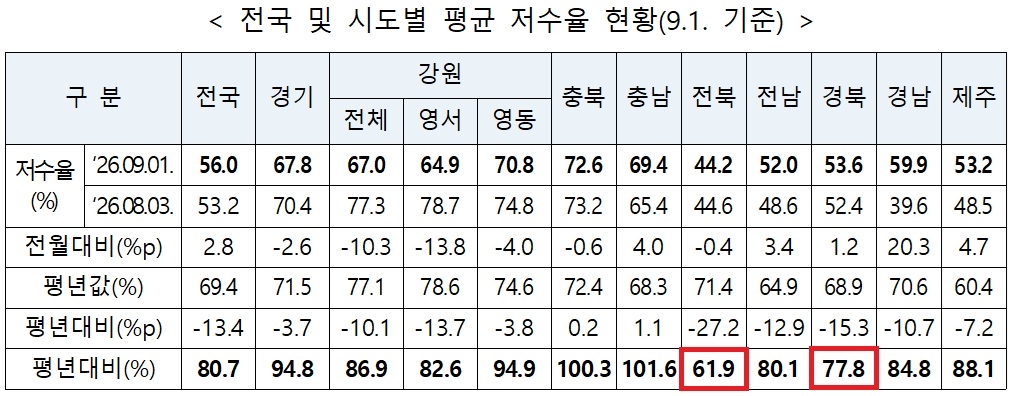
The national average storage rate at agricultural reservoirs stood at 56.0 percent, or 80.7 percent of the long-term average of 69.4 percent. Localized rainfall has created regional variation, with storage rates ranging from 61.9 to 101.6 percent across provinces and cities.
The government plans to continue managing drought conditions — focusing on areas with low reservoir levels — and to press ahead with water supply measures such as replenishing reservoirs using river water, to ensure this year's farming season concludes without disruption.
Storage levels at 19 multipurpose dams and 12 water-supply dams — the main sources for residential and industrial water — stood at 92.5 percent and 68.4 percent of their historical averages, respectively, keeping overall water supply conditions stable.
However, a rainfall deficit in the Nakdong River and Seomjin River basins has pushed storage at 11 multipurpose dams and six water-supply dams in those areas below their historical averages.
Unmun Dam and Seomjin River Dam are at the "Serious" alert level, Miryang Dam is at "Alert," Seongdeok Dam, Andong Dam, Imha Dam, Yeongcheon Dam and Pyeongnim Dam are at "Caution," and Boryeong Dam is at "Attention."
Unmun Dam is being supplied through alternative sources drawing on water from the Nakdong and Geumho rivers, while Seomjin River Dam has introduced alternative supply via the Seomjin River alongside reductions in agricultural water use. The remaining dams, including Miryang Dam, are also managing shortfalls through cuts to agricultural and instream flow allocations and by linking to alternative water sources.
Kim Yong-gyun, director general of the natural disaster division at the Ministry of Interior and Safety, said the government would "continue to work closely with relevant ministries to closely monitor drought conditions nationwide, proactively manage areas at risk of drought, and do everything possible to minimize inconvenience to the public."
thlee@heraldcorp.com