Emergency transport task force formed with alternative transit options
Up to 1,500 free shuttle buses to be deployed — largest mobilization ever
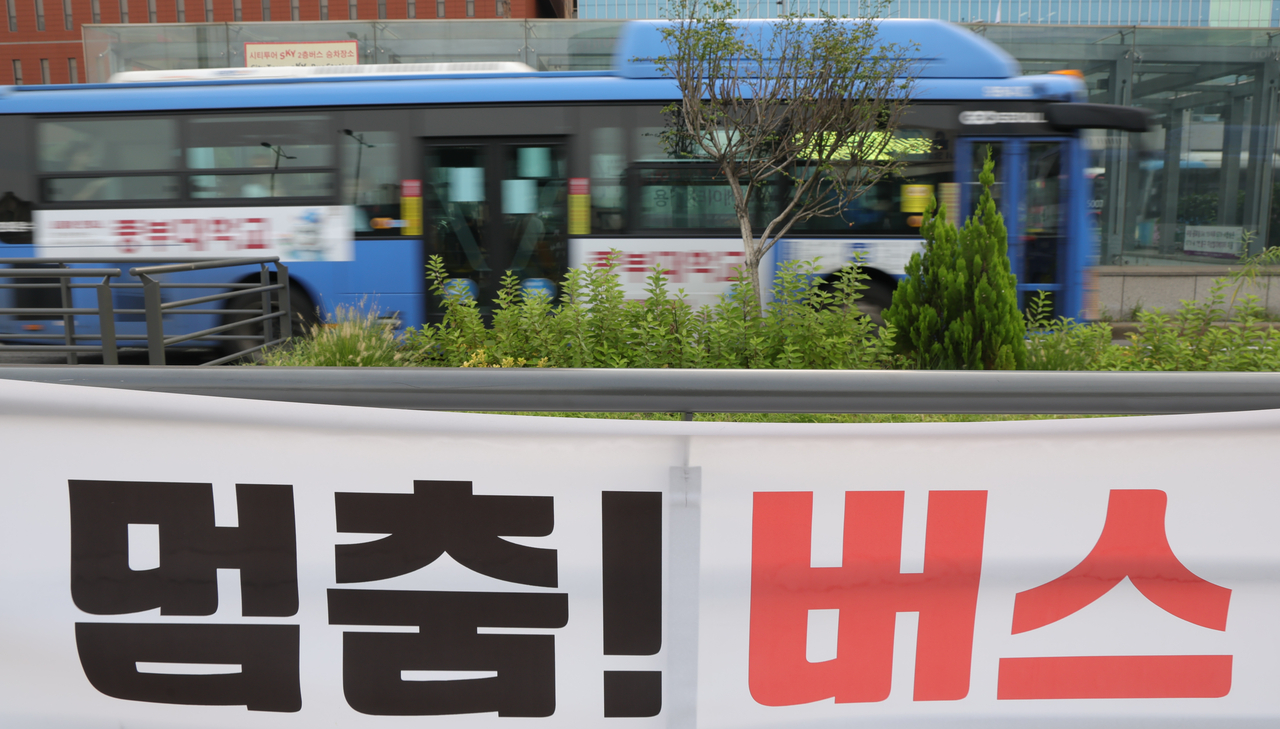
The Seoul Metropolitan Government said Monday it is activating an emergency transport plan in preparation for a potential city bus strike.
The Seoul City Bus Workers' Union has warned it will launch a full strike from the first bus run Wednesday if a wage agreement is not reached by Tuesday.
The city plans to deploy up to 1,500 free shuttle buses — more than double the roughly 700 chartered buses used during the last strike. About 200 of those will run along major arterial roads to support point-to-point travel. If the strike is prolonged, the city said it will expand the arterial shuttle service further. Detailed route and schedule information will be available on the Seoul Metropolitan Government website and those of each district office.
Seoul's 25 district offices will operate up to 1,300 free shuttle buses connecting major hubs and residential areas to subway stations.
The city will also add 10 free shuttle routes — about 200 buses — along major arterial roads including Gangnam-daero, Tongillo and Dobongno to help residents in transit-underserved areas commute smoothly.
Subway services will be expanded by 202 additional runs per day, with last trains extended until 2 a.m. the following day to support late-night travel. Rush-hour service will be extended by two hours in both the morning and evening — four additional hours of peak service per day — a greater expansion than during the strike earlier this year, when the city extended peak and last-train hours by one hour each. The city said the broader expansion this time is aimed at minimizing commuter disruption.
To accommodate the expected increase in private vehicle use, the city will temporarily suspend curbside bus-only lane restrictions and open those lanes to general traffic for the duration of the strike. Median bus-only lanes will remain restricted to buses as usual.
This emergency plan also includes new measures: the use of community buses and Ttareungi public bicycles as alternative transit. The city will accept applications from community bus operators to temporarily run them on arterial routes, and will offer free Ttareungi rides to ease the burden on commuters. Community buses will be temporarily exempted from restrictions on using city bus stops, and operators may apply for provisional route changes — subject to coordination with district offices — allowing them to run on major arterial roads.
The city will also make Ttareungi rides free during the strike to help disperse short- and medium-distance travel demand for trips of around 5 kilometers or less. The offer applies to users registered on the public bicycle app. "We plan to provide a one-day Ttareungi pass on strike days only," a Seoul city official said.
Real-time travel information will be provided through the 120 Dasan Call Center, the Topis traffic information center, the city's website and social media accounts, roadside electronic signs, and bus information terminals at stops. Commuters are advised to check conditions in advance, as travel disruptions during peak hours are expected if the strike goes ahead.
Each of the 25 district offices will also use all available channels to quickly relay local traffic updates to residents.
The city said it will operate temporary routes flexibly depending on how quickly drivers return to work.
During past bus strikes, some drivers returned before the strike ended and operated temporary routes. The city said it will again check route-by-route availability and run shuttle services from bus depots to major subway stations. Routes with sufficient driver availability will be restored to full service.
Shuttle buses will display their operating section and shuttle status on the front of the vehicle. Routes running full service will show arrival information on bus information terminals at each stop.
Given that normal bus service will not be available, temporary routes will in principle be fare-free. However, the city said it will decide separately whether to collect fares depending on how quickly normal service is restored.
The city has also set up a response system at each bus depot to protect the operating rights of companies and drivers who wish to continue running buses despite the strike.
Civil servants will be stationed at each depot, and the city said it will work closely with police to respond swiftly to any illegal interference with bus operations.
To ease traffic congestion during the strike, the city has asked elementary, middle and high schools, public institutions and private companies to shift school and work start times by one hour. It also encouraged the use of remote work and flexible working arrangements where possible.
Yeo Jang-gwon, head of the Seoul Metropolitan Government's transportation bureau, said the city would "mobilize all available alternative transport to minimize disruption for residents" while taking firm action under the law against any illegal interference with drivers and companies seeking to operate normally. He also urged both sides to show understanding and flexibility, saying "there is still time for labor and management to resolve this through dialogue, and we ask that negotiations conclude at a reasonable level that citizens can accept."
Meanwhile, the Seoul City Bus Workers' Union — affiliated with the Federation of Korean Trade Unions' National Automobile Workers' Federation — announced Friday that a strike authorization vote passed with 96.25 percent approval. Of the 18,296 union members across Seoul's 61 city bus companies, 16,716 participated in the vote and 16,089 voted in favor. That represents 96.25 percent of those who voted and 87.94 percent of all registered members.
The union will launch a strike if it cannot reach an agreement with the Seoul Bus Transport Business Association at the second mediation session of the Seoul Regional Labor Relations Commission on Tuesday. The two sides attended a first mediation session Wednesday but failed to reach a deal. The union subsequently asked that the second session, originally scheduled for Tuesday, be moved up to allow for additional mediation.
cook@heraldcorp.com