Typographer Yu Ji-won, director of the Geulmunhwa Research Institute, joins the Herald Design Lounge 2026 panel. She sees letterforms as music heard through the eyes — and says convention must be broken.
How far can design go? Design no longer stops at creating visible beauty. In an era when AI, data and interactive technology are reshaping everyday life and creative practice, design is expanding into a domain that shapes emotion, experience and meaning. Herald Design Lounge 2026, themed "Beyond Visuals," brings together creators from graphic design and typography to media art, architecture and content to explore what design can become next — asking what it means to connect human senses, lives, technology and society beyond what the eye can see.
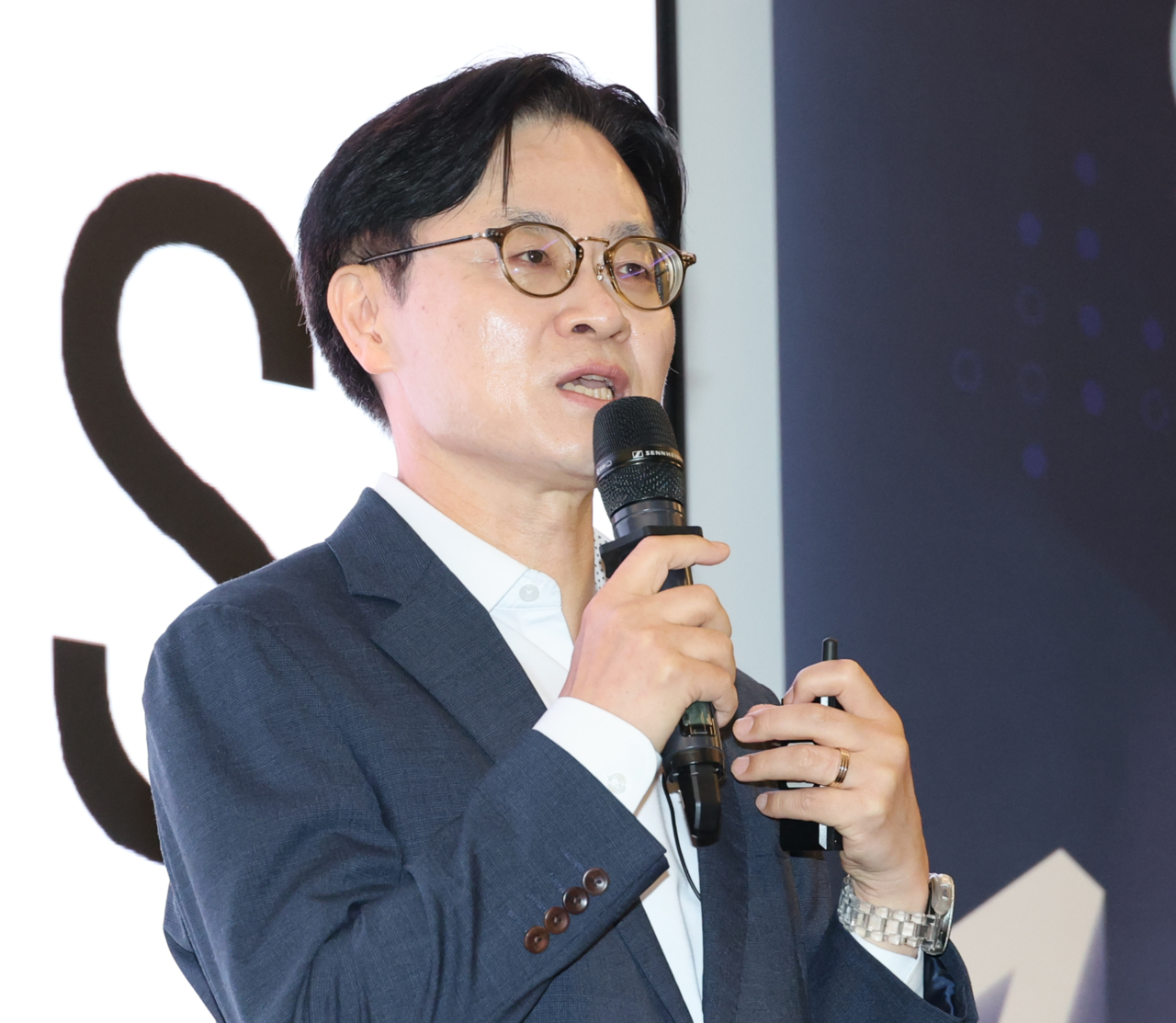
![Yu Ji-won, director of the Geulmunhwa Research Institute [Herald Design Forum]](https://wimg.heraldcorp.com/news/cms/2026/09/14/news-p.v1.20260914.24d6325ebe044fb0a2192e13d84c6b78_P1.png)
"I'm in Gungseo mode right now."
Gungseo for sincerity, Myeongjo for formality, Gothic for anger — typefaces breathe vivid emotion into otherwise flat text. The same logic explains the acute cognitive dissonance people feel when a celebrity's handwritten apology is printed in a rounded Gulim font, or a resignation letter arrives in a cute handwriting style. When a letterform "betrays" the weight of the words it carries, the rhythm falls apart. In an age when conversation has migrated to mobile messengers and SNS, type does more than record language — it conveys a person's intonation, expression and emotional temperature.
"A medical drama series, even with the same title, reads as a human-interest story if you use a soft font, but signals a tense, high-stakes clinical setting if you use a sharp one," she said. "Just as the same words carry different nuances depending on how they're said, the same content leaves a different impression depending on which font you use."
Yu Ji-won, director of the Geulmunhwa Research Institute and a panelist at the Herald Design Lounge panel talk on the theme "Beyond Design" on Oct. 2, said in a written interview that "a font is an accent for the eyes — a nonverbal message." Yu studied visual design at Seoul National University before pursuing typography at the Leipzig Academy of Visual Arts in Germany. She went on to work as a book designer at Minumsa and as a senior researcher at Sandoll before founding the Geulmunhwa Research Institute.
Within the worlds of spoken and written language, typography is the discipline of "shape." For Yu, letterforms are music heard through the eyes. "Just as music is made of timbres arranged into sequences of notes, typography weaves together hangul's 24 basic letters to create every linguistic and nonlinguistic meaning in the world," she said. Most people think of a typographer's work as making things look pretty, but for Yu, designing letters is a humanistic and scientific inquiry into human life and the body.
![The Minumsa Complete Works of Shakespeare, designed by Yu Ji-won, director of the Geulmunhwa Research Institute. "A collected edition spends far more time on a bookshelf than open on a desk, which gives it the character of interior design," she said. "The ability to grasp a complex situation and recognize, more quickly than others, what influence factors that were previously overlooked might have — that is what matters." [Geulmunhwa Research Institute]](https://wimg.heraldcorp.com/news/cms/2026/09/14/news-p.v1.20260914.47bad9ad968b422bbc98d77db22f8b09_P1.jpg)
"I think constantly about what human beings truly need. People often cannot precisely identify what their bodies and minds really want. The same is true in letterform design. I use 'what do people truly need and want through type' as my North Star."
Yu sees letterforms as living, evolving organisms — their shapes, she argues, have always "reflected locality and the spirit of the age." As aging and individualization accelerate, typography is stretching beyond aesthetics to become a social responsibility that sustains the lives of those with physical limitations. In a digital environment that enables small-batch, high-variety production, she has been developing fonts for older adults and people with low vision who live with conditions such as presbyopia and glaucoma.
"When you combine ophthalmology and cognitive science to study how the eye functions at a given age, the font enters the realm of vision rather than aesthetics," she said. "If you focus only on function, you end up viewing human beings too mechanically — the emotional lives of older adults deserve as much respect as their functional needs. Working through visual research has led me to think deeply about the human dignity that letterforms must protect."
Preserving hangul's identity in a multilingual typographic environment where the world's scripts converge is, for Yu, an extension of that same responsibility. "Hangul is a vast and subtle ecological network that has evolved over a long time through the intricate interplay of the Korean language, the Korean environment and the physical characteristics of Korean people," she said. "Because it cannot be fully reduced to a Western-centric framework, the final authority over the formal and cultural direction of hangul design must remain with native designers who have internalized hangul as their mother tongue."
In an era when AI generates new typefaces from vast datasets, where does the human creator stand? Yu argues that what AI-era creators need is "the ability to step outside existing conventions, reframe the design question and define the problem anew."
"AI carries the risk of reinforcing individual biases, and humans must not lose the capacity to endure friction with one another," she said. "Amid the dizzying gap between the individual and vast systems, we need to rebuild human-scale communities that we can actually see and grasp. Above all, taking responsibility for one's actions and decisions — that is the domain only humans can occupy."
shee@heraldcorp.com