Korea-China FTA follow-up talks reach substantive conclusion
Films, games to receive most-favored-nation treatment, non-discrimination principle
Co-production scope expanded to dramas and variety shows

Since "Assassination" opened in China in September 2015, only one Korean film — "Oh! Moon-hee" in December 2021 — has received an official theatrical release on the Chinese mainland. In the intervening years, "Veteran," "Sunny" and "A Wedding Invitation" were remade with Chinese casts and screened in Chinese theaters. For a decade, what crossed the border was not Korean cinema itself, but its stories.
Hopes are now growing that the barriers China erected after the THAAD (Terminal High Altitude Area Defense) missile defense dispute may finally come down. South Korea and China declared a substantive conclusion to follow-up negotiations on the services and investment chapter of their bilateral free trade agreement at a summit held Wednesday in Shenzhen, China — nearly eight years and eight months after talks began in March 2018.
According to the Ministry of Trade, Industry and Energy, China agreed to extend most-favored-nation treatment to South Korea in the film and gaming sectors, meaning Korea will not be treated less favorably than any third country. China also agreed to apply a non-discrimination principle to pre-screening procedures for online games and films — the first time Beijing has enshrined such commitments in a trade agreement. The two countries also expanded the scope of eligible co-productions beyond film to include drama series, animation, variety shows and documentaries.
Minister of Trade, Industry and Energy Kim Jung-kwan said the conclusion of the follow-up negotiations "has laid a stable institutional foundation for Korean companies to enter the Chinese market in areas where they have competitive strengths, including K-content, tourism, finance and retail." China has in effect blocked Korean drama series, films, performances and the broadcast appearances of Korean entertainers since the July 2016 decision to deploy THAAD on Korean soil. Beijing has never officially acknowledged the existence of the so-called hallyu ban — the informal restriction on Korean Wave content. The agreement is therefore seen within and beyond the cultural industry as potentially providing a legal basis to demand the ban's removal.
China's language remains cautious. According to a statement from China's Ministry of Foreign Affairs, President Xi Jinping said at the summit that he hopes to "continuously promote people-to-people exchanges between the two countries and gradually, step by step, develop healthy and beneficial cultural exchanges." The agreement text must still go through legal review, formal signing and ratification procedures, and no timeline has been set.

Expectations of a hallyu ban lift have swelled and deflated several times over the past decade. Even after then-Foreign Minister Kang Kyung-wha announced in October 2017 the so-called "three nos" position — pledging no additional THAAD deployments, among other commitments — Korean films still did not open in China. A thaw appeared possible in late 2022 when China issued a batch of foreign game licenses to Korean titles and a film by director Hong Sang-soo appeared on Tencent Video, but reports the following year indicated that Chinese review of Korean drama series had stalled again.
Last year, anticipation rose once more as Tencent Music's acquisition of a stake in SM Entertainment in May coincided with Xi's first visit to South Korea in 11 years in November. When the two leaders met again at the Great Hall of the People in Beijing in January, they agreed in principle to expand cultural content exchanges "gradually and in phases" — yet the atmosphere of the hallyu ban has persisted.
Finished films stalled, but rights crossed the border
Before the hallyu ban, two or three Korean films a year received official theatrical releases in China. Korean-Chinese co-productions including "A Wedding Invitation" and "I Am a Witness" performed well at the Chinese box office. That flow stopped after the THAAD deployment in 2016. In materials submitted to the National Assembly in 2023, the Ministry of Culture, Sports and Tourism noted that while "China has never officially acknowledged the hallyu ban and no formal restrictions exist," the near-total absence of Chinese release approvals for Korean films and co-production approvals was "presumed to reflect the ban's influence."
The sole exception to emerge in six years was "Oh! Moon-hee." The film traveled through China's state-owned distribution network: imported by China Film Group and distributed by China Film Co., it passed review by China's National Film Administration on Nov. 30, 2021 and opened nationwide on Dec. 3. Korean films have not appeared in Chinese theaters since.
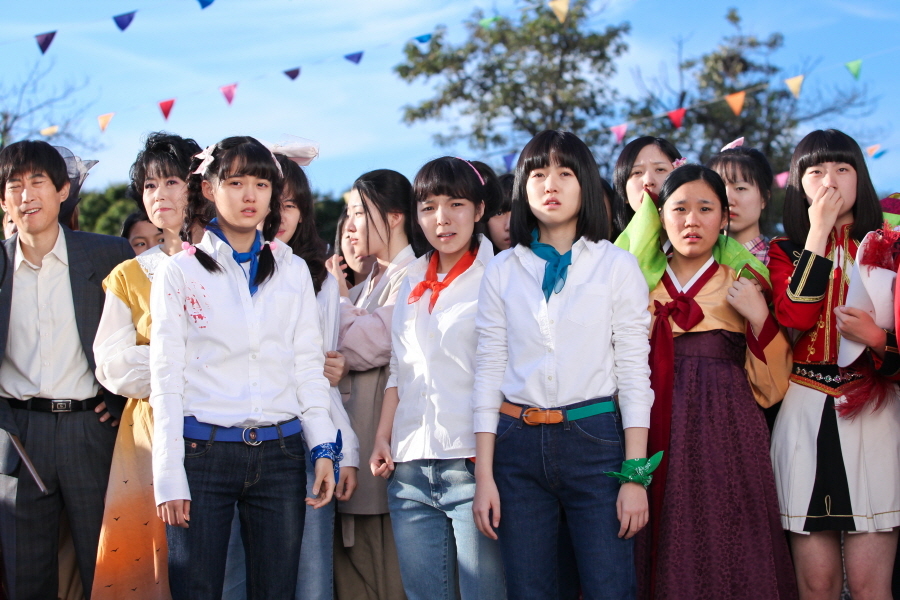
The gap in Chinese theaters was filled by remakes. "Veteran" and "Sunny" were remade as Chinese productions and screened in Chinese theaters, while "A Wedding Invitation" was remade under the title "Our Summer." A Chinese film based on webtoon artist Cho Seok's "Moon You" drew more than 70 million viewers in 2022. Remake rights for "Wonderland," "Innocent Witness," "Sinkholes" and "Only You" were also sold to Chinese buyers.
Rights transactions reshaped export statistics as well. According to Ministry of Culture, Sports and Tourism content industry data, Korean film exports to China reached $8.39 million in 2021 — the largest destination for Korean film exports that year, accounting for 21.1 percent of total Korean film exports and more than seven times the $1.17 million recorded in 2019. The figure even exceeded the pre-hallyu-ban level of $8.2 million in 2014. Most of it came not from sales of finished films but from remake rights deals.
That trend did not last. According to Korea Creative Content Agency figures, Korean film exports to China plunged to $7 million in 2024. China's total theatrical market that year was worth $7.18 billion.
The path to a finished Korean film opening in Chinese theaters remains difficult. Director Yun Ga-eun's "Masters of the World" won two awards at the Pingyao International Film Festival in China last year in September and was pre-sold in October to Light Films — the company that distributed "Parasite" in China — but no Chinese theatrical release date has been set. In its place, a special retrospective of Yun's work organized by the Korean Film Council's Beijing office last month sold out every screening. Since the hallyu ban, Korean films have reached Chinese audiences only through non-commercial screenings at film festivals or Korean Cultural Centers.
Many in the film industry say Chinese audiences have a strong appetite for Korean films. The Korean Film Council also held a Korea-China IP showcase in Seoul from Monday through Wednesday, introducing Korean film intellectual property to investors and producers from both countries. Even so, most-favored-nation treatment notwithstanding, China still caps the total annual screening time for imported films at each theater to no more than one-third of its total programming.
Co-productions offer a way around drama restrictions
The blow to broadcasting was even heavier. From 2017 through 2021, not a single Korean drama series or variety show aired on Chinese television or OTT platforms. Korean broadcast program exports to China in 2021 totaled $34.1 million — less than half the $78.17 million recorded in 2016, just before the THAAD deployment.
What sold in place of finished content was story. Between 2019 and 2022, 55 percent of Chinese remake dramas were based on Korean originals. On Jan. 10 this year, a Chinese adaptation of "My Ajeossi" — titled "Chuxue Man Guo De Dong Tian" — premiered on the streaming platform Youku. In variety, formats such as "Running Man" were sold before the ban, with Korean producers traveling to China to share production know-how directly. After official channels closed, Chinese programs strikingly similar to "Youn's Kitchen" and "Three Meals a Day" began appearing on Chinese screens.

The expansion of co-production eligibility to drama series and variety shows under the new agreement is seen as an encouraging development for the broadcasting industry. According to the Ministry of Culture, Sports and Tourism, content co-produced with China is recognized as Chinese content and therefore exempt from import quotas. China limits imported programs on each OTT channel to no more than 30 percent of the previous year's broadcast share, and bars imported programs from airing during prime time — 7 to 10 p.m. — without approval from the National Radio and Television Administration. Co-production offers a way to sidestep barriers that finished Korean dramas cannot clear on their own.
For production companies that have come to rely on global OTT platforms, Chinese platforms represent a new distribution channel. "If the barriers come down, there is much more room to diversify partnerships toward major Chinese OTT players like Tencent and iQIYI, moving away from the current distribution structure that is heavily concentrated on global platforms," one broadcasting industry official said. There is also hope that Korean content currently consumed illegally in China could begin generating proper revenue once official distribution resumes.
A swift opening for finished content is not guaranteed, however. When the Associated Press checked four Chinese video platforms in April this year, it found around 50 Korean drama series available to watch — all of them more than four years old. "Expectations of a hallyu ban lift have come and gone multiple times over the past decade, and the repeated pattern of thaw signals followed by disappointment has left its mark," one drama production company official said. "It is premature to paint a rosy picture based on a declaratory agreement alone."
The film industry, which secured most-favored-nation treatment in writing, is also measured about the pace of change. "There has been a consistent stream of moves to make contact with local industry figures in China, but it will take time before we can confirm that the atmosphere and the results have actually changed," one production company official said.
shee@heraldcorp.com