Jeong Min leads Gangneung City Symphony in 'Das Rheingold'
Dec. 18–19 at Gangneung Arts Center Saimdang Hall
All 14 singers, conductor and director are Korean
Tiered orchestra pit renovation sets the stage
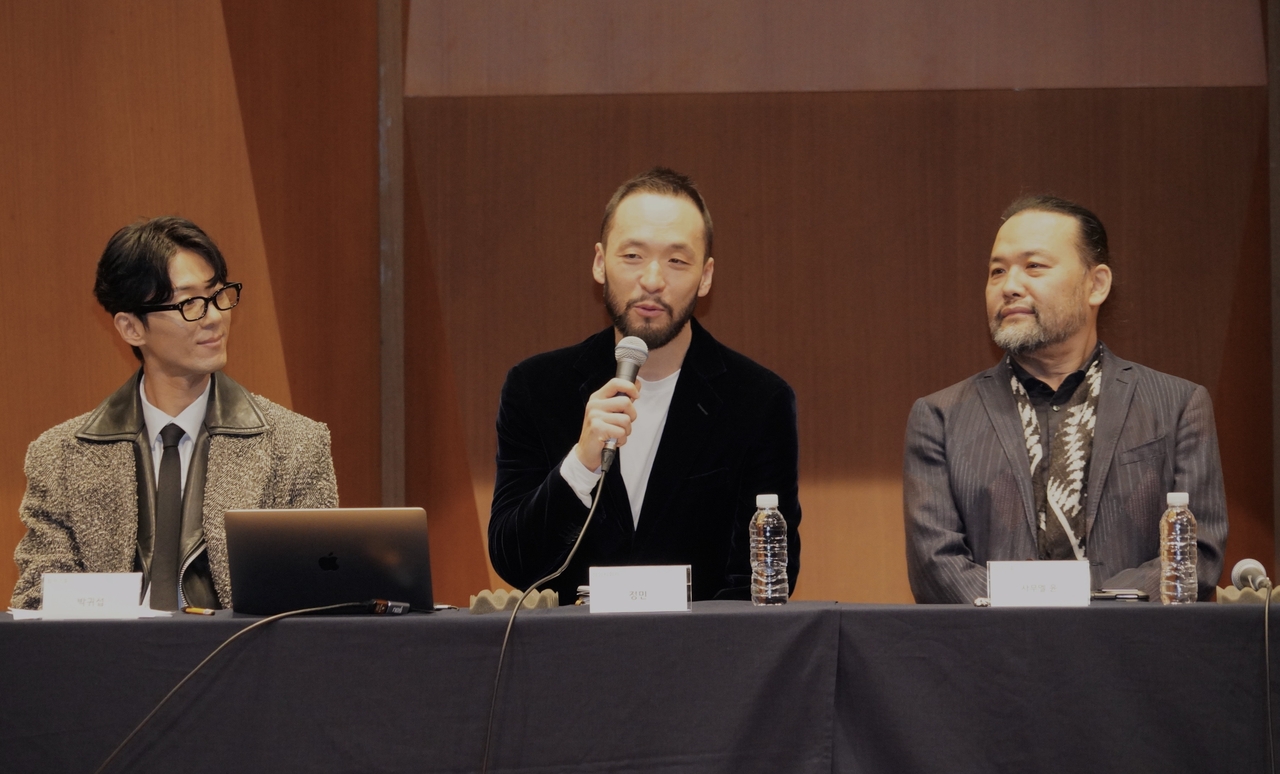
"It's rare to sing Alberich three times in a single year. Yet every time, no matter the production, it feels like starting from scratch." — Bass-baritone Samuel Youn
Alberich — the dwarf who steals gold from the Rhine's depths and forges a ring of absolute power — awakens for the third time this year on a Korean stage, and all three times through the voice of bass-baritone Samuel Youn. Add his European engagements and Youn has sung the role four times in 2026 alone. Having been stripped of the ring at a music stand last summer and on an opera house set in the fall, Alberich now appears on a stage overlooking the East Sea. The vehicle is "Das Rheingold," the first installment of Wagner's four-part "Der Ring des Nibelungen," to be staged by the Gangneung City Symphony Orchestra. In this production, Youn takes on not only the singing but also the weight of co-director.
Jeong Min, who has led the Gangneung City Symphony as music director since 2022, was candid at a press conference held recently at Kumho Art Hall in Seoul. "Anyone who heard that the Gangneung City Symphony was doing the Ring cycle would have thought it was absurd," he said. "And they would have been right."
The orchestra plans to stage all four operas of Wagner's cycle over four years — "Das Rheingold" first, followed by "Die Walküre," "Siegfried" and "Götterdämmerung" — completing the full tetralogy exactly 150 years after its world premiere at the Bayreuth Festspielhaus in Germany in 1876. Every member of the creative team, from the conductor and director to all 14 singers, is Korean — a homegrown Ring cycle in every sense.
From a casual coffee to a Bayreuth-style pit
The seed of the project was planted in 2022. After Jeong and Youn shared a stage together for the first time five years ago, the idea of staging the Ring came up over coffee.
"Dozens, hundreds of pieces fell into place over five years to bring us here," Jeong said. "Along the way, I discovered that no one in Korea had ever produced a domestic Ring cycle."
The timing — coinciding with the 150th anniversary of the Ring's world premiere — was entirely unplanned. "I had no idea this year was the 150th anniversary," Jeong said. Youn laughed and added: "After five years of preparation, once we finally committed to doing it, we found out it was the 150th anniversary. Honestly, it felt a little unfair."
For Jeong, the youngest son of conductor Chung Myung-whun, Wagner had been "a composer I hadn't dug into the way my father has." Just before taking up his post with the Gangneung City Symphony five years ago, he recalled his father saying Wagner was one composer he had yet to tackle and that he hoped to take on the challenge someday. "This might look like a calculated plan," Jeong said, "but this project came entirely from my own personal ambition."
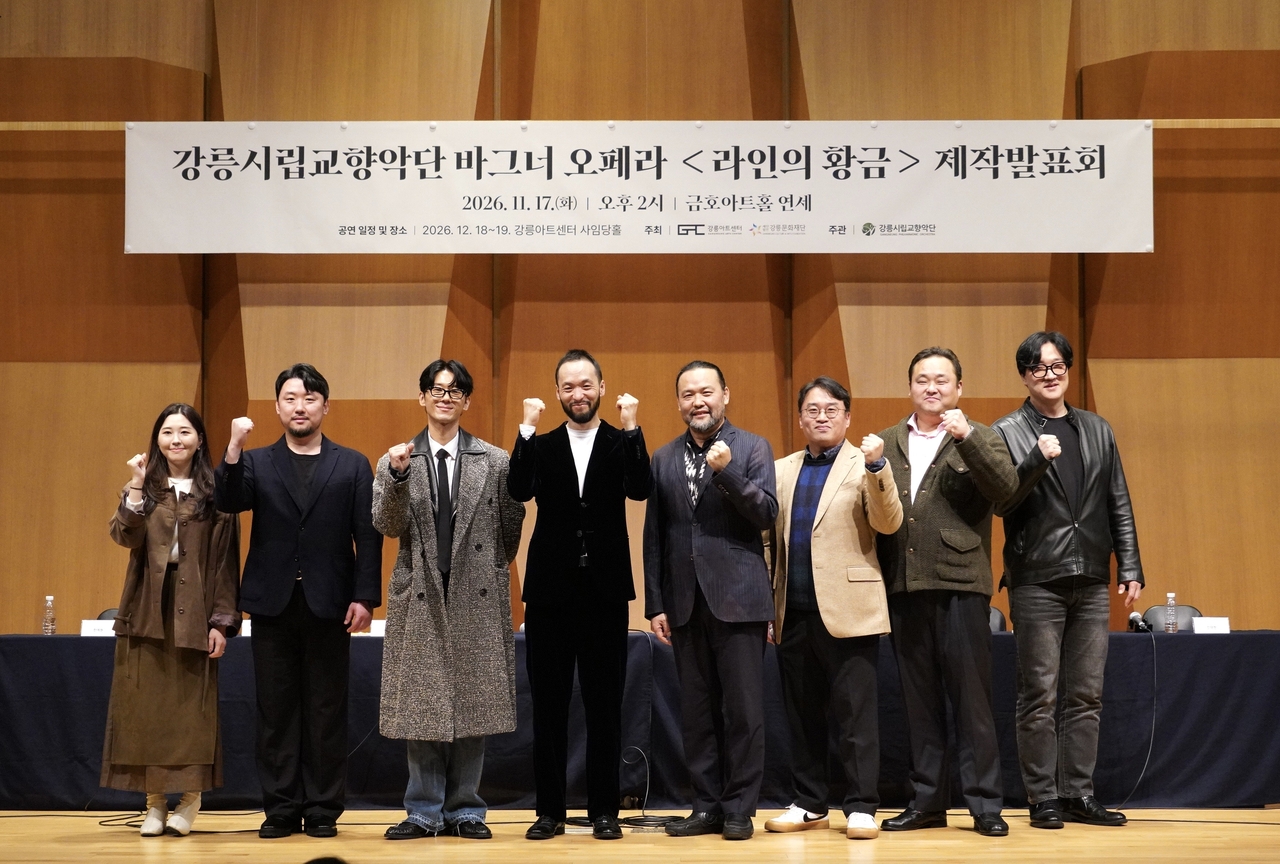
When Jeong first arrived in Gangneung, his ambitions were modest. Rather than vowing to elevate the orchestra, he simply hoped "to be of even a little help to an unfamiliar city, an unfamiliar theater and an unfamiliar ensemble." But as he built a rapport with the musicians, the projects grew year by year. "Even now, holding a press conference to announce the Ring cycle, it still feels unreal," he said. "I think of it as fate."
What turned the joke into reality was a major renovation of the concert hall. Gangneung Arts Center is a 998-seat multipurpose venue that opened in 2017 ahead of the 2018 PyeongChang Winter Olympics. A planned construction project to build a large rehearsal room beneath the stage was redirected toward expanding the orchestra pit. The internal consensus became: if we are going to do this, do it properly.
The model the Gangneung City Symphony looked to was Wagner's own "mystic abyss" — the sunken pit he designed for the Bayreuth Festspielhaus. By hiding the orchestra beneath the stage, the pit keeps musicians out of the audience's sightline, directing all attention to the singers above. The Bayreuth pit descends in tiers deep below the stage, placing the loud brass instruments at the lowest level and layering the strings above them. Gangneung Arts Center's pit has been built on the same tiered principle, and next year the bottom level is to be expanded into a double-height space.
The renovation was made possible because the original construction left more than 5 meters of below-ground space beneath the stage. "The current state isn't 100 percent satisfying," Jeong said. "We plan to make further adjustments this year, and next year we will convert the lowest tier of the pit into a double-level space." Youn, who performed on the Bayreuth stage for 12 years, toured the facility and said he was impressed. "They were aiming for something far more specifically Bayreuth-like than I had expected," he said. "By the time all four operas are done, this could be a venue known as 'the Bayreuth of Korea.'"
Mounting a Wagner opera is notoriously expensive, given the large forces required, the sheer length of the works and the mythological scope of the staging. Jeong was unfazed. "Everyone says you can do it if you have the money, but that's not true," he said with a laugh. "Ideas matter more than money. If you have a brilliant idea, those problems solve themselves."
The Bayreuth-style pit is also new territory for the orchestra's own musicians. "What you learn in an opera pit is very different from what you experience on a concert stage," Jeong said. "You learn to react and adapt instantly to what is happening above you." He added that few orchestras anywhere in the world — let alone in Korea — have the opportunity to perform the entire Ring cycle.
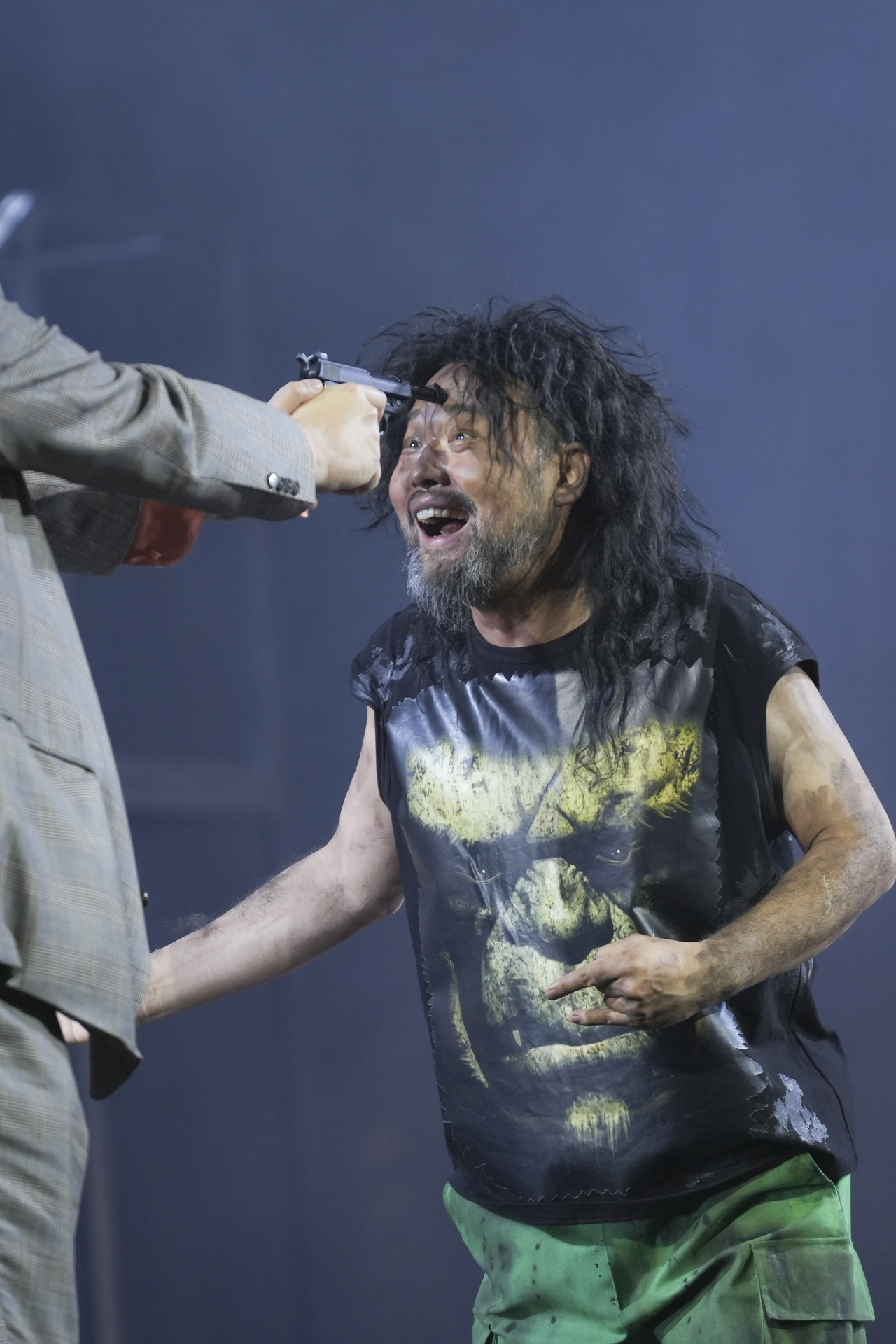
Three Alberichs: from concert hall to opera house to Gangneung
For Youn, this is the third Alberich of the year — but each of the three has been a different character.
The formats alone set them apart. The first was a Ring highlights concert (opening Aug. 8 at Seoul Arts Center and Bucheon Arts Center), conducted by Bucheon Philharmonic Orchestra Music Director Adrien Perruchon, which compressed the 15-hour tetralogy into 205 minutes. It was an ideal introduction to the Ring for newcomers. With no sets or costumes, Youn moved between Alberich and his son Hagen, embodying in a single performance both the figure who sets the ring's curse in motion and the one who brings it to its end. Youn had been involved in the project from the planning stage.
The second was the National Opera of Korea's "Das Rheingold" (opening Oct. 29 at Seoul Arts Center's opera house), the first installment of the company's own long-term project to stage all four operas through 2029. Lothar Koenigs conducted the Korea National Symphony Orchestra, and director Lorenzo Fioroni transposed the world of the gods into a contemporary city entangled in money and crime. Youn shared the role of Alberich with baritone Yang Jun-mo.
Youn has treated both productions as stepping stones toward Gangneung. "The highlights concert with the Bucheon Philharmonic and the National Opera's 'Das Rheingold' were both enormously important endeavors," he said. "Because those attempts came first, we will be able to create something more fully realized." In between, Youn also sang Alberich in April in a European performance of "Siegfried" with the Rotterdam Philharmonic conducted by Yannick Nézet-Séguin.
The directorial approach in Gangneung also diverges from the National Opera's production. Director Lee Gang-ho said the aim is "to stay a little closer to the original than the National Opera did," while drawing a clear line: "It is not a choice made with the National Opera in mind." From the very first planning meeting, he said, the team decided to set aside experimental foreign stagings and instead ask how to fully understand Wagner and convey the depth of the story to the audience.
The three productions have also brought Korea's Wagner singers together in one place. Park Seung-ju (Mime), Jeon Tae-hyeon (Fasolt), Jeong Ju-yeon (Flosshilde) and Kim Ji-won (Wellgunde), who appeared in the Bucheon Philharmonic highlights concert, reunite in Gangneung, and Lee Dan-bi, who sang Erda in the National Opera production, joins in the same role. The god-king Wotan is sung by Leonardo Yi. The entire run uses a single cast, with the same performers in every showing.
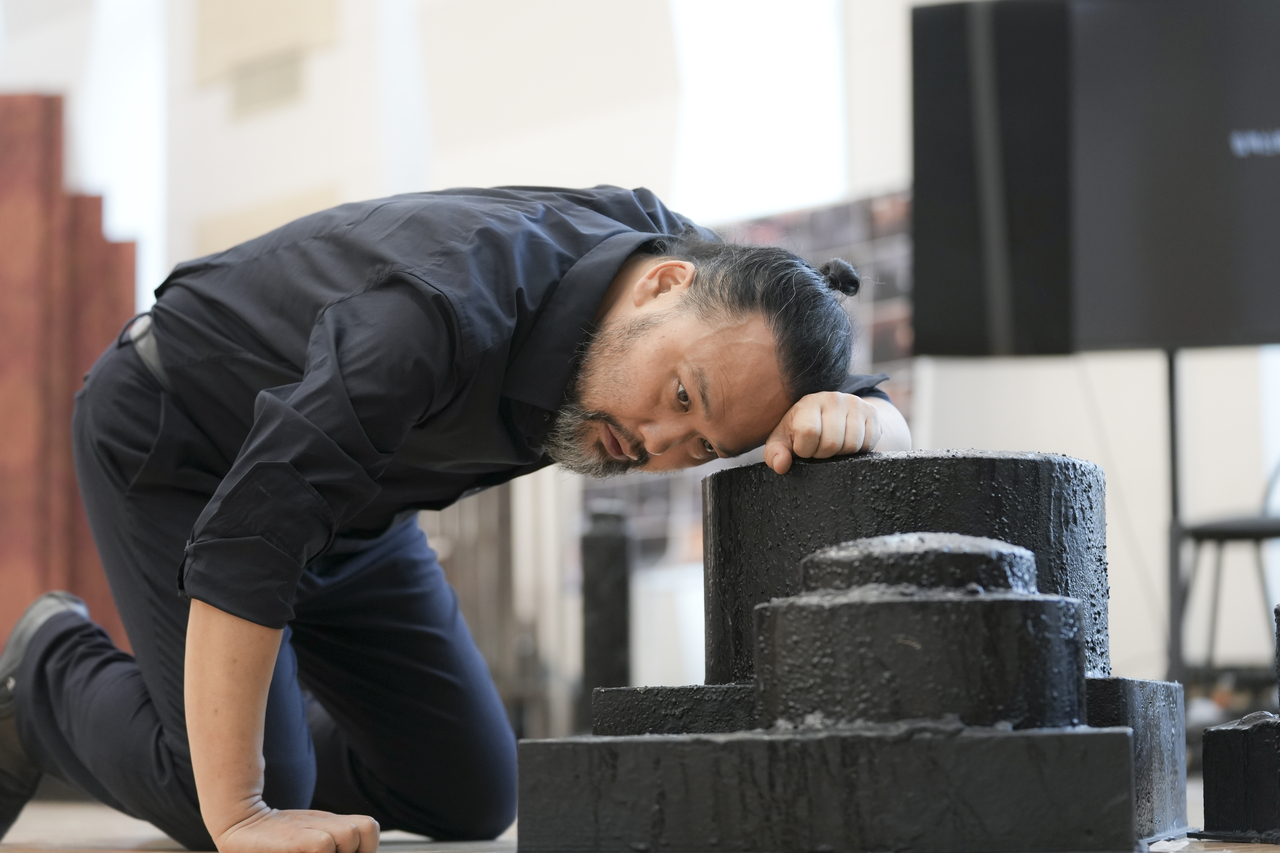
Light is chance, desire is choice, the curse is fate
When the curtain rises, the stage opens wide. Lines of laser light become the surface of the river; below the line is water, above it is land. Alberich, wandering the riverbank, crosses the boundary of light and walks into the depths. Visual artist Park Gwi-seop, who is responsible for the concept and scenography, said: "It is a technology that did not exist in the 19th century when Wagner lived, but we want to use lasers available today to express the water's surface." The interpretation is that gold becomes visible only where light falls, and the moment it is seen, desire awakens.
One element that sets this production apart from others staged in Korea is that the Nibelungs of Nibelheim are played entirely by dancers. The light from lanterns carried by the dancers converges on Alberich, and his shadow swells into the shape of power. The scene in which Alberich transforms himself using the Tarnhelm is also rendered through shadow.
The worlds of gods, humans and Nibelungs are layered on the branches of a single world tree. At the very top sit the gods, who live off the tree's fruit. At the center of the ring — made deliberately too smooth — is engraved a human eye, meant to open the moment desire is born.
Director Lee, who handles both the staging and the dramaturgy, poses a central question: who owns the light? "Light was an accident," he said. "The figures who appear as gods in the Ring cycle are merely its administrators, not its creators." His interpretation is rooted in a line from a letter Wagner wrote to a friend: "Wotan resembles us to the last hair."
Lee's reading of the Ring cycle can be distilled to a single line: "Light is chance, desire is choice, the curse is fate." Alberich, who stumbles upon the light by accident, chooses power over love; the curse he lays as the ring is torn from him becomes the destiny of all who hold it, and that destiny shapes the entire world of the Ring. "From this first opera, I want to keep hold of the thread that will carry the audience through to the end of all four," Lee said.
Youn leads the singers on stage. His vision of Wagner is of a composer who notated every entrance, every exit and every quiet sound — a composer who dreamed of a total artwork in which singing, acting and staging fuse into one. That is why Youn volunteered to serve as co-director.
"I wanted to show how magnificently Korean artists can present this total artwork — something more innovative and original than what you see on the Bayreuth stage," Youn said. "I wanted to play an important role in that."
Singing Alberich while also co-directing is a first for Youn. "My role on stage is to stand beside each singer and help them give everything they have," Youn said.
With the long-awaited all-Korean Ring finally set to open, opera lovers and classical music fans have been paying close attention. Conductor Jeong offered a measured word of caution as the curtain prepares to rise. "Please do not expect a perfect performance. There will be awkward moments, and there will be shortcomings. The first time is always awkward," he said. "But the team we have assembled, the spirit with which we approach this work, and the very attempt to reshape the theater itself to fit the music — all of that is my measure of success."
shee@heraldcorp.com