EXAONE Tabular cuts model update time by 85% at LG Innotek
LG affiliates accelerating AI transformation with EXAONE
Physical AI development underway, combining robotics with foundation models
![LG AI Research holds the "LG AI Talk Concert 2026" at LG Science Park's Convergence Hall in Magok, Gangseo-gu, Seoul, on Monday, showcasing expert AI applications developed for manufacturing, finance and science. [Courtesy of LG]](https://wimg.heraldcorp.com/news/cms/2026/09/14/news-p.v1.20260914.248b18b7ddec4eb09af60beb9912449e_P1.png)
"In the AI era, what matters is how we combine national industrial competitiveness with AI to build an even stronger edge. If Samsung wants it, we are willing to provide EXAONE." — Lee Hwa-young, head of AI business development at LG AI Research
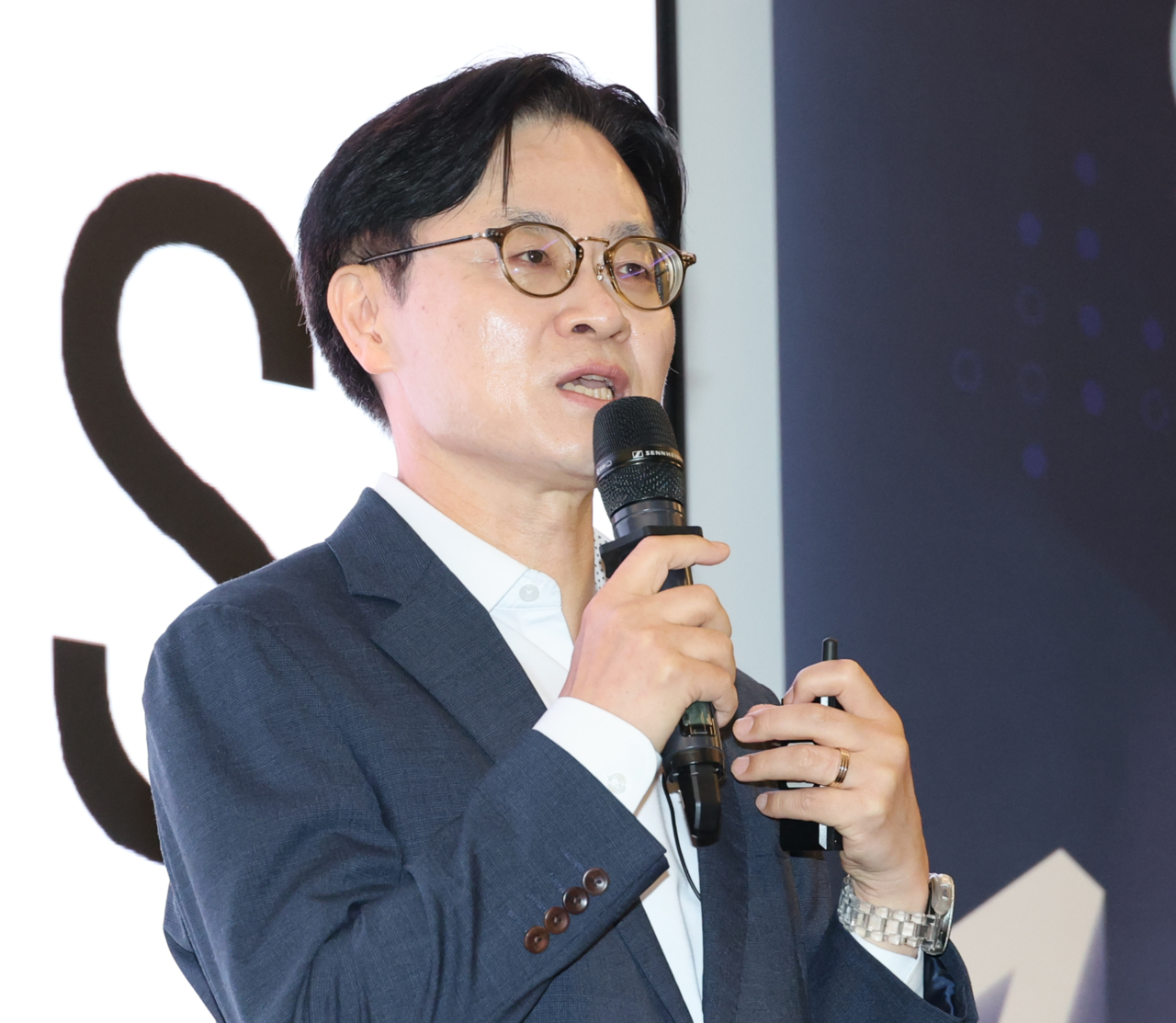
LG AI Research held the "LG AI Talk Concert 2026" at LG Science Park's Convergence Hall in Magok, Gangseo-gu, Seoul, on Monday, unveiling expert AI applications it has developed for manufacturing, finance and science. The event emphasized AI that can be deployed directly on factory floors — not AI still confined to the research stage.
LG AI Research is running proof-of-concept projects to apply AI to manufacturing processes across LG's production affiliates, including LG Innotek, LG Display, LG Electronics and LG Energy Solution, all using its EXAONE model.
"In the past, manufacturing sites would analyze the cause of a problem after it occurred and then respond," said Lim Woo-hyung, co-director of LG AI Research. "Going forward, AI will predict problems before they arise and proactively take the necessary steps."
The flagship technology, EXAONE Tabular, analyzes numerical data generated on factory floors — including temperature, pressure, process conditions and quality inspection results — to forecast changes in quality and production. Its key advantage is that it can be applied quickly with minimal data, without needing to rebuild a model from scratch or collect large new datasets each time a process changes.
LG Innotek is currently rolling out EXAONE Tabular across its manufacturing processes. The company aims to build an autonomous factory in which AI analyzes data in real time across its entire production lines — covering camera modules and semiconductor substrates — to predict process anomalies and automatically adjust production conditions.
"Under the previous approach, when process conditions changed, we needed at least 14 days and more than about 300 hours of production data to retrain the model," said Yoo Jeong-seon, who leads AI transformation at LG Innotek. "By using EXAONE Tabular, we have cut the time needed to reflect changed conditions to around 50 hours." That represents roughly an 85 percent reduction in model update time.
LG AI Research is also applying AI to visual inspection — using cameras on the factory floor to detect product defects. Previously, whenever a product or production line changed, engineers had to collect new data and develop a new model, a process that could take anywhere from several weeks to several months before deployment.
EXAONE Omni-Inspect, developed by LG AI Research, reduces the need for separate retraining even when the inspection target or process changes, enabling faster deployment. Built on a vision-language model, it can continuously refine inspection models, making it suitable for environments with frequent line changes such as high-mix, low-volume production. LG AI Research plans to deploy it in actual inspection processes this year.
![LG AI Research holds the "LG AI Talk Concert 2026" at LG Science Park's Convergence Hall in Magok, Gangseo-gu, Seoul, on Monday, showcasing expert AI applications developed for manufacturing, finance and science. [Courtesy of LG]](https://wimg.heraldcorp.com/news/cms/2026/09/14/news-p.v1.20260914.3885b12a9ef24ea69517197d5e6377a0_P1.png)
LG AI Research is also pursuing commercialization with external clients. Lee, the head of AI business development, said demand for EXAONE Tabular from outside the group has been "extremely high," with inquiries coming from global customers, pharmaceutical companies, hospitals and energy firms.
Beyond manufacturing AI, LG Group is developing physical AI — combining robotics with AI — as its next major growth pillar. The group is building a "robot foundation model" to serve as the brain of its robots, integrating hardware capabilities from its affiliates — robots and finished products from LG Electronics, sensors from LG Innotek and batteries from LG Energy Solution — with the platform expertise of LG CNS and the AI technology of LG AI Research.
"LG Group holds a vast trove of real-world data accumulated across its global production sites," said Kim Seung-hwan, head of the Physical Intelligence Lab at LG AI Research. "The data we have secured from our home appliance business can also be applied to robotics — that is our strength." The vision is to extend EXAONE's foundation model capabilities into robotics, ultimately realizing autonomous factories in which AI makes decisions and robots act on them directly.
Manufacturing AI adoption, however, remains in its early stages. An analysis of Statistics Korea's corporate activity survey by the Korea Institute for Industrial Economics and Trade found that only 3.9 percent of manufacturing companies were using AI as of 2023. A key obstacle is that products, processes and data environments differ from factory to factory, making it difficult to scale AI developed at one site to another.
LG AI Research sees general-purpose industrial AI — capable of getting started quickly with minimal data and scaling across multiple processes — as the key to spreading AI transformation throughout manufacturing.
"Even when we worked with LG affiliates to build a good model and deploy it on-site, we found that scaling it further was difficult," Lim said. "We will make AI more accessible and usable through foundation models that can adapt quickly to a wide range of situations."

go@heraldcorp.com