Global Infrastructure Cooperation Conference 2026
AI, data centers among topics at global infrastructure forum
'Korea has experience building and operating new towns in a short time'
![Minister of Land, Infrastructure and Transport Kim Yun-deok delivers a welcome address at the Global Infrastructure Cooperation Conference 2026 on Tuesday morning. [Ministry of Land, Infrastructure and Transport]](https://wimg.heraldcorp.com/news/cms/2026/09/15/news-p.v1.20260915.4b695b6197a8450087589cee015a1090_P1.jpg)
Minister of Land, Infrastructure and Transport Kim Yun-deok said Tuesday that South Korea is "the most prepared partner that the rapidly reshaping global infrastructure market is looking for," speaking before ministers, vice ministers and industry officials from 32 countries at the Global Infrastructure Cooperation Conference.
The opening ceremony of GICC 2026 was held Tuesday morning at the Conrad Seoul hotel in Yeouido, Yeongdeungpo-gu. Now in its 14th year, the conference has been held since 2013 to support cooperation in infrastructure among the government, major overseas project owners, multilateral development banks, and construction and engineering firms.
More than 500 people attended this year's conference, including ministers and vice ministers, CEOs, and officials from domestic and international public institutions and construction and engineering companies. The halls and corridors were packed with attendees from around the world as early as 30 minutes before the event began, and the Grand Ballroom — with roughly 500 seats — filled up quickly.
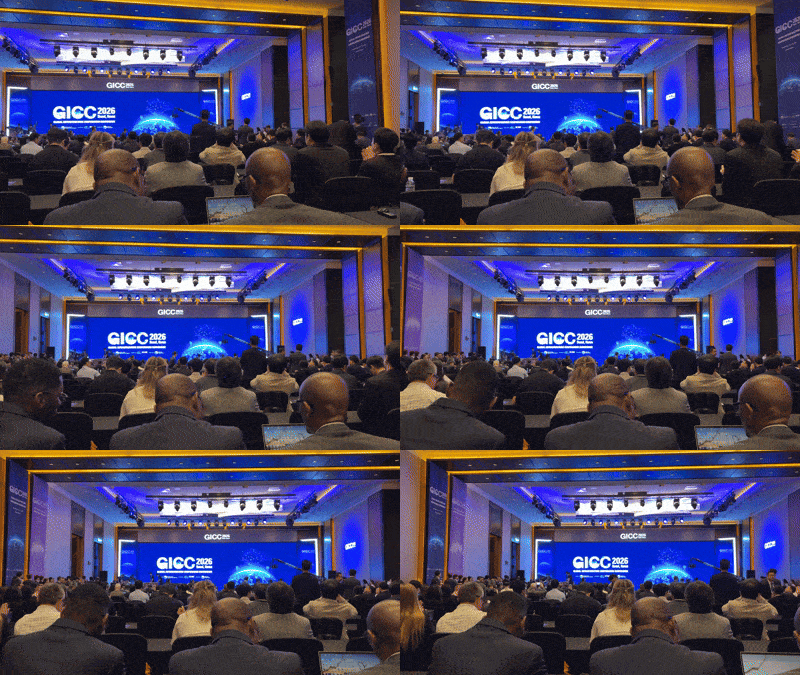
This year's GICC was organized around the theme "Opening Global Infrastructure Cooperation with AI," reflecting rapidly shifting trends in the global infrastructure market. Over three days of seminars, forums and multilateral meetings, participants are set to discuss how AI will reshape construction and transportation infrastructure and explore concrete avenues for cooperation.
In his welcome address, Kim said he has witnessed firsthand how quickly the global infrastructure market is changing. "Visiting diplomatic posts and meeting counterparts in various countries while serving as minister, I have come to feel just how rapidly the global infrastructure market is being reshaped," he said. "What struck me most was that the way the market looks at infrastructure construction projects has fundamentally changed."
Kim said the market is now seeking more than contractors. "Rather than companies that simply build well, the market is looking for partners who will think through projects together, arrange financing and handle operations," he said. "South Korea has the experience of having built and operated roads, railways, airports and new towns in a short period of time."
He also highlighted the track record of Korean companies. "Korean companies have been active on job sites around the world, achieving the remarkable milestone of $1 trillion in cumulative overseas construction orders in 2024," Kim said. "Drawing on that experience and advanced technological capabilities, South Korea will be a reliable partner throughout the entire project cycle — from conception and design to construction, long-term operations and maintenance."
![Attendees pose for a group photo at the Global Infrastructure Cooperation Conference 2026. [Ministry of Land, Infrastructure and Transport]](https://wimg.heraldcorp.com/news/cms/2026/09/15/news-p.v1.20260915.fd481a1da1df4912bc7d4fdec7d57828_P1.jpg)
In his opening remarks, Han Man-hee, chairman of the Overseas Construction Association of Korea, said AI is both advancing the sophistication of infrastructure construction and management and generating new construction demand in the form of data centers, power and energy infrastructure. "Korean companies have participated in urban infrastructure development projects around the world, accumulating broad experience spanning planning, design, construction and project operations," he said.
Han described the conference as a venue for countries to share policies and development plans and for overseas project owners and Korean companies to discuss cooperation. "I hope the discussions that begin at GICC will lead to new projects, investment and sustained cooperation," he said.
The keynote addresses were delivered by Jeff Rubenstone, deputy editor of the American construction and engineering trade publication Engineering News-Record, and Hwang Tae-hwan, executive vice president at Samsung Electronics. "In the past, the infrastructure industry was defined by who built what," Hwang said. "The next 100 years will depend on how AI is applied, built and operated." He added that Samsung Electronics would be a strong partner in building AI infrastructure, noting the growing importance of combining construction, manufacturing and IT technology.
GICC is one of the largest international events of its kind in South Korea, having drawn participants from 90 countries and 590 organizations over its history, and has given rise to roughly 450 international projects. A multilateral meeting held immediately after the opening ceremony brought together six senior ministers from overseas project-owning countries to discuss global infrastructure development plans and strategic cooperation.
The conference also features transportation cooperation seminars, a global cooperation forum, project briefings and one-on-one business meetings, where overseas project owners and Korean companies share project information and discuss areas of mutual interest. The event will also support Korean companies' participation in overseas investment and development projects as well as multilateral development bank-funded projects.
shy@heraldcorp.com
hwshin@heraldcorp.com