Labor and management fail to even begin talks on 'ordinary wage calculation hours,' the central sticking point
Seoul Metropolitan Government calls for shift from post-settlement to pre-fixed subsidy system
Seoul Mayor Oh Se-hoon urges designation of city buses as essential public service
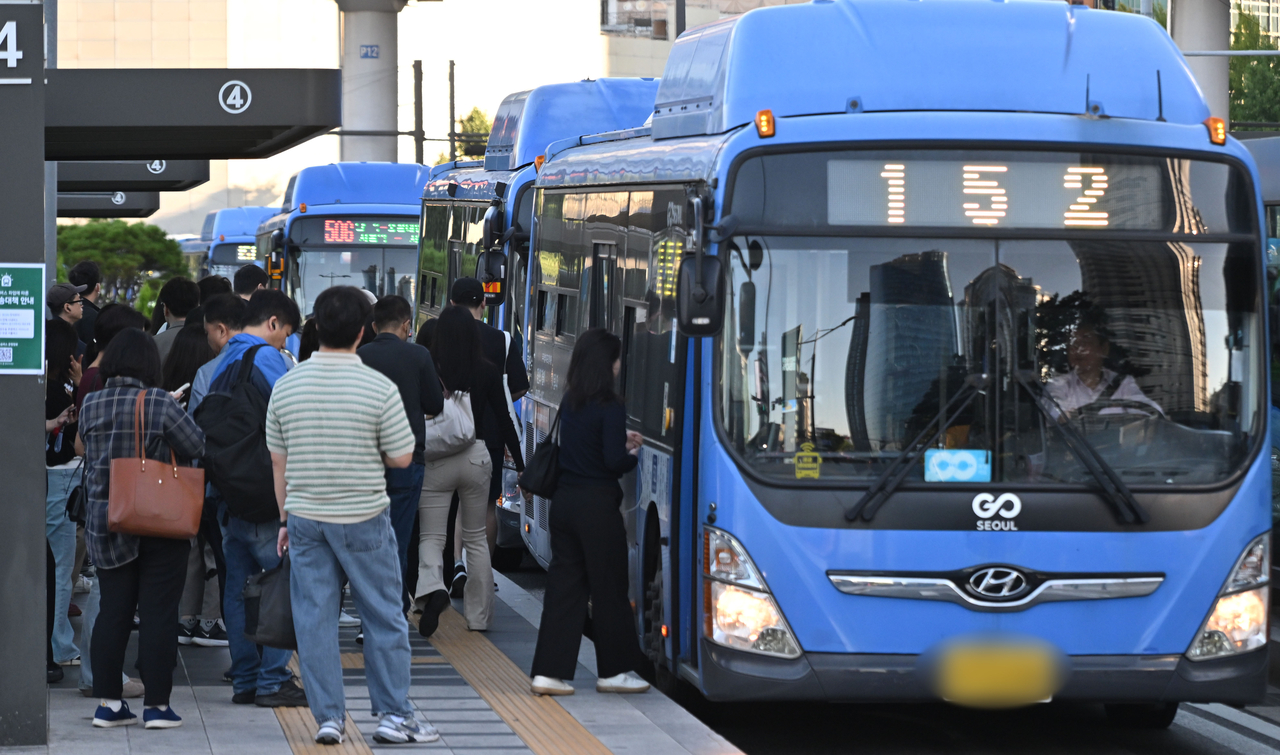
Seoul's city bus operators narrowly averted a strike after nearly 12 hours of negotiations ended in a last-minute agreement Wednesday, but the most contentious issue — how to calculate ordinary wages — was left unresolved. The Seoul Metropolitan Government warned that labor unrest could recur and said the city needs to overhaul its bus subsidy system and push for city buses to be designated an essential public service.
The Seoul City Bus Workers' Union, affiliated with the Federation of Korean Automobile Workers' Unions, and the Seoul Bus Transport Business Association reached a final agreement on a wage and collective bargaining deal at around 1:50 a.m. Wednesday at the Seoul Regional Labor Relations Commission in Yeongdeungpo-gu. The union immediately called off a strike that had been set to begin with the first buses of the day, and all routes resumed normal service.
Under the agreement, both sides accepted the commission's mediation proposal and agreed to raise wages by 3.2 percent for 2026 — 0.3 percentage points above last year's increase of 2.9 percent.
However, the dispute over the baseline hours used to calculate ordinary wages was excluded from the deal. Labor and management agreed to revisit the issue after the Supreme Court issues a ruling on ordinary wage calculation standards for transport companies, expected by year's end.
The union has argued that 176 hours per month should serve as the calculation baseline, citing a second-instance ruling in the Dong-A Transport ordinary wage case last year and the Supreme Court's April ruling this year. Management and the city government have countered that 230 hours should apply, taking into account contractually agreed working hours. Management had sought to resolve the ordinary wage question at the negotiating table, but the union declined to engage on the issue, sources said.
With the ordinary wage calculation hours left unresolved, the underlying conflict remains. Because the ordinary hourly wage is derived by dividing the monthly ordinary wage by the baseline hours, applying the union's figure of 176 hours would result in a higher effective hourly rate for workers. Another round of labor-management confrontation is widely expected once the Supreme Court issues its ruling at year's end.
The ordinary wage calculation hours are also a critical fiscal concern for the city. Seoul currently provides about 500 billion won ($372 million) annually in subsidies to city bus operators under a quasi-public management system. Accepting the union's position on ordinary wages would add an estimated 200 billion won in additional costs.
The city plans to use the strike threat as an impetus to actively pursue a shift from the current post-settlement subsidy system to a pre-fixed system. In 2024, when the city announced a reform plan marking the 20th anniversary of the quasi-public bus management system, it said it would replace the existing arrangement — under which the city fully reimburses operating deficits after the fact — with a pre-fixed model that sets total revenue and costs in advance and covers only the difference. The city estimated the change could save up to 18 billion won per year, including reductions in administrative costs and loan interest.
Yeo Jang-gwon, head of the Seoul Metropolitan Government's transportation bureau, said at a briefing on Tuesday that "if the ordinary wage issue is deferred again, the same conflict will repeat itself," adding that "it is right to resolve the uncertainty quickly and put the wage structure in order." He called the shift to a pre-fixed system "the top priority in the reform plan," while acknowledging that "it will be an extremely difficult undertaking" requiring the consent of both the union and bus company operators. "Even so, we must move to the pre-fixed system," he said.
Another unresolved challenge is the push to designate city buses as an essential public service. Under the Trade Union and Labor Relations Adjustment Act, railways, urban rail, and air transport are already classified as essential public services, meaning a minimum level of operations must be maintained even during strikes. City buses, which do not carry that designation, can be subject to a complete work stoppage.
Kim Jeong-hwan, chairman of the Seoul Bus Transport Business Association, said after the deal was reached that city buses, as a public service, should be subject to more substantive negotiations, and that designating them an essential public service would prevent commuters from being stranded.
Seoul Mayor Oh Se-hoon also called on the government and the National Assembly on Tuesday, via Facebook, to immediately move to amend the law to designate city buses as an essential public service.
ikson@heraldcorp.com