54 subsidiary CEOs at top 5 financial groups face year-end term expirations
Succession processes underway, but firms call for clearer guidelines
FSS chief to meet financial holding company heads Sept. 23
![Financial Supervisory Service Director General Lee Chan-jin. [FSS]](https://wimg.heraldcorp.com/news/cms/2026/09/16/news-p.v1.20260622.da596f108f3c4a79b5e1ef62d1054eb3_P1.jpg)
Tensions are rising across the financial industry after Financial Supervisory Service Director General Lee Chan-jin publicly criticized the CEO succession procedures at financial holding company subsidiaries, with year-end personnel decisions approaching. While financial firms broadly agree that transparency and fairness in succession processes need to improve, they say clearer standards are needed on exactly what must be fixed and to what degree.
According to industry sources Wednesday, the terms of 54 CEOs at subsidiaries of the country's five major financial groups — including the heads of KB Kookmin, Shinhan, Hana, Woori and NH NongHyup Bank — are set to expire at year's end. The breakdown is 10 from KB Financial Group, 12 from Shinhan Financial Group, 13 from Hana Financial Group, 12 from Woori Financial Group and seven from NH NongHyup Financial Group.
The Financial Supervisory Service recommended in its 2023 best-practice guidelines on bank governance that financial holding companies and banks begin management succession procedures at least three months before a sitting CEO's term expires. Financial holding companies and banks have since revised their succession procedures and internal regulations accordingly. With so many CEOs facing year-end term expirations, the selection process at each financial group is expected to begin in earnest this month.
Against that backdrop, Lee raised the issue at an FSS executive meeting Tuesday, saying the CEO succession procedures at financial holding company subsidiaries were inadequate. He said the procedures drawn up by the subsidiary CEO candidate recommendation committees at many holding companies fell short, and that the role of subsidiary executive candidate recommendation committees was also limited.
![[Newsis]](https://wimg.heraldcorp.com/news/cms/2026/09/16/news-p.v1.20260309.938d8fa5475d41f7bedf20157d4c554c_P1.jpg)
Lee cited as problems cases where CEO qualification requirements were stated too vaguely, or where no minimum verification period was set for each stage of the candidate-screening process. He also said some institutions managed their standing candidate pools only as a formality, and that the process of narrowing and vetting candidates lacked transparency. His message was that transparency and fairness must be strengthened across the entire succession process — from candidate selection and verification to evaluation and record-keeping.
The reaction within the financial industry has been one of bewilderment, with firms saying it is unclear not just what the criticism means in principle but which specific procedures need to be improved and how.
"He said qualification requirements are too abstract and verification procedures are inadequate, but it is hard for financial firms to judge exactly which parts fall short and by how much," one industry official said. "Without specific standards or inspection findings, it is difficult to know where to start, and there is genuine confusion internally." Another official said, "The personnel decisions for bank heads and subsidiary CEOs will be affected in some way, but the specific direction is hard to read — we will have to wait and see what standards the authorities put forward."
A corporate governance reform plan that financial authorities have been discussing since early this year also remains unfinalized in both content and timing. Options under consideration include raising the approval threshold for chairman candidate recommendation committees or tightening shareholder meeting requirements, rather than directly capping financial holding company chairmen to three consecutive terms — but the FSC says neither the specifics nor a release schedule have been set. As a result, voices within the industry are growing louder that year-end selection procedures will move forward before the direction of any new regime is clear, making it difficult to gauge what standards regulators will ultimately require.
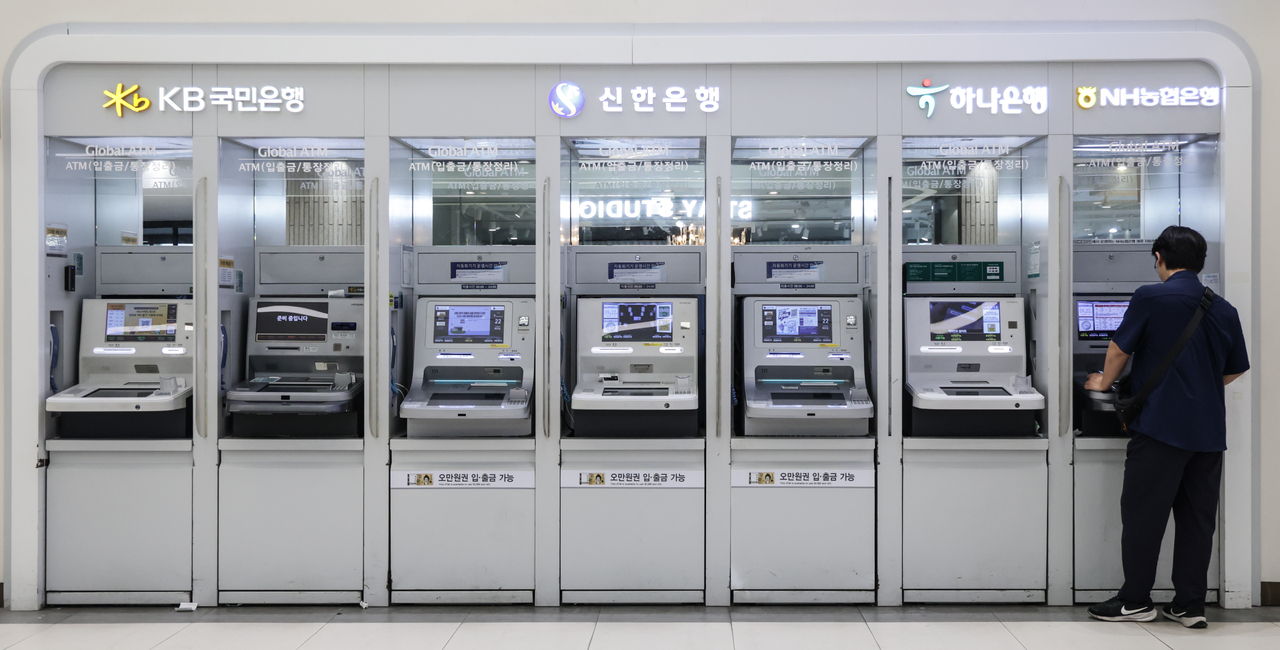
![Bank ATM machines in Seoul. [Yonhap]](https://wimg.heraldcorp.com/news/cms/2026/09/16/news-p.v1.20260910.aae2a3e12e1143e89804c851f78b7f40_P1.jpg)
There are also considerable concerns that a broad CEO turnover could disrupt the continuity of medium- and long-term business plans. Since most major projects at financial firms unfold over several years, a change in leadership could shift business priorities and strategic direction.
"Executives do not decide everything at a company, but when a CEO changes, the management direction and business plans can shift as well," one industry official said. "There is a real possibility that continuity in medium- and long-term plans could be affected." Amid these concerns, Lee is scheduled to hold a breakfast meeting with the heads of major financial holding companies on Sept. 23, where he is expected to address subsidiary CEO succession procedures and other pending governance issues.
rim@heraldcorp.com