![A concept image related to corporate bonds. [Getty Images Bank]](https://wimg.heraldcorp.com/news/cms/2026/09/16/news-p.v1.20260827.f539147733af4fca97fa39de0cbe9fab_P1.jpg)
Companies are facing mounting pressure to roll over debt as nearly 23 trillion won ($17 billion) in corporate bonds come due by year-end. Maturities from September through December are up 25 percent from a year earlier, while new issuance of A- to BBB-rated bonds has fallen sharply. With market interest rates climbing on the possibility of further US Federal Reserve rate hikes, lower-rated companies must refinance maturing debt at increasingly higher rates.
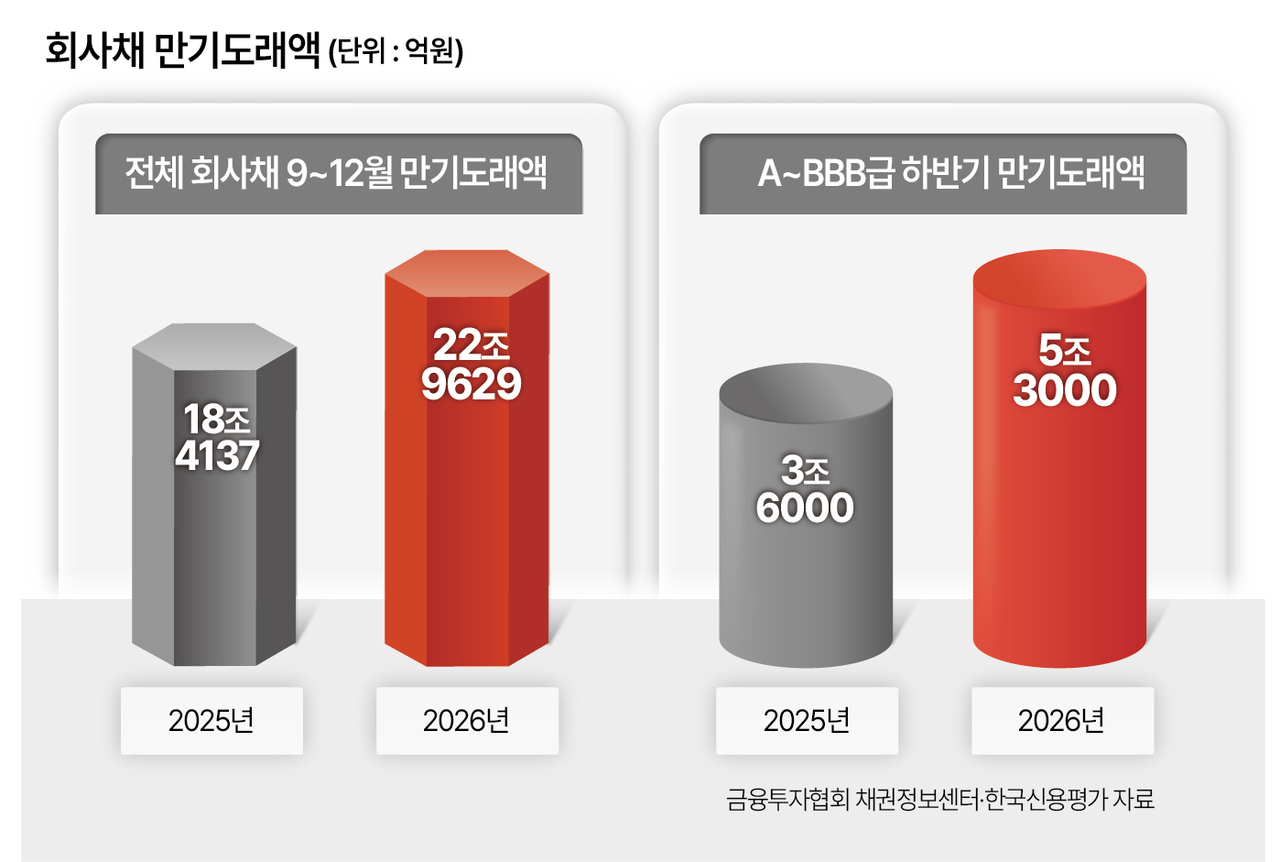
Corporate bonds maturing between September and December this year total 22.96 trillion won, up 4.55 trillion won, or 24.7 percent, from 18.41 trillion won in the same period last year, according to the Korea Financial Investment Association's bond information center.
Among A- to BBB-rated bonds, maturities are rising while issuance is falling. Second-half maturities for bonds rated A+, A, A- and BBB combined reached 5.3 trillion won this year, up 47.2 percent from 3.6 trillion won in the second half of last year, according to Korea Ratings. A+-rated maturities doubled from 1.3 trillion won to 2.6 trillion won, A-rated maturities rose from 600 billion won to 1.1 trillion won, and BBB-rated maturities climbed from 800 billion won to 1 trillion won. A--rated maturities were the exception, falling from 900 billion won to 600 billion won.
On the issuance side, A+-rated corporate bond issuance in the first half of this year came to 3 trillion won, down 41.2 percent from 5.1 trillion won in the same period last year. A-rated issuance fell from 2.9 trillion won to 1.7 trillion won, and A--rated issuance dropped from 1.2 trillion won to 700 billion won. BBB-rated issuance plunged 61 percent, from 1.6 trillion won to 600 billion won. Korea Ratings attributed the decline in general corporate bond issuance in the first half to rising interest rates, credit events and weakening investor sentiment.
Corporate funding channels have also shifted. General companies swung from net issuance of 5.5 trillion won in corporate bonds in January through July last year to net repayment of 16.2 trillion won over the same period this year, according to Nice Ratings. Bank loans surged 82.2 percent from 31.4 trillion won to 57.2 trillion won, and funding through commercial paper and short-term bonds rose 37.5 percent from 8.8 trillion won to 12.1 trillion won. Total fundraising edged up only slightly, from 55.2 trillion won to 57.3 trillion won, but the composition shifted decisively away from corporate bonds toward bank loans and short-term instruments.
Reliance on short-term borrowing was heavier among lower-rated companies. As of the end of June, short-term borrowings accounted for 30 to 40 percent of total debt for AA-rated companies and 40 to 60 percent for A-rated companies, according to Nice Ratings. For BBB-rated companies, the share rose from 65.9 percent in June last year to 100 percent in June this year, meaning their borrowings were in effect entirely concentrated in short-term debt. The shorter the maturity, the sooner companies must refinance, compounding rollover risk.
Kim Ga-young, head of the rating standards division at Nice Ratings' rating policy unit, said the more critical question is not the rise in short-term funding itself but whether companies can shift back to long-term financing when needed. "If access to long-term markets and the capacity for alternative bank funding remain intact, the shift to shorter maturities may be no more than a temporary funding strategy," she said. "But for companies where both channels are weakening simultaneously, the shift to short-term debt could be an early sign of growing rollover risk."
Bond yields at home and abroad have been climbing ahead of the Federal Reserve's benchmark interest rate decision Thursday. The yield on the 10-year US Treasury note rose as high as 5.041 percent during trading Tuesday (local time), its highest level since July 2007 — nearly 19 years ago. In South Korea, the three-year government bond yield closed at 4.091 percent on Tuesday, while the 10-year yield finished at 4.600 percent. The yield on three-year unsecured AA- corporate bonds rose 6.0 basis points from the previous session to 4.750 percent. (One basis point equals 0.01 percentage point.)
Shinyoung Securities raised its forecast ceiling for domestic government bond yields — to 4.15 percent for the three-year note and 4.65 percent for the 10-year — reflecting an upward revision to its domestic benchmark interest rate outlook and external shocks. Cho Yong-gu, a researcher at Shinyoung Securities, said he expects the Fed to raise its benchmark interest rate twice this year, including in September, bringing the policy rate to 4.00 to 4.25 percent by year-end. "The Bank of Korea will also move to raise rates again in November, with the benchmark interest rate reaching 3.50 percent in February or April next year," he said.
Kim Myeong-sil, a researcher at iM Securities, said government bond yields could spike sharply in the short term if the Fed's additional tightening, the war, rising oil prices, foreign futures selling and auction supply pressures all materialize simultaneously. "If potential growth rates and neutral interest rates rise, the benchmark interest rate will stay elevated for longer, and with added government bond supply pressure, long-term yields will likely settle at higher levels than in the past," she said.

hajun825@heraldcorp.com