Shinhan Bank's '20 years of experience' vs. Hana Bank's 'local ties' — the real battleground is the city's tax payment network
With 48 of 100 points riding on citizen convenience and treasury management, questions mount over whether a single-day presentation can deliver rigorous scrutiny
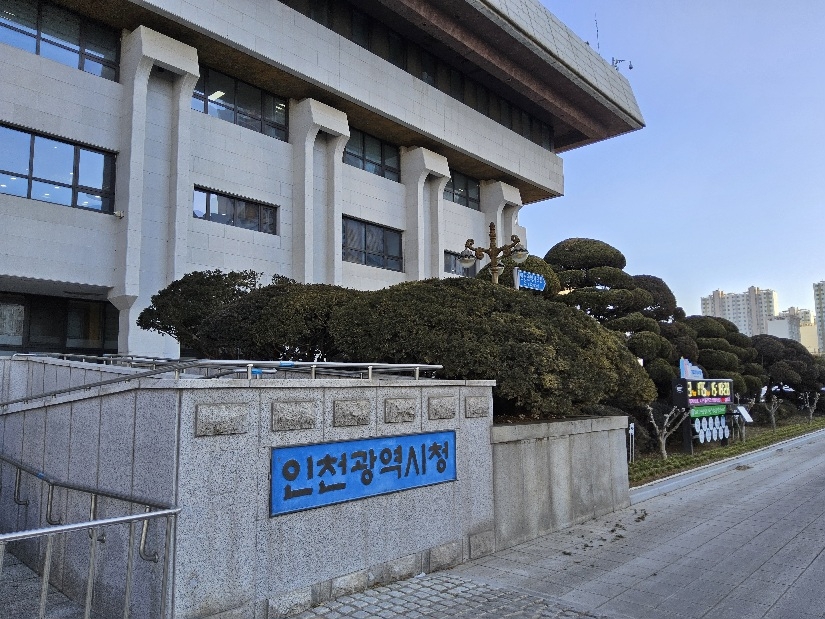
The selection of Incheon's primary and secondary city treasury banks — institutions that will manage an annual budget of 17 trillion won ($12.5 billion) over four years from 2027 to 2030 — will be decided Monday.
Attention has focused particularly on the two-way race between Shinhan Bank and Hana Bank for the primary treasury designation.
As the treasury selection committee prepares to choose the primary bank — which will handle a cumulative 60 trillion won over four years — the most critical factor it should scrutinize is the IT network underpinning local tax payments and revenue processing that directly affects Incheon residents.
The central question is how thoroughly the treasury designation review committee can verify which bank is capable of operating that system more stably and conveniently.
With presentations by both banks scheduled for Monday, concerns are growing that if the committee completes its deliberations and announces a result the same day, controversy will be difficult to avoid.
The reason is straightforward. The evaluation allocates 24 points each to "citizen convenience" and "treasury management capability" — a combined 48 points, nearly half of the total 100 — and there are doubts about whether criteria of that weight can be properly verified and scored within a single day.
The primary duties of the Incheon city treasury include collecting local taxes, non-tax revenue, and water and sewage fees, as well as processing expenditure payments.
Ultimately, the IT network is not merely an internal banking system. It is the core infrastructure of an administrative service through which 3 million Incheon residents pay their taxes and the city confirms and accounts for its revenue.
Questions have been raised about how deeply such a critical IT system and treasury management capability can be assessed through a single day of presentations.
Shinhan Bank has managed Incheon's primary city treasury since 2007 — a span of nearly 20 years. Making its sixth consecutive bid, the bank is highlighting its long operational track record and the stability of its IT systems as key strengths.
Yet two decades of tenure should not automatically translate into an evaluative advantage. There is growing public sentiment that Shinhan should instead be required to present an objective account of system outages and recovery history, security responses, IT upgrades, data management practices, and its record of adapting to regulatory changes over that period — and be assessed accordingly.
Hana Bank, meanwhile, is mounting a bid to reclaim the primary treasury designation by emphasizing its contribution to the local economy and community ties, pointing to the planned relocation of Hana Financial Group's headquarters to Incheon's Cheongna International City district later this month.
For Hana Bank, a challenger for the city treasury, a key question is whether it can demonstrate the financial IT capability and operational stability needed to run Incheon's local tax and revenue network reliably.
Should Hana Bank win the primary treasury for the first time, the critical areas for verification would include how it plans to integrate with and transition from the existing system, whether it can operate independently on its own IT network, and what redundancy and backup arrangements it would put in place to ensure uninterrupted tax payment services for residents during the switchover.
Hana Bank currently uses Shinhan Bank's IT system for treasury operations in some Incheon district offices, paying annual fees of hundreds of millions of won for that access.
However, this does not necessarily indicate a deficiency in Hana Bank's own IT capabilities. What the treasury designation committee must obtain is a clear, objective answer to whether the bank can stably operate local tax and revenue processing on its own systems if it takes over the primary treasury.
Incheon city's official announcement also stipulates that the IT systems and operating programs required for treasury operations must be fully functional from Jan. 1, 2027, and that failure to meet this deadline could result in liability for damages, including penalty charges.
This underscores that the IT system is not a peripheral condition but the core infrastructure on which the normal conduct of treasury operations depends.
The deeper concern lies with the review process itself. The city's official announcement requires the committee to conduct objective and fair deliberations by cross-referencing submissions against public disclosures from relevant agencies.
It also calls for presentations and question-and-answer sessions with each financial institution on measures to improve the convenience of local tax and revenue payments, as well as on treasury management capabilities, in order to enable thorough and substantive review.
That means Monday's presentations by the two banks should be a genuine exercise in verification, not a mere formality.
But if deliberations, evaluation, and the announcement of results all follow on the same day as the presentations, the picture changes considerably.
The concern is whether listening to each institution's pitch and scoring it within a matter of hours is sufficient for the 48-point block of core evaluation criteria that accounts for nearly half of the total score.
If committee members are expected to cross-check submitted materials against public disclosures from the Financial Supervisory Service and other relevant agencies — and to conduct additional fact-finding where necessary — it is worth asking whether there is physically enough time to do so.
This concern is even more acute for IT systems. The ability to respond to system failures cannot be assessed from a handful of presentation slides.
Processing capacity under peak local tax payment loads, server recovery times after outages, backup systems, cybersecurity responses, data integration, and the stability of the system transition process all require verification through detailed documentation and operational track records.
Local financial industry observers said that whether Shinhan Bank leads with 20 years of operational experience or Hana Bank leads with its headquarters relocation and local economic contributions, the final decision must rest on objective evaluation. "Shinhan needs to have its two-decade track record scrutinized, and Hana needs to have its proposed new treasury operating framework scrutinized," they said.
The committee faces a critical juncture: it must determine which bank can actually handle Incheon residents' tax payments more safely. Monday may well become the day the committee's own capacity for rigorous verification is put to the test, as it attempts to assess 48 points' worth of core IT and management capability in a single day.
Meanwhile, the Incheon Peace and Welfare Solidarity released a statement Sunday calling for the city treasury selection to prioritize citizens' interests through a fair review process. The group called for the committee to focus on what Incheon residents stand to gain from the selection and to ensure the committee itself is composed in a fair and balanced manner.
gilbert@heraldcorp.com