Learning to 'design the board' from Donald Trump's negotiating style
Extreme anchoring and unpredictability as tools of leverage
'Winning negotiations? Build a structure that favors you from the start'
![US President Donald Trump speaks on administration policy in the Oval Office last month. [Reuters]](https://wimg.heraldcorp.com/news/cms/2026/09/17/rcv.YNA.20260901.PRU20260901094001009_P1.jpg)
Moral and political assessments of US President Donald Trump diverge starkly. Provocative, blunt and unafraid to threaten, he is an unpredictable dealmaker — at once the world's most controversial figure and the key player shaping the course of nearly every major international negotiation and issue today.
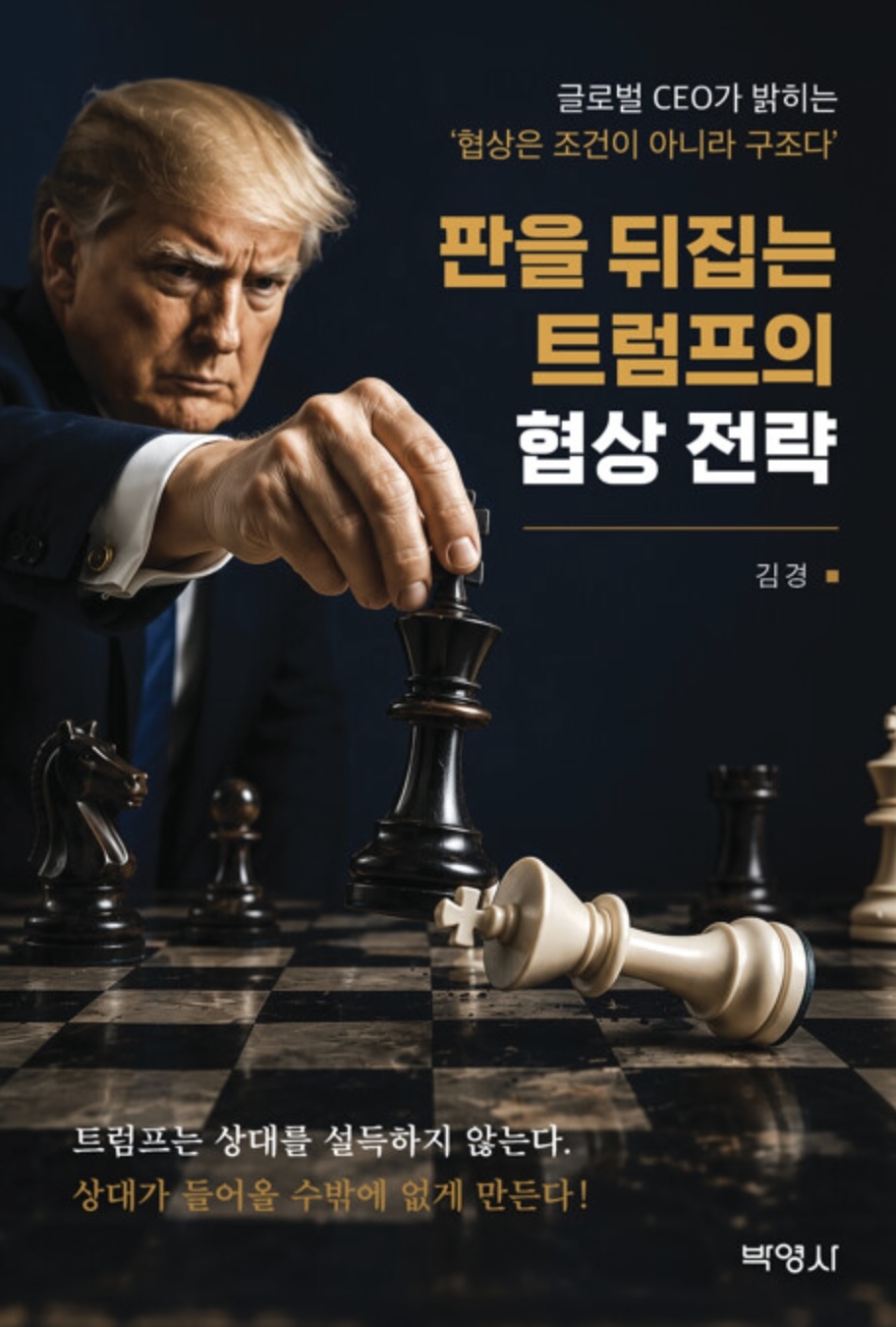
Business negotiation expert Kim Kyung's book "Trump's Negotiation Strategy That Flips the Board" opens with a single question: why does the world tremble at Trump's every word? The author dissects Trump's negotiating tactics and presents his "art of winning" as a practical guide for today's business world.
For Trump, the negotiating table is a battlefield where every deal is won or lost. Win-win outcomes — built on mutual respect, logical persuasion and relationship maintenance — hold no interest for him. Once Trump sits down, his only concerns are domination and victory. "In the ruthless world of business, this 'nice negotiating' approach often ends in an agreement where only you come out the loser," the author writes.
Trump does not simply try to extract better terms. He rewrites the rules of the game entirely. By deploying extreme anchor points to unsettle his counterpart and preemptively narrowing the range of available options, Trump effectively decides 80 percent of the outcome before he ever takes his seat at the table.
A prime example of his extreme anchoring tactic is the Special Measures Agreement negotiations over South Korea's share of USFK defense costs. In the first round of talks in 2020, the Trump administration put $5 billion on the table — roughly five times the existing contribution. The South Korean negotiating team had anticipated an increase of 10 to 20 percent, so the figure was so far beyond any acceptable range that it shifted the entire baseline of the negotiation.
Trump uses his counterpart's vulnerabilities as leverage, keeps them in a state of constant anxiety through unpredictable moves, and enters every negotiation ready to walk away at any moment. The author stresses that the most powerful force in any negotiation is not a stronger argument, but "the courage to leave the table without a second thought."
When Trump took office, for instance, he signed an executive order withdrawing from the Trans-Pacific Partnership, signaling to the world that the United States was not an automatic participant in multilateral cooperation. "Trump weaponized uncertainty — the message being, 'We'll be fine without you, but you'll struggle without access to the American market,'" the author writes. "That posture allowed the United States to hold an overwhelming advantage in subsequent negotiations, including the revision of the Korea-US Free Trade Agreement and US-Japan trade talks."
The author repeatedly emphasizes that negotiation is not a single conversation but a continuous process of preparation, execution and follow-through. Just as Trump's seemingly impulsive and chaotic behavior follows a discernible pattern on closer inspection, the key to successful negotiation lies in building a favorable structure across the entire arc — from pre-negotiation preparation to in-the-room responses to post-negotiation consolidation.
"Negotiation is about reading the flow, not just the dialogue — about structure, not just terms, and about the whole board, not just the moment's gain," the author said.
"Trump's Negotiation Strategy That Flips the Board" by Kim Kyung, published by Parkyoungsa
balme@heraldcorp.com