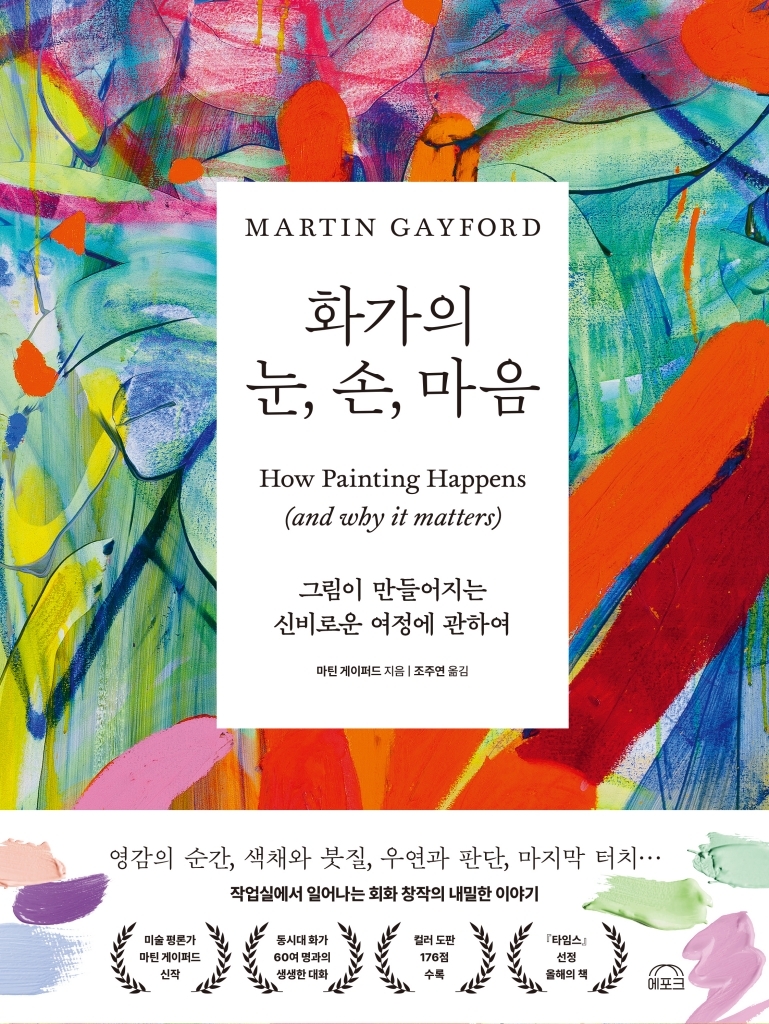
"The Eyes, Hands and Heart of a Painter" by Martin Gayford, translated by Jo Ju-yeon (Epoch) — Painting is the longest-running art form in human history, stretching from prehistoric cave walls to contemporary galleries. People love pictures, yet reading the thought behind them is rarely easy. What goes through a master's mind before a blank canvas? How do artists choose their subjects and materials, and how do they decide where to place the brush? Art critic Martin Gayford draws on more than 30 years of conversations with painters — among them Gerhard Richter, Frank Auerbach, David Hockney, Paula Rego, Jenny Saville, Frank Stella, Lee Ufan and Zeng Fanzhi — to let the artists speak for themselves. Hockney was fond of quoting a Chinese proverb: "To paint well, you need your hands, your eyes and your heart." The idea is that great painting demands a hand skilled enough to command the right materials and tools, a mind attuned to the mood and spirit of the work, and the constant judgment of the eye. The book guides readers through artists' lives and stories, and through art history, so that they can experience paintings in fuller dimension.
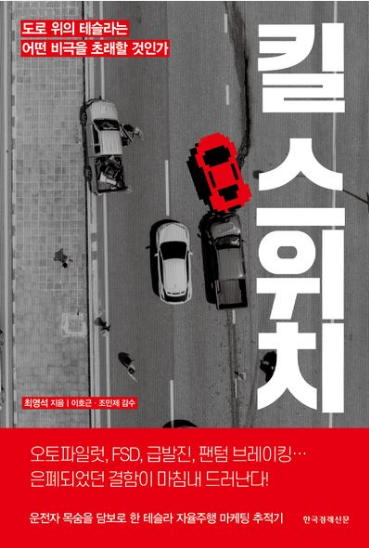
"Kill Switch" by Choi Young-seok (Hankyung BP) — "The car in the advertisement is not the car on the road." Starting from that premise, the author — a product liability officer at a consumer advocacy organization — digs into the reality behind Tesla's autonomous driving technology, including Autopilot and Full Self-Driving. His conclusion: the flashy marketing language and the low accident rates cited in statistics do not tell the whole story. Choi examines a series of cases one by one — the 2018 death of Walter Huang in California, a 2020 Model X fire in Hannam-dong, Seoul, and the 2025 Florida Benavides verdict that assigned Tesla 33 percent of the liability — and argues that autonomous driving technology has been rolling on public roads without adequate verification, all under the banner of innovation. He pays particular attention to South Korea, where many retail investors hold Tesla shares alongside drivers who use its vehicles. He argues that whenever Tesla's safety record makes headlines, confirmation bias, sunk-cost effects and loss-aversion psychology all kick in at once, leading people to deliberately refuse to acknowledge the company's flaws.
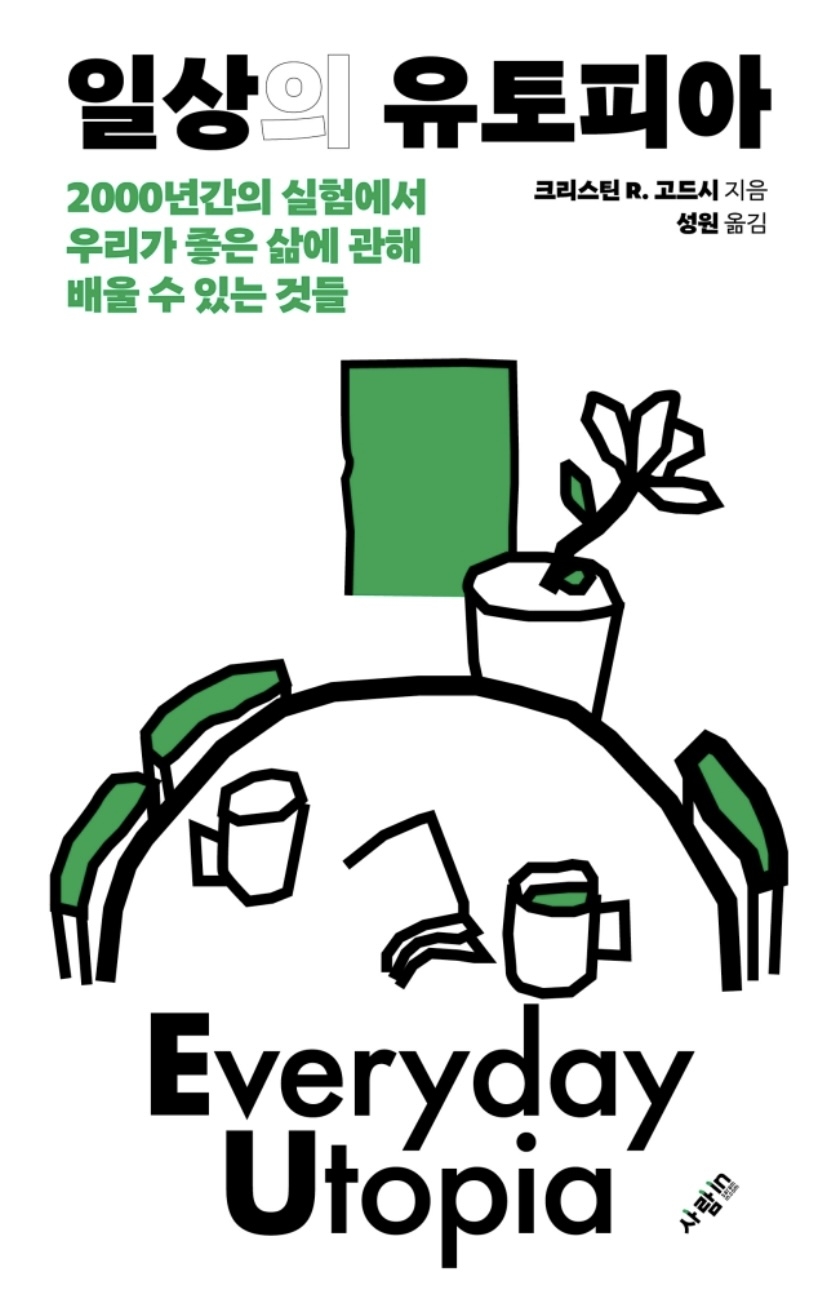
"Everyday Utopia" by Kristen R. Ghodsee, translated by Seong Won (Saram in) — "Utopia," a word for an ideal and perfect society, is commonly used as a synonym for the unrealistic. American ethnographer Kristen R. Ghodsee pushes back against that assumption, arguing that utopianism has been a consistently recurring current throughout more than 2,000 years of history. To make her case, she traces how utopian visions — appearing at every moment of upheaval and inspiring generations — have ultimately become reality. Universal childcare is her central example. Plato imagined "Kallipolis," a society of communal child-rearing in which parents and children would not know one another; in the 19th century, Engels called for state-guaranteed universal childcare. By the 21st century, the public childcare those thinkers envisioned had become ordinary life — ideas once dismissed as radical had, over time, taken root as policy and everyday practice. Ghodsee extends her gaze beyond Western intellectual history to utopian communities in Asia and Africa, and invites readers around the world to pursue their "social dreams" together. People still dream of different ways of organizing life, she writes, even at personal risk — proof that utopianism is not a relic of the past but an ongoing, present-tense experiment.
pink@heraldcorp.com