Ninth solo show at Sun Gallery
43 works on view, from 1981 debut pieces to new works this year
Rounded masses swell outward, hollows plunge deep, and curves coil inward before unfurling again. Shapes carved into hard stone pulse with the tension and rhythm of living things.
A solo exhibition titled "Organic Space" surveying sculptor Lee Jong-ae's half-century of work runs through Dec. 19 at Sun Gallery in Jongno-gu, Seoul. The show brings together 43 sculptures and installations spanning from early pieces made in 1981 to new works completed this year.
"Organic Space" is both the title Lee has given every work over more than 50 years and the defining language of her sculptural practice. Starting from a fascination with living organisms — fish, birds, insects and plants — she has long rendered the generation and growth of life, and the relationships between beings, in abstract form.
Her materials and methods have shifted with the decades. In the early 1980s she worked in bronze to capture the fluid movement of living creatures. Later in that decade she turned to wooden panels fitted with plastic laminate, assembling them in interlocking configurations that probed the boundary between flat surface and three-dimensional form. From the 1990s onward she moved to stone — marble, granite and other varieties — using it to express the union and equilibrium of contrasting forms.
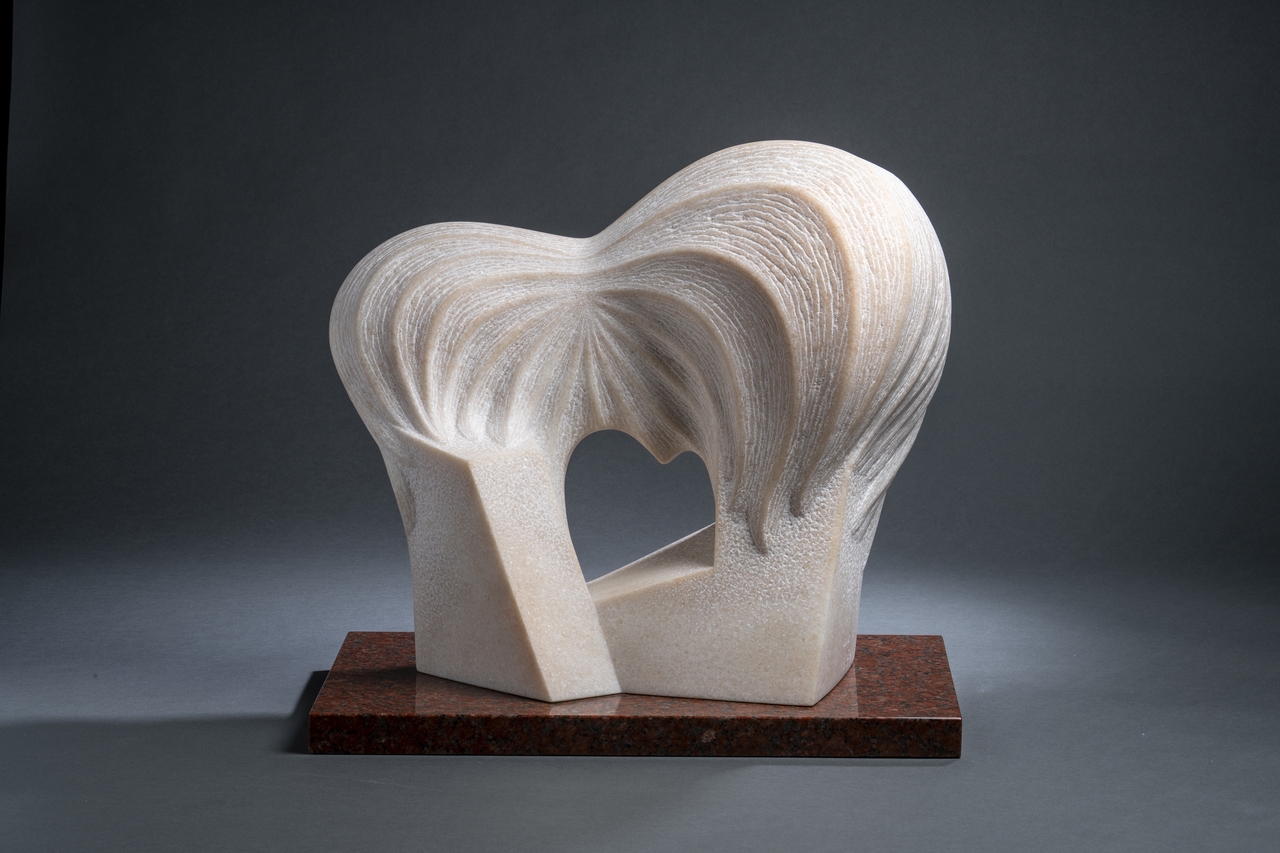
"Equilibrium" (1990) places two stones of different shapes and weights atop a support resting on two legs. Held in balance within a single structure, the stones convey a sense of justice and equity.
"Harbor of Hope" (2004), composed of three independent sculptures, uses organic curves and open space to evoke rest and possibility. Because the angle and position of each piece are adjusted with every installation, the work never settles into one fixed form — it takes shape anew each time through the space the three elements create together.
Love runs as a second thread through Lee's body of work. Her inquiry into life extends outward into faith and the nature of love.
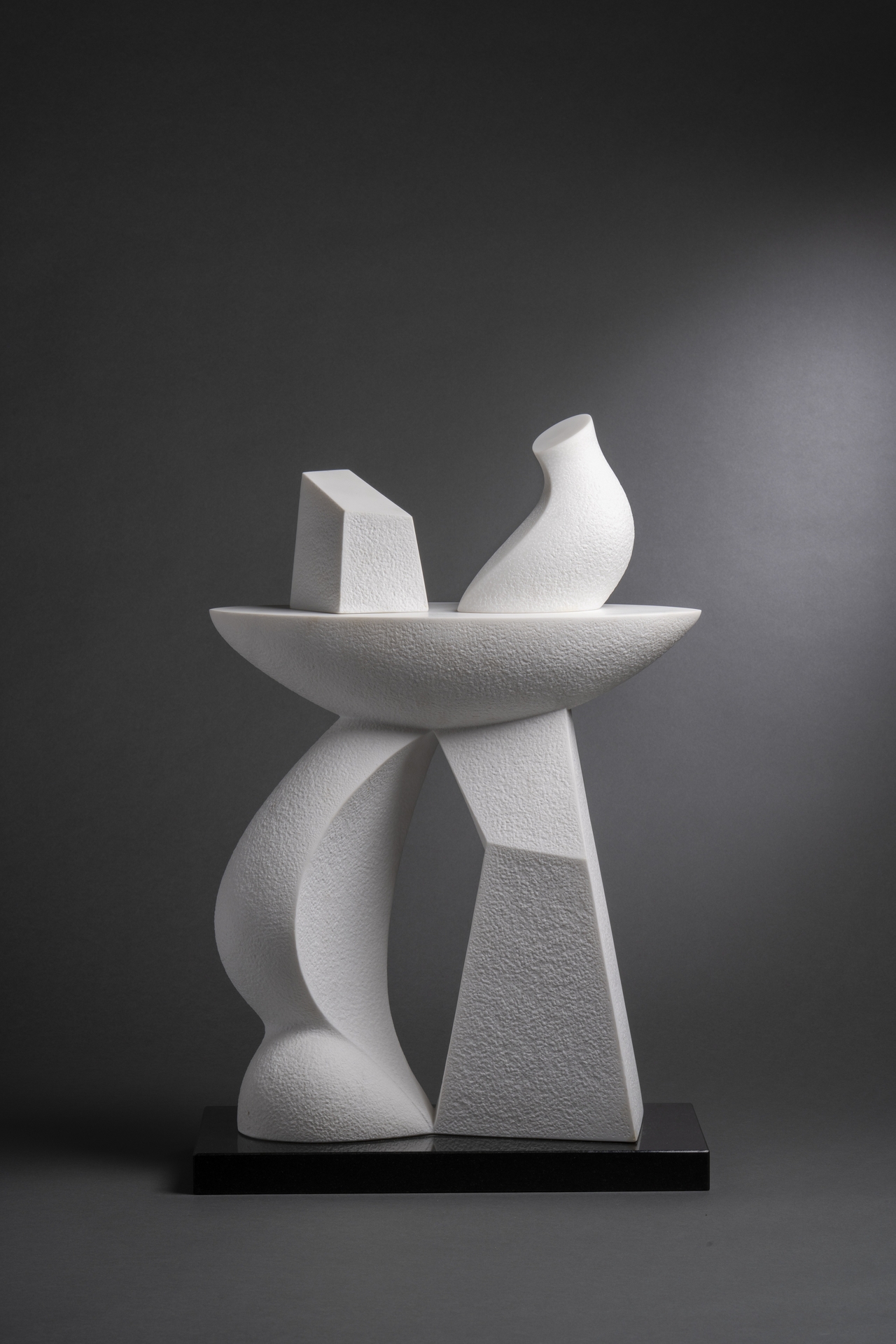
"Overflowing I" (2012) reveals a self-giving love through a heart-shaped void at the center of the piece. Lines radiating from that heart form spread downward, transforming love into a sense of ceaseless, outward motion.
"As I observed and collected biological organisms, my fascination with the mysterious phenomenon of life naturally shifted toward the Creator," Lee said. "From that point, my work moved beyond structural abstraction and became a vessel for spiritual reality."
The exhibition also features the "Together Arirang" series, inspired by Korean traditional dance. Lee studied traditional dance for years in preparation for the works. The figures dancing together within a circular space are rendered as one connected whole.
Two new works completed this year, "Jachin" and "Boaz," make their public debut. The titles come from the bronze pillars that stood before Solomon's Temple in the Bible. Each symbolizes a different aspect of divine establishment and power, offering a window into the inner world Lee has built through a lifetime of faith.
Lee graduated from Hongik University's sculpture department in 1977 and studied at the University of California, Los Angeles in 1984. This is her ninth solo exhibition since her debut show at Gonggan Art Museum in 1982. She has served as president of the Korean Women Sculptors Association and has works in the permanent collections of the National Museum of Modern and Contemporary Art and the Seoul Museum of Art.
pink@heraldcorp.com