Complainant says Park delayed arrest warrant request by investigation team
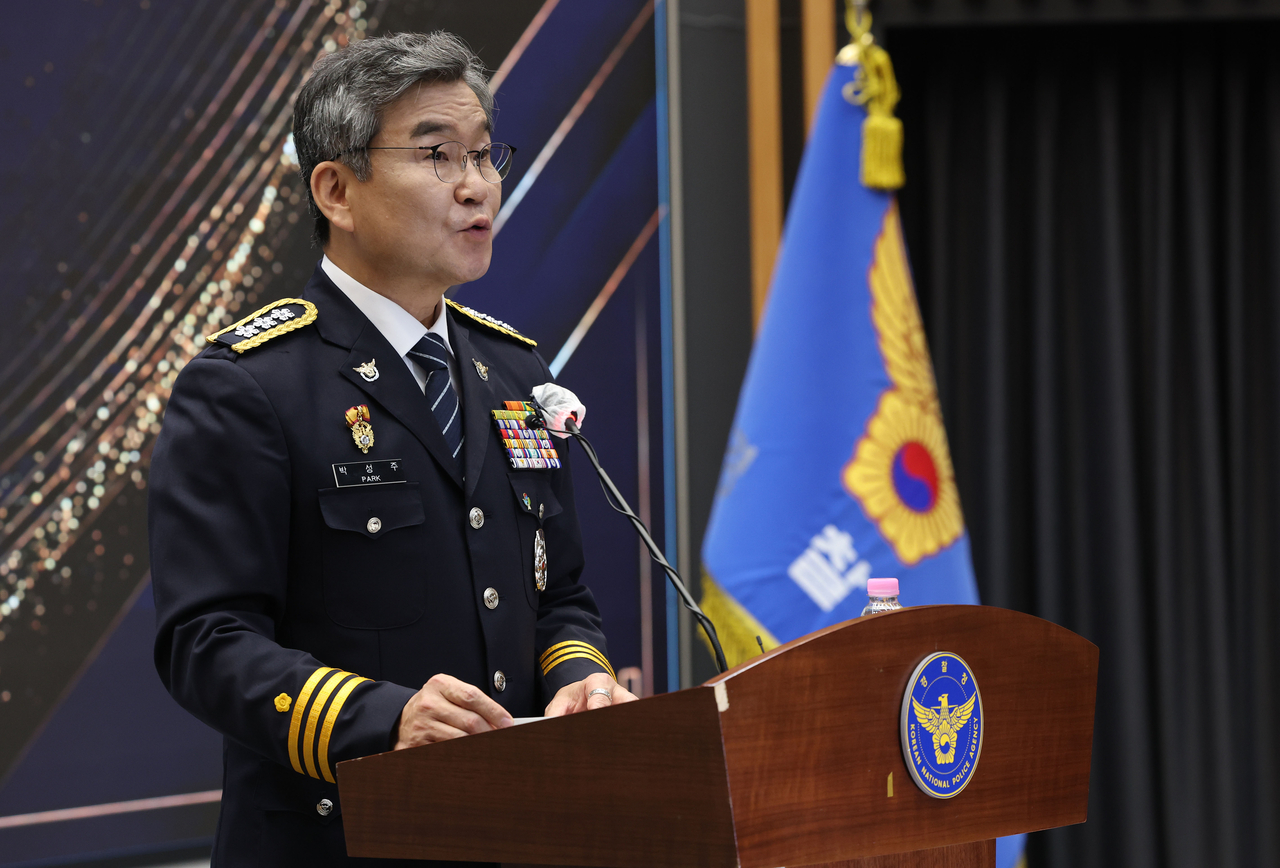
Park Sung-joo, the former chief of the Korean National Police Agency's National Investigation Headquarters, is expected to face a prosecutors' investigation over allegations that he deliberately delayed a police probe into independent lawmaker Kim Byung-kee, the former floor leader of the Democratic Party of Korea.
A former aide to Kim, identified only by the surname Kim, filed a complaint Thursday afternoon with the Seoul Central District Prosecutors' Office accusing Park of abuse of authority and dereliction of duty. The aide alleged that Park used his influence to delay the Seoul Metropolitan Police Agency's public crime investigation unit from seeking an arrest warrant against the lawmaker.
The Seoul Metropolitan Police Agency sought an arrest warrant for Kim on Sept. 7 — more than a year after launching its investigation — but prosecutors rejected the application. Critics have argued that the delay in seeking the warrant caused police to miss the optimal window to secure custody of the lawmaker.
In the complaint, the former aide alleged that Park "systematically obstructed and delayed the legitimate exercise of investigative authority by the Seoul Metropolitan Police Agency's investigation team, which had completed prior consultations with prosecutors and confirmed a plan to promptly seek an arrest warrant, by exploiting his position as the top investigative commander of the National Investigation Headquarters."
The Seoul Metropolitan Police Agency completed preliminary consultations with the Seoul Central District Prosecutors' Office on seeking an arrest warrant in April, when Kim was last summoned for questioning. The former aide wrote in the complaint that police and prosecutors had at that point reached a shared understanding that securing custody was necessary, given the gravity of the case and concerns about destruction of evidence. "However, due to Park's intervention, the Seoul Metropolitan Police Agency's investigation team was unable to seek an arrest warrant in a timely manner, and prosecutors cited that delay as grounds for rejecting the application — resulting in the failure to secure custody of the lawmaker," the complaint stated.
Park also faces allegations that he publicly intervened to halt the Seoul Metropolitan Police Agency's plan to release investigation findings on Kim's charges one by one as each was completed, thereby slowing the overall handling of the case.
Park Jung-bo, who was then Seoul Metropolitan Police Agency chief, said at a press briefing in April that police would "first reach conclusions on charges where the investigation has been completed." The intent was to accelerate case proceedings by resolving finished inquiries among the 13 allegations against Kim before wrapping up the rest. Park, however, publicly broke with that position, telling reporters that "conclusions can only be drawn once the investigation into all allegations is complete."
Park oversaw the investigation into Kim until his mandatory retirement on June 30. On June 8, ahead of his retirement, he told reporters that he had directed investigators to conduct additional work on areas the National Investigation Headquarters deemed in need of supplementation in connection with the Seoul Metropolitan Police Agency's preliminary findings.
The former aide drew a parallel to the case of Jang Yun-gi, writing in the complaint that the Gwangju District Prosecutors' Office had indicted a senior official in that case on the logic that "the authority to direct an investigation must be exercised solely for the legitimate purpose of uncovering the truth, and must not be used to conceal organizational wrongdoing or avoid external criticism." The former aide argued that in Kim's case as well, Park had delayed investigative procedures not out of concern for legal propriety or truth-finding, but for external political reasons.
Earlier, Park had already been indicted in connection with the Jang Yun-gi case — in which police were accused of conducting a shoddy investigation into the murder of a high school girl — on charges of improper investigative direction. The Gwangju District Prosecutors' Office indicted Park on Sept. 2 on charges of abuse of authority, concluding that he had directed investigators to handle Jang's alleged intent to commit sexual assault separately from the murder charge, thereby influencing the investigation team's ability to fully establish the facts of the case.
arin@heraldcorp.com