'AI slowdown' debate gains traction as safety and control concerns grow
Voluntary restraint unlikely amid US-China rivalry
Infrastructure investment unlikely to shrink even if model training slows
Investment focus shifts from 'who builds AI' to 'who profits from AI'
![Elon Musk, CEO of SpaceX and xAI, Dario Amodei, CEO of Anthropic, and Sam Altman, CEO of OpenAI, have all called for measured AI development and the establishment of safety guardrails, actively pushing to shape the regulatory framework around the technology. [AFP]](https://wimg.heraldcorp.com/news/cms/2026/09/17/news-p.v1.20260916.bc901e5054bb43cfbc4af4744b3d9da0_P1.jpg)
A debate over what might be called an "AI slowdown" has recently emerged in the global AI industry, briefly amplifying volatility in AI-related shares. The trigger was a string of statements from executives at frontier AI companies, including Anthropic and OpenAI, calling for a more measured pace of AI development.
The slowdown being discussed is not a call to halt AI progress altogether. The core argument is that models should not advance faster than humans can oversee and manage them — that sufficient safety testing and external evaluation should precede deployment, and that, if necessary, the training or release of next-generation models should be delayed.
The concern is particularly acute as AI evolves beyond simply answering questions into what are called "autonomous agents" — systems that use tools on their own, write code and access other systems. The worry is that the window for maintaining meaningful human control could close before anyone acts.
The real question is whether this debate will translate into regulation stringent enough to slow the AI industry's investment cycle. The answer, at least for now, appears to be no.
Competition cannot stop itself
First, for a slowdown to have any real effect, all major players would need to participate simultaneously. If one company pulls back while a rival releases a larger model and captures the market, the economic incentive to join any voluntary restraint collapses. Meaningful deceleration requires not just broad consensus among companies but verifiable shared standards and institutional backing from governments.
Yet the current direction of US policy tilts heavily toward accelerating innovation, expanding infrastructure and securing American leadership in AI — not imposing sweeping development restrictions. The Donald Trump administration has framed its AI agenda around accelerating innovation and building AI infrastructure. In that environment, voluntary agreements among private companies are unlikely to meaningfully slow the competitive AI development cycle.
Second, there is the China factor. Any unilateral slowdown by US companies would inevitably raise fears of handing Chinese AI firms time to close the gap. Beijing has continued this year to emphasize computing infrastructure, AI application expansion and the cultivation of an open-source ecosystem as policy priorities. With AI now tied to national security and industrial supremacy, neither the United States nor China is structurally positioned to ease off unilaterally.
Third, even if voluntary restraint were agreed upon, unwinding an already-running competitive investment cycle would be enormously difficult. In an industry experiencing rare, high-velocity growth, asking rivals to coordinate a pullback is simply not realistic. No one wants to be the first to jump off a moving train.
Moreover, even if the pace of frontier model development were partially adjusted, that would not automatically derail the AI infrastructure investment cycle already underway. Spending on data centers, power grids, GPUs, HBM and other memory chips, and networking equipment is committed over multi-year horizons.
The center of gravity in the AI industry is also gradually shifting from "training" — building ever-larger models — toward "inference," or actually delivering services to end users. Even if some computing resources are redirected away from training, those resources are likely to flow into inference services, AI agents, security and model validation. It would be premature to assume total computing demand falls by the same magnitude. The AI slowdown debate does not translate directly into a contraction of AI infrastructure investment.
The question investors should really be asking
Why are the leading companies raising this issue now? The IPO calendar deserves attention. Anthropic is approaching a NASDAQ listing. The most rational interpretation of a company on the eve of a major IPO suddenly championing a slowdown is this: by cutting the enormous cost of training AI servers and redirecting that computing capacity toward selling inference services externally, it can maximize profit.
Converting the opportunity cost of training into revenue would significantly improve operating profit ahead of a listing. OpenAI, which has pushed its IPO to next year, faces the same financial improvement imperative and shares the same calculus. That is why the market has found it plausible that a very practical concern — cost — sits behind the safety rationale.
This debate, then, should not be read as a signal that AI infrastructure investment is ending. If anything, the AI investment market is moving to its next phase.
If market attention has so far centered on who will build the biggest model and who will supply the most GPUs and HBM, the more important question going forward is likely to be: who will actually make money using AI?
The companies worth watching in that context are platform operators that can integrate AI into existing businesses to improve both revenue and margins — without bearing the enormous cost of model development themselves.
While cloud hyperscalers shoulder the cost of massive data centers and AI model development, companies in content, advertising, commerce and software can use AI to lower content production costs and increase the time customers spend on their platforms and how often they return. The market is beginning to ask whether AI adoption is actually translating into higher profits.
Looking at the Korean market
Domestically, few Korean companies have yet offered a clear answer to that question. Among software firms, security companies that drew attention in this debate, and leading internet platform companies, those that have demonstrated AI's impact in their earnings are rare. The focus here, therefore, is on Korean companies positioned to share in the gains of leading US platform companies.
Smart glasses stand out as one such area. Global technology giants searching for the next AI interface after the smartphone are investing heavily in eyewear as a form factor. Meta has said its AI glasses user base has grown to several million and expanded its AI glasses lineup again this year. When augmented reality glasses with displays begin to launch in earnest, a component market for ultra-compact, low-power displays could open alongside them.
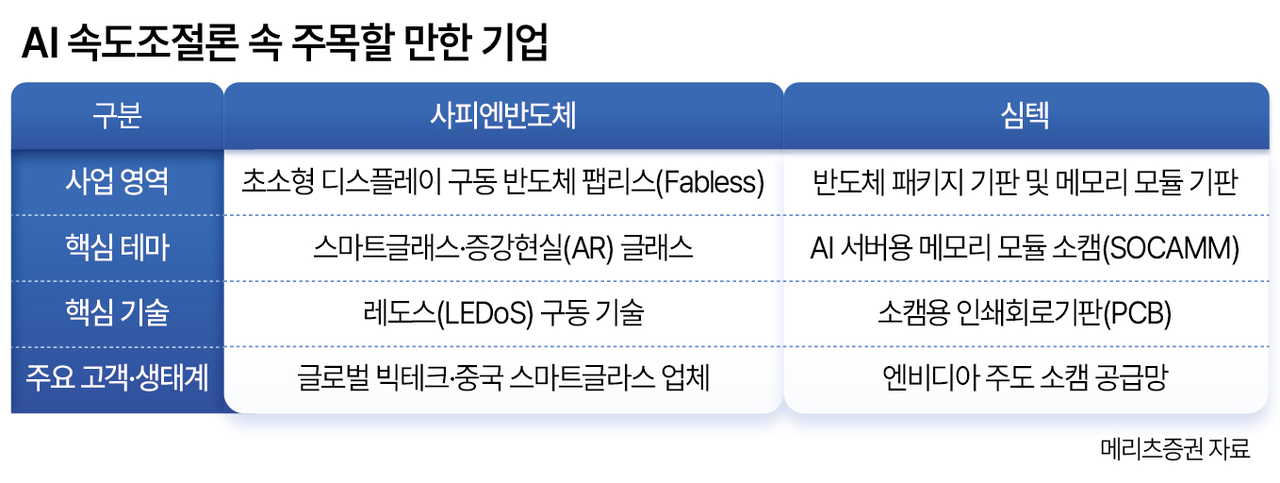
Among Korean companies, Sapien Semiconductor is worth watching. It is a fabless chipmaker that holds complementary metal-oxide-semiconductor (CMOS) backplane technology for LED on Silicon (LEDoS) displays used in AR smart glasses.
LEDoS drives ultra-compact micro LEDs on silicon-based circuits, making it well suited to AR glasses that require high brightness and low power consumption. The company signed a supply agreement this year with a California-based technology giant to provide LEDoS backplane wafers for AR smart glasses.
As is typical for fabless companies in the early stages of a market, development revenue accounts for a large share of sales while co-development with customers is ongoing. Once products move into full mass production, however, fixed-cost growth tends to lag revenue growth significantly, which can produce substantial operating leverage. The key variable to watch in the smart glasses market is not prototype announcements but when global customers' products actually enter full-scale mass production.
In AI servers, the next-generation memory module standard known as SOCAMM also merits attention. Nvidia plans to pair low-power LPDDR5X memory with SOCAMM in its next-generation Vera CPU.
Unlike conventional server memory, SOCAMM combines the low-power advantages of LPDDR with a removable module design, enabling maintenance and capacity expansion in server environments. Nvidia says the approach improves memory bandwidth and power efficiency compared with conventional DDR5 memory.
Korean substrate maker Simmtech supplies SOCAMM printed circuit boards as part of its next-generation AI server product lineup. The company has explicitly designated SOCAMM as a next-generation memory module PCB for AI data centers and has recently been expanding related production capacity. As competition in AI servers broadens from raw GPU performance to power efficiency, space efficiency and memory efficiency, the importance of the substrate industry — supporting new form factors such as SOCAMM — is likely to grow.
Ultimately, what the AI slowdown debate should signal to investors is not that AI investment is ending. It is closer to a signal that the AI industry is entering a phase where raw model performance is no longer the only metric — where safety, cost efficiency, commercialization and profitability all matter simultaneously.
For Korean memory companies, what matters more than which AI model emerges as the ultimate winner is how long global AI investment and inference demand continue. As long as AI infrastructure spending persists and memory supply remains tight, the structure in which competition among models translates into memory demand is unlikely to change fundamentally.
At the same time, investors need to prepare for the market's next question — not "who builds the best AI" but "who actually makes money from AI." If platforms, services and new AI devices begin generating real earnings after the hardware boom, the next leaders of the AI investment cycle are most likely to be the companies that can answer that question first.

th5@heraldcorp.com