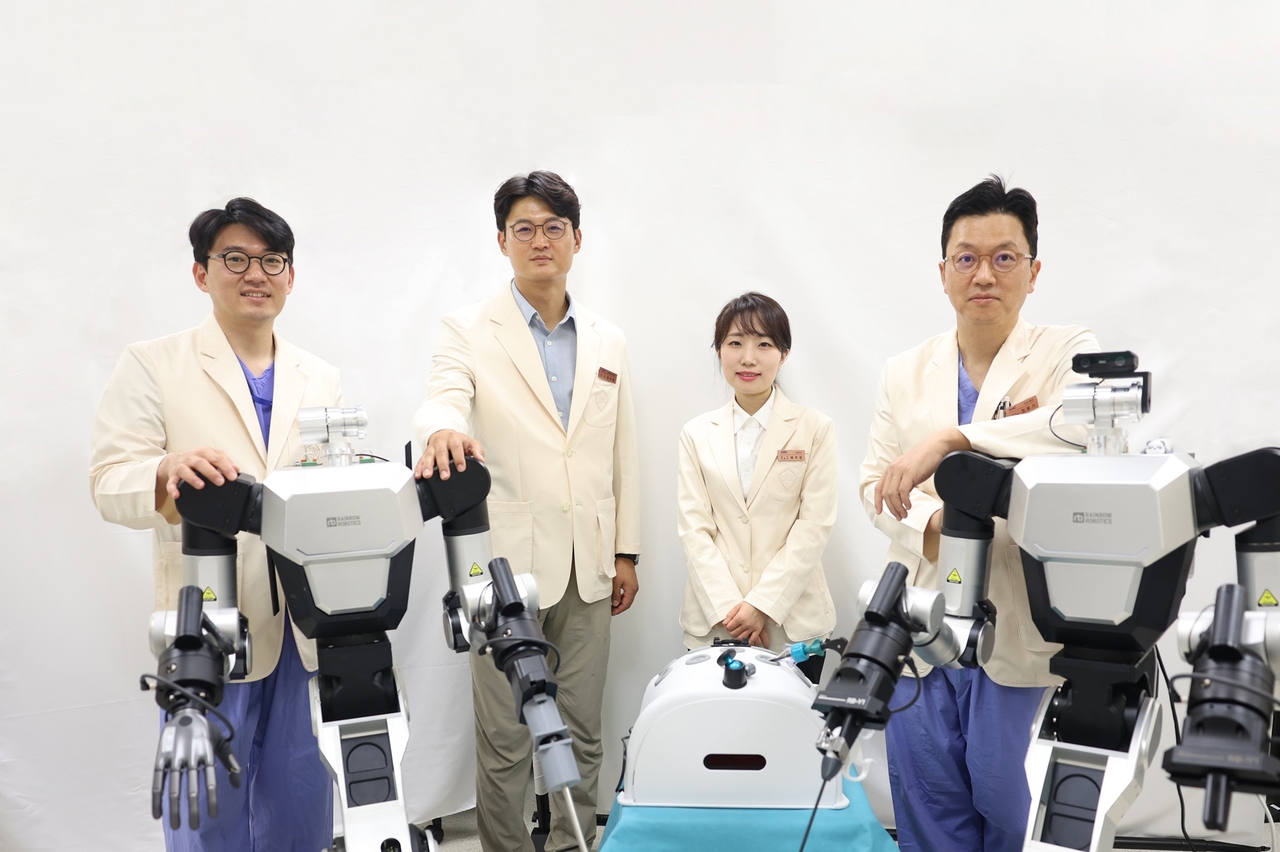
Samsung Medical Center publicly demonstrated its humanoid surgical assistant robot Wednesday at the ninth floor of Samsung Life Insurance's Ilwon Station Building B.
Samsung Medical Center was selected in 2025 as the lead institution for a major national research initiative — South Korea's version of the US ARPA-H program — and has since been developing a "humanoid Physical AI-based surgical assistant robot for efficient operating room environments." The hospital is carrying out the project through a consortium called ORchestra, which includes Rainbow Robotics, Aidin Robotics, Hahaeho, the Samsung Advanced Institute for Health Sciences and Technology, Seoul National University, the National Cancer Center and Jeonbuk National University Hospital.
The team is currently in the verification stage, testing the robot's ability to pass and retrieve surgical instruments, manipulate endoscopes, retract tissue, understand voice commands, and safely stop and recover in a simulated operating room environment. The path to commercialization will involve repeated performance testing, simulated and preclinical trials, usability evaluations by medical staff, GMP quality system compliance, clinical trials and medical device regulatory approval.
The humanoid surgical assistant robot — developed over roughly the past year and publicly unveiled for the first time — demonstrated step by step how it can share responsibilities with medical staff, from handling repetitive support tasks in the operating room to performing precise movements in minimally invasive surgery.
"We were able to see intuitively how successfully a humanoid surgical assistant robot — one that follows the commands and controls of medical staff who hold full authority to judge and intervene throughout the procedure — can assist humans in the operating room," said Prof. Jung Yong-ki of Samsung Medical Center's otolaryngology department.
In the first demonstration, the robot was shown directly grasping surgical instruments and performing a series of precise procedures: incision, dissection and suturing of biological tissue. Jung said the robot is not yet at the stage where it independently assesses a patient's condition and operates autonomously. "Rather, it is a system in which skilled medical staff control the robot's two arms and surgical instruments in real time through a control device," he explained.
The robot mirrors the movements of the operating surgeon as the surgeon watches a monitor — similar to the motion-mimicking robot depicted in "Real Steel," the science fiction film starring actor Hugh Jackman. "The humanoid surgical assistant robot converts the movements of a human's hands and arms into the robot's coordinate system and reproduces them inside the operating room," Jung said.
In the second demonstration, the robot took on the role of a surgical scrub nurse — handing over instruments on request — as well as that of an assisting physician, responding to instructions such as "insert the laparoscope a little deeper." The robot handled tasks previously performed by humans: circulating surgical instruments, maintaining the endoscopic field of view and retracting tissue to support the operating surgeon.
The demonstration showed the humanoid surgical assistant robot carrying out a continuous sequence of tasks mirroring an actual surgical procedure. Particularly notable was a scene — described as a world first — in which two robots collaborated with a human surgeon simultaneously. Robot No. 1 served as the scrub nurse: it understood the surgeon's verbal requests, identified the requested instrument, adjusted the handle orientation and delivery position so the surgeon could safely grasp it, and passed it over. Once the instrument was used, the robot retrieved it, returned it to its designated position, and updated the status of available instruments and pending requests.
"The key is not simply handing over a tool once and stopping, but completing the full instrument-circulation cycle — request, delivery, use, retrieval and organization — just as a human would during an actual operation," Jung said. Robot No. 2 simultaneously performed the roles of both assisting physician and nurse: its left hand held a laparoscopic endoscope and adjusted the field of view to keep the surgical site centered on the monitor, while its right hand was fitted with surgical forceps to retract biological tissue in the direction specified by the operating surgeon.
Research into introducing humanoid surgical assistant robots into operating rooms remains at an early proof-of-concept and demonstration stage worldwide, and South Korea has entered the competition at the outset to help pioneer the market.
Development of surgical humanoid robots is broadly heading in two directions: one focused on logistics and preparation tasks before and after surgery, and the other on participating directly in procedures and handling surgical instruments. Foxconn, the world's largest electronics CMO, drew attention at this year's Computex trade show in Taiwan when it introduced Nuarbot, a robot capable of moving through hospital wards to deliver medicine and supplies and also perform operating room nursing duties.
The commercial prospects for humanoid surgical assistant robots that replicate human-controlled surgical movements have also grown considerably. In July, researchers at the University of California San Diego published findings in Nature showing that a humanoid surgical assistant robot, guided by human teleoperation, successfully performed surgery on a porcine model using conventional laparoscopic instruments.
"This means the humanoid surgical assistant robot can use existing operating rooms designed for humans and existing surgical instruments as they are, without the need to build a separate operating room," Jung said. "After commercialization, it could be rapidly deployed in actual operating room settings without any additional environmental changes."
Samsung Medical Center said the focus of this demonstration was not on perfecting individual movements but on connecting the entire surgical workflow — enabling the robot to understand and act across the full arc of a procedure, the way a human team member would.
While surgical robots being developed elsewhere in the world are largely advancing toward performing specific tasks as well as, or better than, humans, Samsung Medical Center said its distinguishing approach is to build an operating room system in which multiple humanoid surgical assistant robots share surgical context and collaborate with humans as a single team.
"If humanoid surgical assistant robots can assist humans in environments that are difficult for people to operate in, or in areas involving repetitive and physically demanding labor, we can create a more favorable surgical environment for patients," Jung said. "We expect the robots to help run surgeries more stably with a limited medical workforce, and to fill staffing gaps in nighttime, emergency and essential medical settings where it is difficult to secure skilled surgical support personnel."
The humanoid surgical assistant robot development project at Samsung Medical Center is part of the "2025 Korean ARPA-H Project," supported by the Ministry of Health and Welfare and the Korea Health Industry Development Institute's K-Health Future Promotion Division. The government-funded research and development project runs 54 months, from July 2025 through December 2029, with total funding of 13.84 billion won ($10.1 million). It is a competitive initiative in which projects advance to a second phase following a first-phase competitive evaluation at the end of 2026.
kty@heraldcorp.com