Cost of ritual table for four reaches 303,750 won, up 4.1%
Hanwoo prices surge — grade 1+ sirloin up 15.6% from last year
Egg prices still elevated despite output recovery
Experts call for structural fixes to distribution chain
![Food prices rise ahead of every major holiday, with different items driving costs each year. This year, hanwoo beef and eggs have soared. Given the long lead times required to raise livestock, elevated prices are expected to persist for now. Shoppers browse a traditional market in Seoul. [Yonhap]](https://wimg.heraldcorp.com/news/cms/2026/09/18/rcv.YNA.20260914.PYH2026091412690001300_P1.jpg)
Food prices surge ahead of every major holiday in South Korea, and this year livestock products — particularly hanwoo beef and eggs — are leading the charge. Unlike vegetables and fruit, whose prices swing with heat waves and heavy rains, livestock products require long rearing and production cycles, making it difficult to quickly boost supply even when prices rise.
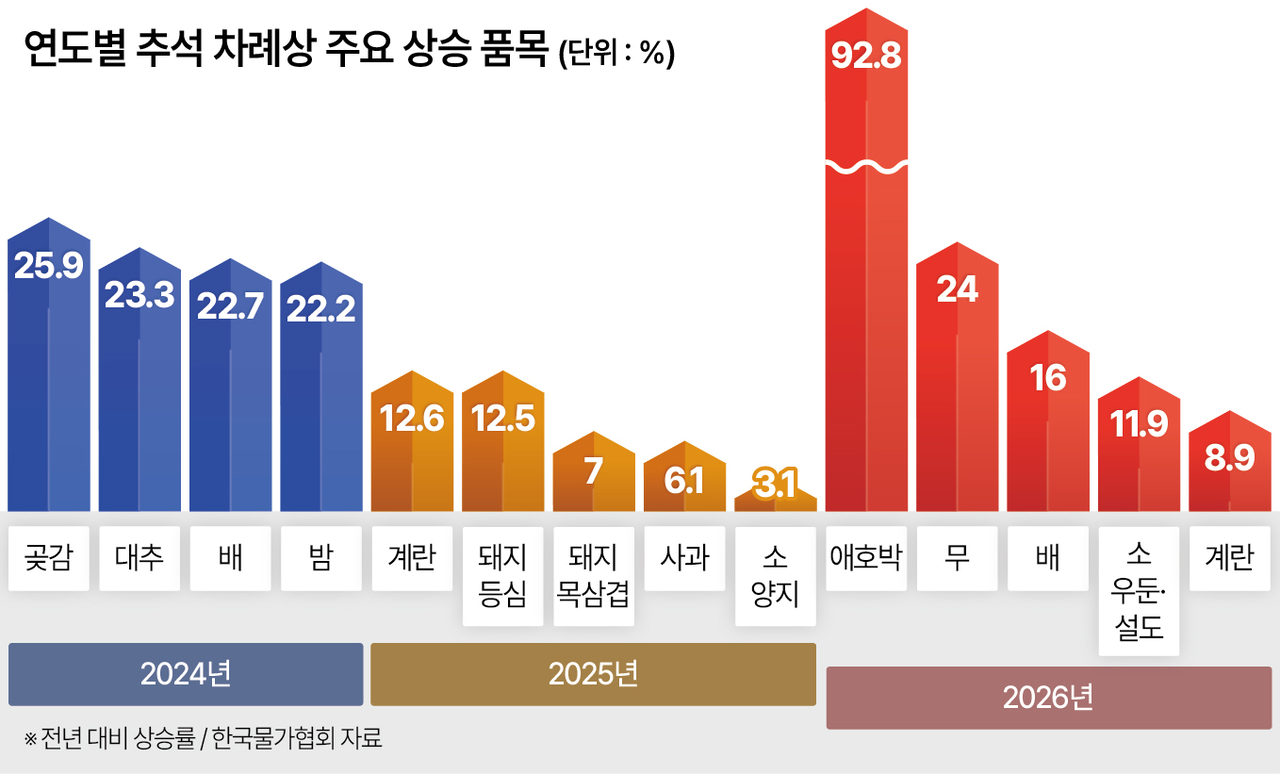
According to the Korea Price Association, the cost of a Chuseok ritual table spread for a family of four reached 303,750 won ($220) this year, up 4.1 percent from a year earlier. The figure is based on a survey of 28 items at traditional markets in Seoul, Busan, Incheon, Daegu, Gwangju and Daejeon conducted Saturday and Sunday. Beef cuts drove much of the increase — brisket rose 10.5 percent and round and rump cuts climbed 11.9 percent. Eggs were up 8.9 percent. Some vegetables and fruit also rose, including zucchini (92.8 percent), radish (24.0 percent) and pears (16.0 percent).
Chuseok table costs do not rise every year. Last year they fell 1.1 percent from the previous year, helped by stable vegetable and fruit prices, and in 2023 they dropped 1.4 percent. By contrast, from 2020 to 2022, poor harvests caused by monsoons and typhoons combined with the initial shock of the COVID-19 pandemic pushed costs up more than 7 percent for three consecutive years.
Different items lead each year — this year it's hanwoo
Holiday demand repeats every year, but prices vary depending on supply conditions for the items most in demand. Pears rose 16.0 percent this year, yet fell about 17 percent at last year's Chuseok. Last year it was apples — where the share of large-grade fruit had shrunk — that climbed 6.1 percent, while beef increases were more modest: brisket up 3.1 percent and round and rump cuts up just 0.1 percent. Pork took the spotlight instead, with sirloin rising 12.5 percent and neck and belly cuts up 7.0 percent on reduced supply and higher feed costs.
This year, hanwoo is the standout. According to the Korea Institute for Animal Products Quality Evaluation, the September average retail price of grade 1+ hanwoo sirloin stood at 13,330 won per 100 grams as of Thursday, up 15.6 percent from a year earlier and 13.8 percent above the long-term average. Grade 1+ rump and tenderloin rose 14.4 percent and 14.1 percent, respectively. Grade 1 cuts also rose across the board — tenderloin up 13.5 percent, rump up 10.3 percent, sirloin up 7.9 percent and brisket up 6.1 percent.
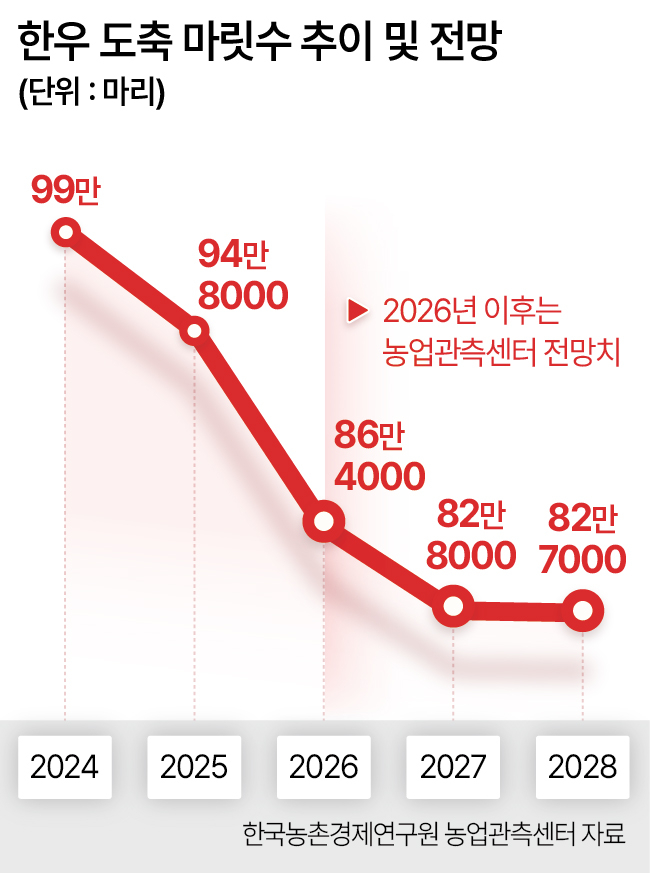
The underlying cause is a shrinking herd. According to the Agricultural Outlook Center at the Korea Rural Economic Institute, the number of hanwoo cattle being raised in September stood at about 3.218 million head, down 3.3 percent from a year earlier. The figure is expected to fall further to about 3.156 million by December. The number of cattle slaughtered this year is also projected at 864,000 head, down 8.8 percent from last year and 5.0 percent below the long-term average.
When hanwoo prices rise, supply cannot be increased quickly. It takes years from the time a calf is brought in to when it is ready for market, meaning farm decisions made years ago determine today's supply. After late 2022, a slowing economy and rising interest rates dampened hanwoo consumption, and the Russia-Ukraine war pushed up feed costs, prompting farmers to scale back their herds. The result is today's reduced slaughter volumes.
Slaughter numbers seen falling through 2028, keeping prices high
The decline in slaughter numbers is expected to continue through 2028. The Agricultural Outlook Center projects next year's slaughter count at 828,000 head, down 4.1 percent from this year, with 2028 coming in at a similar 827,000. After peaking at 990,000 head in 2024, the number has been falling steadily. A recovery is not expected until 2029.
Shifts in supply by grade are also affecting prices. As farmers have improved their rearing techniques, more are extending the feeding period to achieve higher grades. This is increasing the volume of top-grade 1++ beef while reducing supply of the more popular grade 1 and grade 1+ cuts.
Grade assessment data from the Korea Institute for Animal Products Quality Evaluation show that 581,564 hanwoo cattle were graded from January through August this year, down 5.3 percent from the same period last year. The share receiving the top 1++ grade rose 3.0 percentage points to 31.1 percent from 28.1 percent. Over the same period, the share of grade 1+ fell from 25.8 percent to 25.3 percent, and grade 1 dropped from 23.9 percent to 23.3 percent.
Falling overall supply has been compounded by a shortage of the most sought-after grades. Last month's average auction price for grade 1+ beef was 23,423 won per kilogram, up 18.8 percent from a year earlier — outpacing the 15.4 percent gain for the top 1++ grade. Grade 1 also rose 16.7 percent to 21,355 won per kilogram.
Holiday demand adds further pressure during Chuseok. A survey by the Hanwoo Self-Sufficiency Fund found that 30.1 percent of respondents said they had given hanwoo as a gift during last year's holidays, up 2.9 percentage points from the previous year. The Korea Rural Economic Institute expects the average wholesale price of castrated steers during the Chuseok peak season to reach 24,000 to 25,000 won per kilogram, up as much as 19 percent from a year earlier.
Eggs at over 7,000 won a tray, up 7.4% — price decline slow to materialize
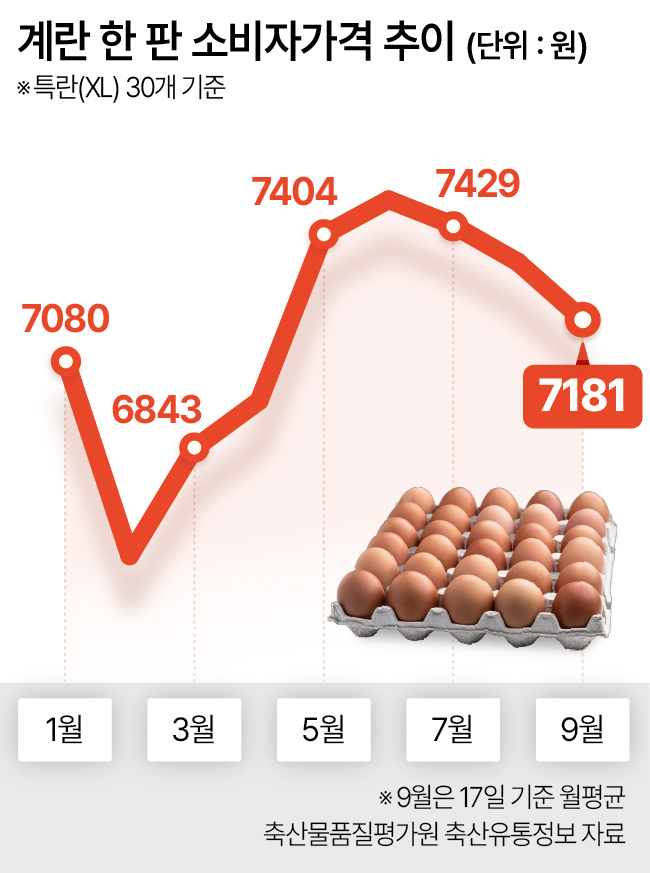
Egg prices remain above 7,000 won a tray. According to the Korea Institute for Animal Products Quality Evaluation, the average consumer price of a 30-count tray of extra-large eggs this month stood at 7,181 won, up 7.4 percent from a year earlier. The main driver was a drop in output caused by culling during a highly pathogenic avian influenza outbreak in the first half of the year. About 11.216 million laying hens have been culled since last winter, according to the Korea Rural Economic Institute.
Production recovered to year-earlier levels in July and August, and egg prices have been easing since peaking in June. The number of laying hens aged six months or older stood at about 57.82 million last month, up 1.2 percent from a year earlier. Average daily output is estimated at about 49.39 million eggs, up 1.1 percent. Farm-gate prices, which had been rising from January through July, fell 2.6 percent last month from the previous month.
Even so, the decline has been slow. Prices had already risen sharply in the first half of the year, and the Chuseok peak season has added to demand.
Even when new chicks are raised, production does not normalize immediately. Farms that experienced an avian influenza outbreak must undergo additional inspections and are barred from restocking for a set period. It also takes time for newly introduced hens to begin laying. Laying hens typically do not reach full production until around 20 weeks of age, creating a gap of several months between restocking and the resumption of full output.
The Ministry of Agriculture, Food and Rural Affairs said price lags also arise during negotiations between producers and distributors over transaction prices. Retailers say that because they were unable to fully pass on rising farm-gate purchase prices to consumers during the upswing — squeezing their margins — they find it difficult to immediately lower retail prices even as farm-gate prices come down.
"Our purchase costs went up, but we didn't pass that on fully to consumers, and we absorbed additional losses through our own discount promotions," a retail industry official said. "Supply conditions are improving, but given the holiday demand and the supply-demand balance across different egg sizes, it's hard to say the price pressure has been fully resolved."
Vegetables and fruit relatively stable this year — 'supply well managed'
The picture is different for vegetables and fruit. According to Korea Agricultural Marketing Information Service data from the Korea Agro-Fisheries and Food Trade Corporation, the price of 10 Hongro apples stood at 23,120 won as of Thursday, down 11.5 percent from a year earlier. A kilogram of Campbell Early grapes was 6,858 won, down 26.7 percent, and white peaches fell 19.5 percent. Napa cabbage dropped 9.4 percent and spinach fell 36.2 percent.
Fruit harvests and peak-season shipments were favorable this year, and many items have not risen in price despite Chuseok demand. Vegetables also remained broadly stable — leafy greens such as lettuce spiked briefly during a heat wave, but aside from zucchini, which fell 50.5 percent short of normal output last month due to insufficient sunlight, conditions were largely calm. Zucchini shipments have been recovering as weather conditions improved in September.
The key difference between livestock and agricultural products lies in how long it takes to restore supply. Vegetables and fruit are highly volatile depending on weather, but prices stabilize quickly once harvests recover. With livestock, a supply shortfall takes much longer to reverse. Even when farm-gate or wholesale prices fall, consumer prices do not come down immediately because retailers are still working through inventory acquired at higher prices, and processing and logistics costs remain elevated.
"Livestock products are items where supply simply cannot be increased quickly," said Lee Hong-ju, a professor of consumer economics at Sookmyung Women's University. "Vegetables are relatively easy to adjust in terms of output, but hanwoo has such a long rearing cycle that prices cannot respond quickly."
![According to the Korea Institute for Animal Products Quality Evaluation, the September average retail price of grade 1+ hanwoo sirloin stood at 13,330 won per 100 grams as of Thursday, up 15.6 percent from a year earlier. Pictured is the meat counter at Lotte Mart's Seoul Station branch. [Yonhap]](https://wimg.heraldcorp.com/news/cms/2026/09/18/rcv.YNA.20260621.PYH2026062106700001300_P1.jpg)
Government expands supply and discounts — but experts urge structural fixes
The government has stepped up supply and discount measures ahead of this year's Chuseok. The Ministry of Agriculture, Food and Rural Affairs plans to supply 163,000 tons of 13 key holiday staples — including apples, pears, hanwoo and eggs — starting three weeks before the holiday, 1.6 times the normal volume. Livestock supply will be increased to 1.3 times the usual level through weekend slaughterhouse operations and expanded distribution through the National Agricultural Cooperative Federation. Egg supply is set to reach 2.4 times the normal level through imports and increased cooperative shipments.
The government is also expanding its agricultural discount support budget from 59 billion won to 149 billion won and extending the support period. More than 4,000 retailers and other outlets will offer discounts of up to 40 percent on holiday staples and items that have seen price increases.
Wholesale and farm-gate prices for hanwoo and eggs have come down from their peaks but remain higher than a year ago. While the government measures should ease the immediate burden on consumers, some observers say they amount to little more than a short-term fix.
"The short-term measures rolled out before every holiday do help soften the price spikes that immediately precede them, but they are hard to call a structural solution to price stability," said Kim Dae-jong, a professor at Sejong University's School of Business Administration. "What's needed is reducing the number of distribution steps between producers and consumers, and cutting distribution costs by expanding online direct sales and large retail networks."
"Rather than directly controlling prices, what matters is ensuring that supply flows adequately through the market," Kim added. "Improving the production and distribution structure so that price competition works even in normal times — that is a sustainable solution, and it is more effective than one-off discount support."
![According to the Korea Institute for Animal Products Quality Evaluation, the average consumer price of a 30-count tray of extra-large eggs this month stood at 7,181 won, up 7.4 percent from a year earlier. Pictured are domestic and US-origin eggs on display at a hypermarket in Seoul. [Yonhap]](https://wimg.heraldcorp.com/news/cms/2026/09/18/rcv.YNA.20260628.PYH2026062804600001300_P1.jpg)
korean@heraldcorp.com
siuu@heraldcorp.com