Skilled hands still essential despite AI and automation
Results vary with die condition, pressure and paper quality
Seoul Institute report calls it 'artisanal handiwork'
Demand holds steady, but an aging workforce threatens supply
"I really wish my son would learn die-cutting."
The factory manager of a large printing plant in Cheonan, South Chungcheong Province, let that thought slip during a recent interview when the conversation turned to family. "AI cannot touch this skill," he said. "It's such delicate, sensitive work that if a person is not doing it directly, the difference in the results is enormous." Walking the factory floor together, he pointed out the plant's die-cutting operator and added quietly: "That person earns the highest salary of anyone working here. The technical difficulty is just that high."
The factory manager also mentioned that even the company's chief executive had joked to employees: "Maybe I should learn die-cutting myself. If I had the time, I would love to pick it up before I retire — just to have something to fall back on."
The printing plant visited that day was stacked floor to ceiling with sheets destined to become snack boxes and ice cream cartons. Sheets fed through the offset press must go through post-press finishing before a machine can fold them into boxes — and that finishing process is die-cutting. Industry insiders say AI will not be able to replace it for at least another decade, which is why a working factory manager wants his son to learn it and a major printing company executive half-seriously considers picking it up for retirement.
Most consumers have never heard of die-cutting. Yet virtually every printed object they handle — snack boxes, cosmetics packaging, rounded-corner cards, stickers, paper cartons of all kinds — has passed through the process. Unlike a standard straight cut, die-cutting can trim paper into any shape, score fold lines and punch holes in a single pass.
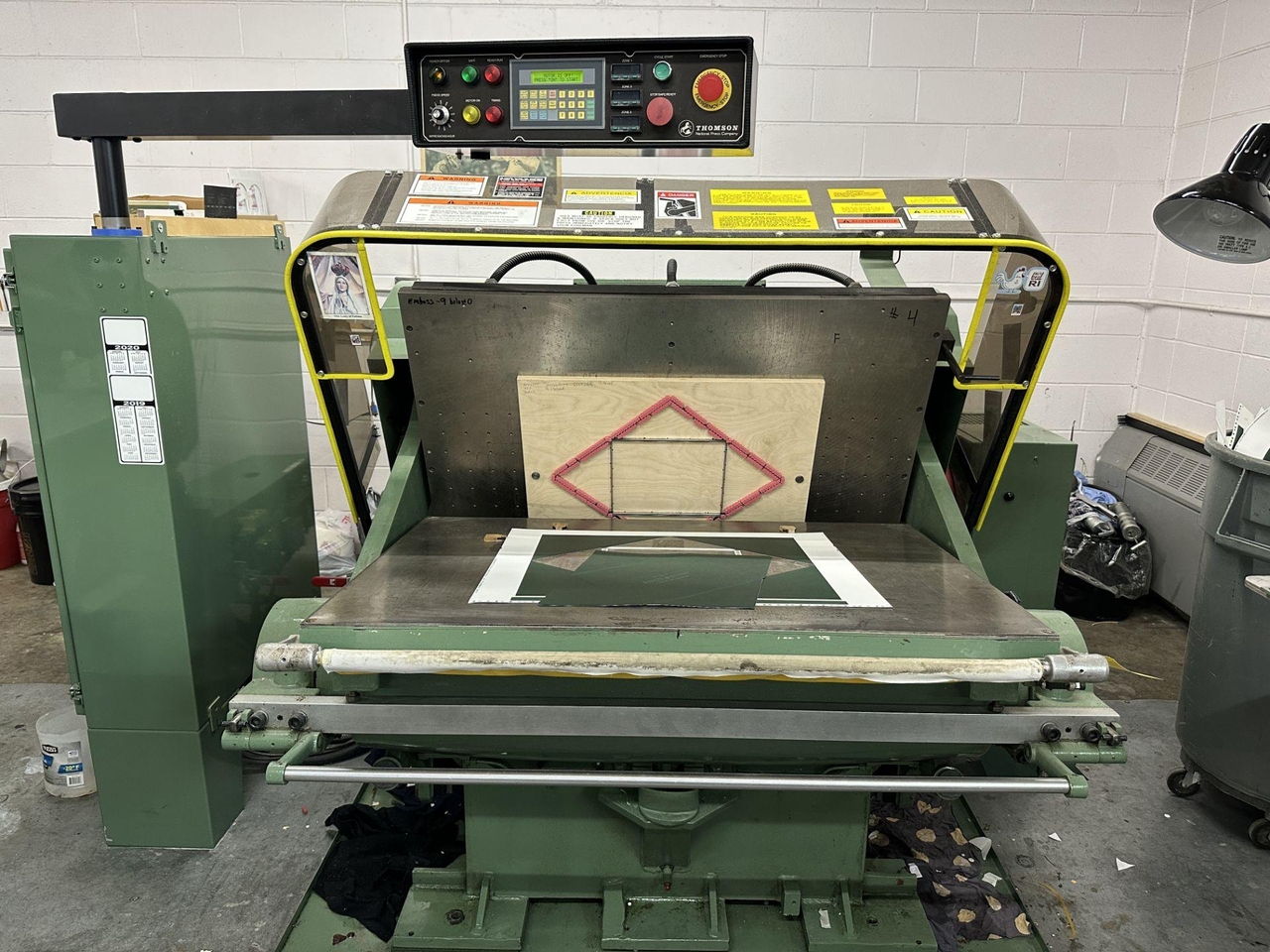
The formal technical term is die cutting, rendered in Korean as "tabal" or "hyeongsang jaedan." On the floor of Korean print shops, however, the word used almost universally is "domusong," a corruption of "Thomson." The name traces back to a die-cutting machine introduced in 1909 by the Thomson Machine Company, founded by American John S. Thomson. The machine spread to Japan, where it was called "tomusson," and that name arrived in Korean print shops as "domusong." In Japan, the same process is still called "Thomson processing."
Die-cutting is a post-press operation that trims printed sheets into whatever shape is required. Much like pressing cookie dough with a cutter, the process involves mounting a wooden die — a board fitted with blades arranged in the target shape — into a press and stamping it onto the printed sheet. When the sheet is destined to become a box, cutting lines and fold lines are created in the same stroke: one press of the die cuts away the waste, scores the folds and perforates wherever dotted lines are needed.
The work looks like simple pressing from the outside, but what separates a good result from a bad one is the setup. Paper thickness, grain direction, humidity, print registration, die condition and blade wear all require the operator to recalibrate the pressure each time. No technology yet exists to replicate that fine-grained human judgment. Skilled operators who hold this expertise are known as "domusong operators," and the minimum experience required is three years — with some employers demanding five or more for experienced hires.
When a die-cutting operator gets the setup wrong, sheets come out incompletely cut, over-compressed or with burst fold lines. The operator must check test runs and repeatedly adjust position and pressure until the output is right. Nearly every stage of the printing industry — from planning and plate-making to content production — can be automated. Die-cutting alone remains the exclusive domain of skilled hands.
A 2013 report by the Seoul Institute on the structure and working world of the printing and manufacturing cluster in Euljiro described die-cutting as "precise work requiring artisanal handiwork." The report noted that becoming a skilled worker across the full printing process takes at least two to five years of on-the-job experience, and concluded that even as automation and digitization advance, Euljiro's workshops sustain a coexistence of machine operations and artisanal craft.
The central problem facing die-cutting today is a persistent mismatch: demand keeps coming, but skilled operators are scarce. That is precisely why a printing company executive jokes about learning the skill himself and a factory manager hopes his son will take it up — the market offers solid returns, but the workforce to serve it is thin. "Once you learn this skill, it is a job for life," one industry insider said. Profit margins in the sector are understood to average around 20 percent.
The shortage is especially acute in and around Euljiro and Chungmuro, the country's largest concentration of print businesses, where the aging of skilled workers and a lack of successors have long been flagged as serious concerns. The problem has recently been compounded by relocation pressures stemming from the Sewoon district redevelopment project. Jung-gu in Seoul has committed to building a public rental industrial facility for small printing businesses in the Sewoon area by 2028, partly to prevent further erosion of the industry's base.
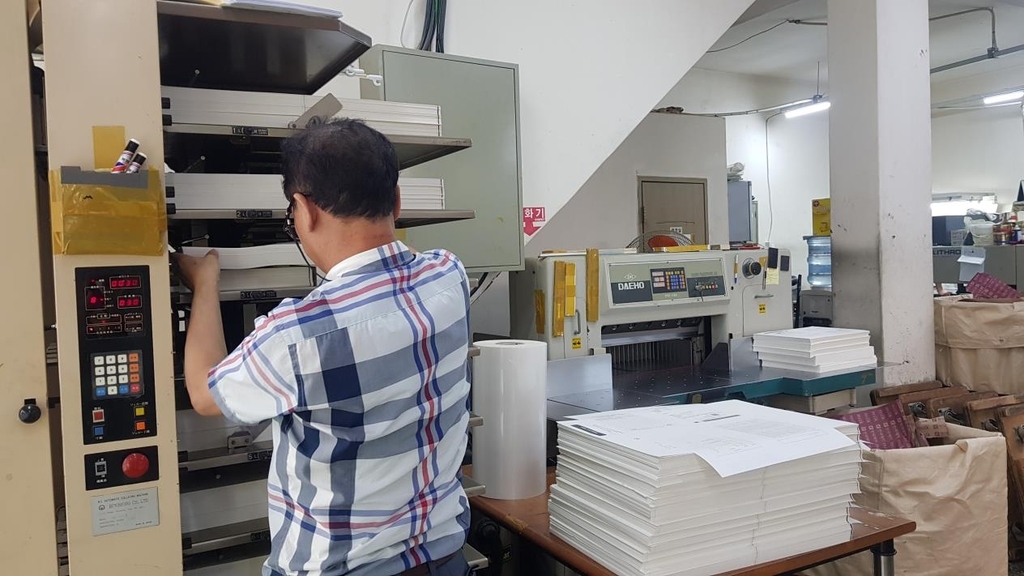
During the visit to the Cheonan plant, a Thomson press stamped out sheets at high speed. Feeding and removing paper was already largely handled by machine. Standing beside it was a worker who appeared to be well into his 60s, watching each sheet as it came off the press — the very spot where the company's chief executive had joked, not long before, about wanting to learn the trade before he retired.
hong@heraldcorp.com