Credit union volunteers collected 20,000 mobility data points to build Daejeon's low-floor bus booking service
Annual wheelchair boardings jump from 13 to 860 after app launch — a 66-fold increase
After five years of private-sector trials, the service transitions to city government as 'Eodiga-yu'
Expansion planned to cover seniors, stroller users and others with mobility challenges
![A launch ceremony for the "wheelchair mobility data collection volunteer drive" is held at the main auditorium on the second floor of the Korea Federation of Community Credit Cooperatives headquarters in Daejeon in July 2023. [Korea Federation of Community Credit Cooperatives]](https://wimg.heraldcorp.com/news/cms/2026/09/22/news-p.v1.20260922.d01a81530b6e45b48659ee02cdb190e0_P1.png)
In the sweltering summer of 2023, some 300 employees of Daejeon-area credit unions spent their lunch breaks and hours after work pushing wheelchairs through city streets. They were checking for curb cuts, testing whether building entrances were accessible, and locating accessible restrooms — photographing every step and staircase along the way so nothing would be missed. In just over a month, they gathered roughly 20,000 pieces of mobility data.
That information became the foundation for a low-floor bus boarding reservation and wheelchair navigation service built with the participation of the Korea Credit Union Social Contribution Foundation. The service lets wheelchair users book a low-floor bus through an app, automatically relaying the boarding information to the driver. After alighting, users can check accessible routes to their destination and receive alerts about pedestrian obstacles along the way.
The foundation presented the progress and results of the low-floor bus reservation app project Monday at the 3rd Korea Social Value Festa held at COEX in Seoul. The project has been underway since 2022 in partnership with SK Happiness Foundation, the city of Daejeon and Wizon Cooperative. The credit union foundation provided funding and collected mobility data; SK Happiness Foundation handled planning and operations; Daejeon city applied the system to its bus network and trained drivers; and Wizon led technology development.
"Low-floor buses were becoming more common, but wheelchair users still found it nearly impossible to board them," said Kim Seon-hong, a manager on the Sesang File team at SK Happiness Foundation. "When we went out to see for ourselves, people told us, 'The bus just drives past,' or 'I want to ride but I have no idea how.' " He added that drivers also had no way of knowing in advance that a wheelchair user was waiting at a stop. "Rather than simply adding more low-floor buses, we decided to focus on making the ones already out there actually usable," he said.
The team built a system in which a user's reservation is sent directly to the driver's onboard terminal. An announcement plays inside the bus to alert passengers that a wheelchair user will be boarding, giving other riders time to clear the aisle and the driver time to prepare the ramp. When the user disembarks, the driver is notified in advance so the ramp and any other necessary assistance are ready.
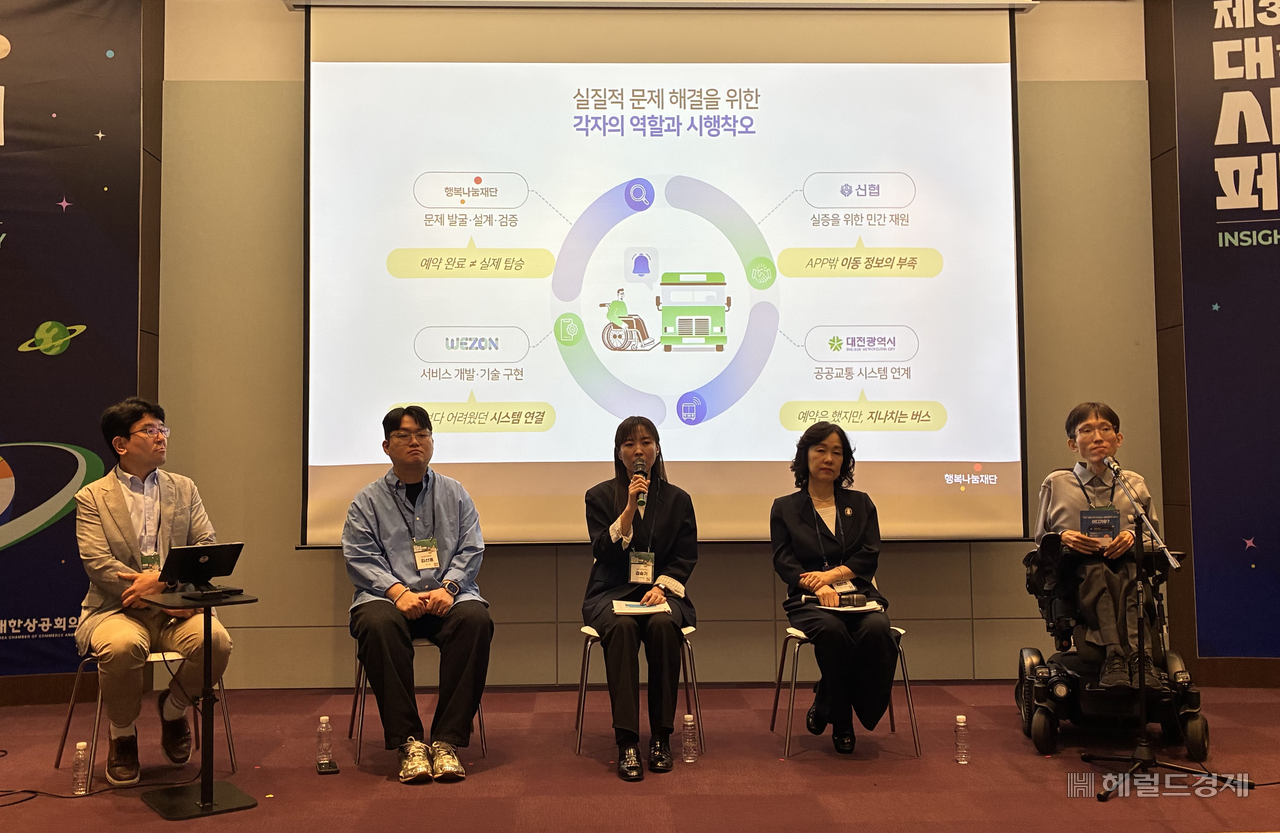
Wheelchair users in Daejeon boarded low-floor buses 860 times last year, up from just 13 annually before the service launched — a roughly 66-fold increase. "We formed a focus group of 20 wheelchair users and measured outcomes every quarter," Kim said. "The time spent searching for mobility information fell by 82 percent, and some users went from leaving home three times a week to six. Compared with the disability call-taxi service, total travel time including waiting dropped by about 66 percent."
Oh Young-jin, a board member of Wizon Cooperative who uses a wheelchair and helped develop the service, recalled how wheelchair users used to call themselves "Cinderellas" because the disability call-taxi service stopped running at 9 p.m. "When a group of us went out together, we'd have to take the call-taxis one by one in order, and just getting home could take two hours," he said. "Now we can take the low-floor bus, so we can make plans that run until the last bus at 11 p.m. or midnight."
Daejeon city reinforced driver training to ensure the reservation system worked reliably in practice. "On a cold Christmas, a wheelchair user had made a reservation and was waiting at the stop, but the driver did not notice and drove past," said Kim Mi-gyeong, head of Daejeon's bus policy division. "That incident prompted us to add the reservation service procedures and guidance on assisting wheelchair users to the regular training curriculum for transit workers."
![The Korea Credit Union Social Contribution Foundation operates a promotional booth for "Eodiga-yu," its low-floor bus reservation service, at the 3rd Korea Social Value Festa held Monday at COEX in Gangnam-gu, Seoul. [Korea Federation of Community Credit Cooperatives]](https://wimg.heraldcorp.com/news/cms/2026/09/22/news-p.v1.20260922.24b0c60cf7564bb983fb12c2dc4671e5_P1.png)
Five years of private-sector trials are now giving way to a public service. The service built by the credit union foundation and its partners is set to be transferred to the city of Daejeon in the second half of this year under the name "Eodiga-yu" — marking the transition of a privately funded social contribution initiative into an official municipal transit service.
The project's scope is also set to expand. Most of the roughly 1,600 current subscribers are wheelchair users, but the plan is to broaden the service to cover seniors, stroller users and people with temporary mobility difficulties, making it a comprehensive transit service for those with limited mobility.
"The most significant achievement of this project is that a model first proven by the private sector is now being taken over by the public sector for stable, long-term operation," the foundation's secretary-general said. "This experience has also shifted our standard for social contribution — away from the scale of support and toward actual problem-solving and measurable change for users."
"This project has also led us to pursue a new initiative to improve financial service accessibility for people with hearing disabilities," the secretary-general added. "We will continue to expand our approach to social contribution — one focused on solving the real, everyday difficulties faced by people with disabilities."
snsd@heraldcorp.com