Cuchen's Yeom Gyu-hyun: 'The rice cooker is the hardest appliance there is'
Started with a plan to stay just 6 months after the Asian financial crisis — then saw his first product on a store shelf and never left
'You have to satisfy water, heat, pressure, taste — and even the consumer's mood'
"I went to mechanical engineering to build cars. Twenty-six years later, I'm still making rice cookers."
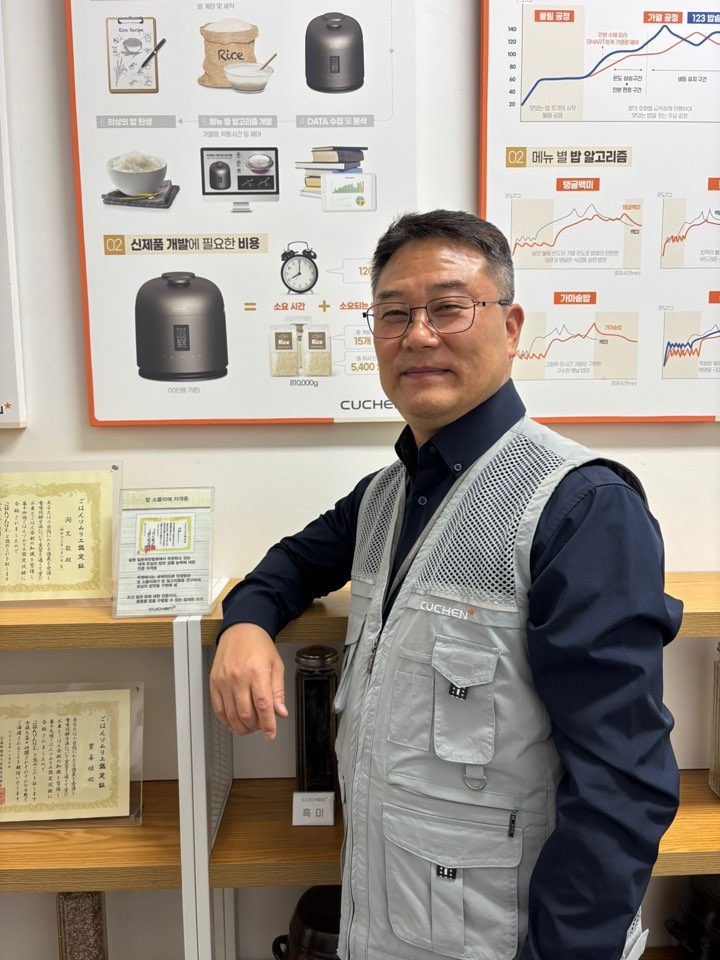
Yeom Gyu-hyun, head of the rice cooker development team at Cuchen, laughed as he described his career. The mechanical engineer who once dreamed of designing automobiles has spent more than two decades working on a kitchen appliance.
It was never the plan. Yeom entered the job market in 1998, in the immediate aftermath of the Asian financial crisis.
"There were no jobs anywhere because of the IMF crisis. A professor recommended me to a company that made rice cookers. I came down thinking I'd work six months and then head back to Seoul — and here I am, 26 years later."
He admitted he resented his professor at first. His outlook changed the moment his first product reached the world.
"I saw the first product I had worked on displayed at a Samsung Living Plaza store with the Samsung Electronics logo on it. The feeling was incredible. Something I had designed on a computer — something that hadn't existed before — was sitting right there in an actual store. From that moment, I thought: 'Still, I made the right call coming here.'"
At his previous employer, Yeom developed a range of home appliances centered on rice cookers, including bidets, air purifiers and humidifiers. Since joining Cuchen, he has focused exclusively on rice cookers for 11 years.
Asked whether the rice cooker still feels difficult after 26 years, his answer was unequivocal.
"In my view, no other product draws on as many branches of mechanics as the rice cooker."
The mechanical engineering graduate ticked them off on his fingers. The moving lid and handle require dynamics. Water and steam bring fluid mechanics into play. Heat must be managed, pressure must be withstood, and the properties of materials must be understood.
Yet the real challenge Yeom identified lies outside mechanical engineering entirely — in the human palate.
He recalled a consumer complaint call he received at a former job. "Someone called to say the rice tasted great yesterday but not today. The cooking process was identical, the rice wasn't undercooked — it just didn't taste good today. We couldn't exactly ask whether they'd had a fight with their spouse or whether their kid had gotten into trouble."
Yeom smiled telling the story, but his conclusion was earnest. "A water purifier just needs to dispense the right amount of water at the right temperature. But a rice cooker is about taste. It's a product that has to match even the consumer's mood. That's why we always say the rice cooker is the hardest appliance in the home."
Even the definition of "delicious rice" keeps shifting. Pressure cookers once focused their technology on producing soft, sticky rice. More recently, Yeom has noticed a growing preference for grains that hold their individual shape and texture — a shift he has felt at home as well.
"My two sons spend a lot of time in dormitories, and when they come home they ask me, 'Can't you make it taste like "haetban"?' They've eaten that style of rice so often outside that the texture has become normal to them. Watching that, I realized the trend in rice taste is changing too."
Cuchen's newly developed "Tanggul Baekmi" cooking mode grew out of that thinking. The soaking time, temperature, pressure and heat levels were redesigned to preserve the shape and springiness of each grain.
Yeom lifted a titanium inner pot onto the table and spent some time explaining it. Forming hard titanium into the shape of a rice cooker inner pot was itself no small feat. The interior surface also incorporates "micro grid texturing" designed to promote active convection.
"No research and development succeeds from the outset. There were trial and errors in producing the material, failures in creating the texture, and setbacks in achieving this shape."
Development of the titanium inner pot alone took about two years. The lead developer was absorbed in the work for an extended period, and Yeom himself said he spent roughly six months focused on it during the mass production phase.
One word came up repeatedly as Yeom talked about rice cookers: pride. He said the most satisfying moments come when he sees a product he made sitting on a store shelf, appearing on television, or being used by a real consumer.
After 26 years, he still has a rice cooker he wants to build. "I want a rice cooker that cooks on its own — whether the consumer presses the button once, taps it on their phone, or eventually just thinks 'I want rice.' Whatever you put in, it figures everything out by itself. A cooker that says, 'I've got this — you just think about cooking.' That's the ultimate goal," Yeom said.
hong@heraldcorp.com