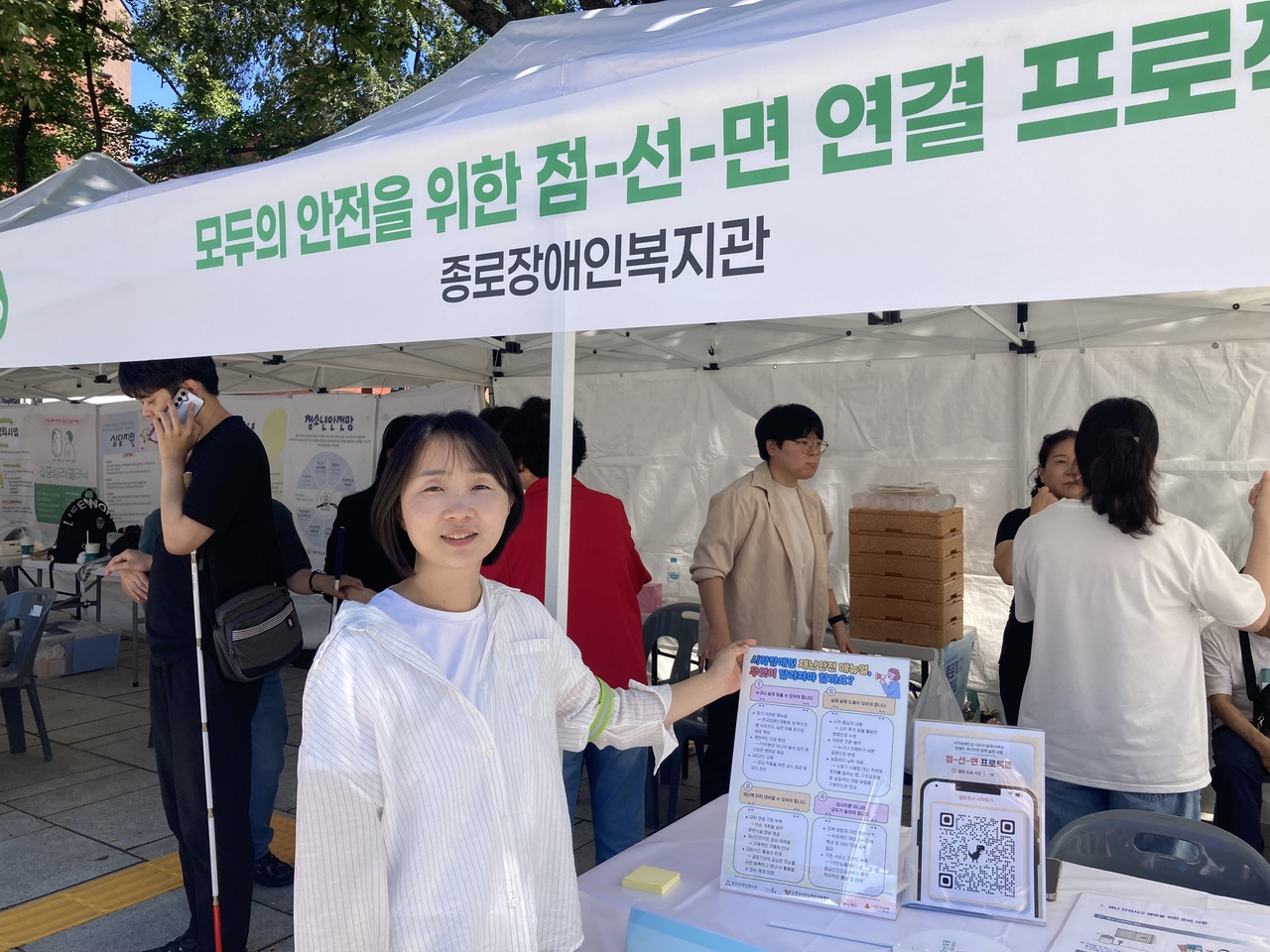
Kim Ji-young, a social worker at Jongno Center for the Disabled, shared her vision of living alongside people with disabilities at the Jongno Welfare Fair. Her younger brother's brain lesion disability sparked her interest in the field. The center runs a "time bank" project — based on the idea that no one is useless — that lets people with disabilities contribute to others and earn help in return. The fair, themed "Meet Welfare in Jongno," drew 29 organizations.
"Please look at people with disabilities as neighbors who simply have a little something special about them."
Kim Ji-young, 41, a social worker at Jongno Center for the Disabled, recently staffed her center's booth at the 2026 Jongno Welfare Fair, held at Marronnier Park in Jongno-gu, Seoul. The center ran a hands-on safety experience booth for the visually impaired, introducing visitors to what it means to live alongside people with disabilities.
"We have non-disabled people directly experience the difficulties that visually impaired people face," Kim said. "We also want them to come away knowing how to act and how to help when they encounter someone who is visually impaired."
Kim began her career in 2014 at a non-governmental organization, handling donor consultations. The work made her want to see firsthand how those donations actually helped people, which led her to go back and study social welfare. She has worked at Jongno Center for the Disabled since 2017.
Her interest in disability issues traces back to her younger brother, who has a brain lesion disability and is two years her junior. Growing up with him made it natural for her to recognize that people with disabilities are part of everyday life.
Jongno Center for the Disabled is not simply a place where people with disabilities come to rest. Kim said the center has been running a project called the "time bank" since 2024. The concept draws on American legal scholar Edgar Cahn's idea that no one is useless, and is built on the premise that the labor of a person with a disability holds the same value as that of a person without one.
"People with disabilities have long been accustomed only to receiving — playing the role of beneficiaries — and that has made them increasingly dependent on being given things," Kim said. "This project started from the idea of finding ways for people with disabilities to contribute something to others instead."
Under the time bank model, one person with a disability may be a skilled artist, another may play an instrument well, and another may excel at sports. The idea is to identify each individual's strengths and assign them a role through which they can contribute to others. When a participant contributes one hour, that time is deposited in the time bank and can later be drawn on to receive an hour of help from someone else.
"Even a person with a physical disability has things they are good at. Social workers like us find what people with disabilities enjoy and do well, then support and encourage them so they can help others," Kim said. "Rather than simple volunteering, we want to help relationships form through this give-and-take — and to have people recognized as someone who matters."
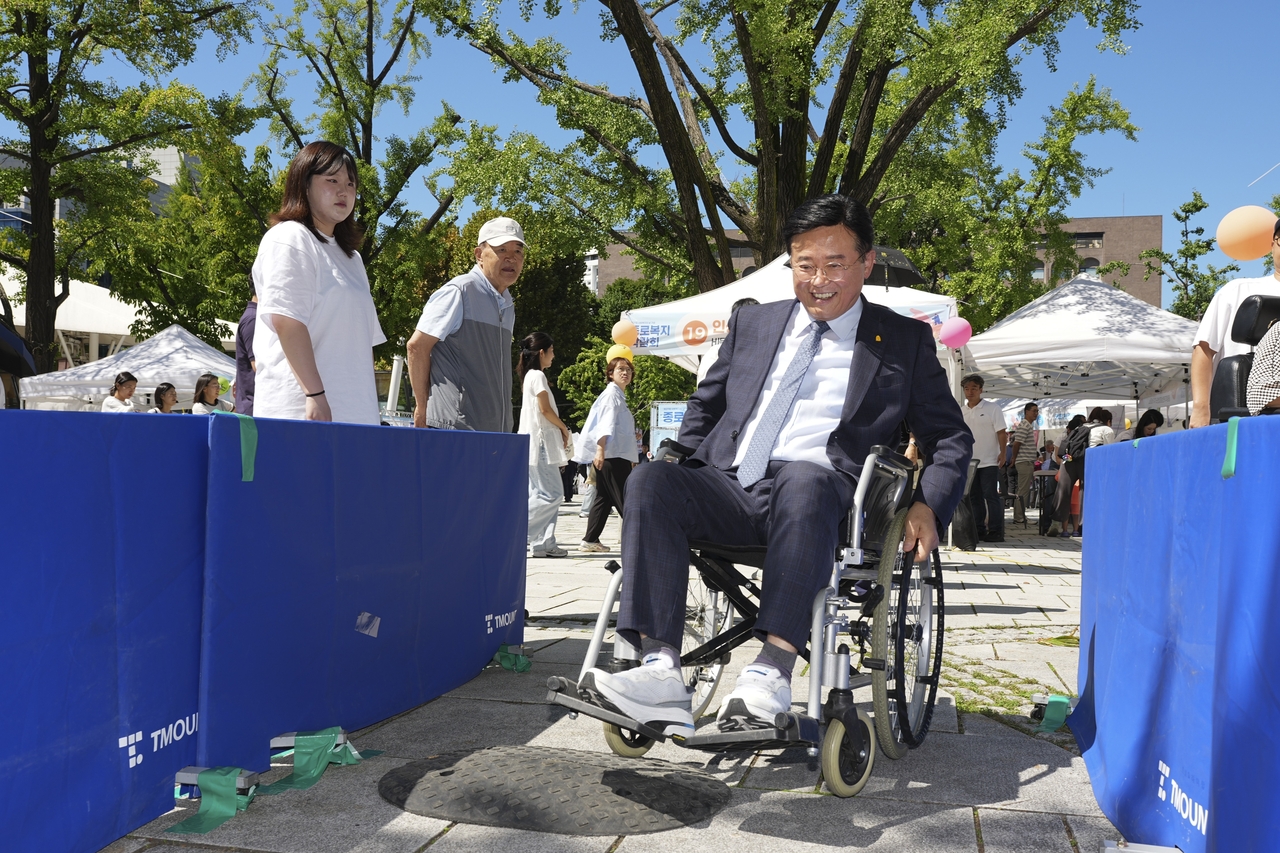
The Jongno Welfare Fair, hosted by Jongno-gu and the Jongno-gu Social Welfare Council, drew 29 social welfare organizations from across the district — including Jongno Center for the Disabled — along with about 400 workers. The fair is held annually to thank those who have dedicated themselves to improving community welfare and to raise residents' awareness of the district's flagship welfare programs.
This year's booths were organized into five areas to help residents engage more directly with available policies and services: family and community welfare, children and youth, seniors and public health, disability services, and residential and employment support. An interactive quiz on improving attitudes toward disability was designed to challenge common misconceptions, and a booth for "Jongno Good Neighbor" — a reporting channel for identifying residents who fall through the cracks of the welfare system — gave visitors a chance to reflect on the struggles of those around them.
Additional offerings included mental health screenings, memory tests, a visually impaired safety experience, portrait photography by people with developmental disabilities, and a mood-lamp crafting program on the themes of family, hope and happiness — making the event a place for people of all ages to enjoy and learn.
Jongno-gu District Mayor Yoo Chan-jong, who attended the event, said he would "work hard to build a warm community with no blind spots in welfare coverage and to make Jongno a welfare city that residents can truly feel."
ikson@heraldcorp.com