Cheonggyecheon A01 bus shifts to nighttime service after a year of daytime runs
Covered 9,500 km over past year with zero self-caused accidents
Adult fare set at 1,400 won when paid service launches next year
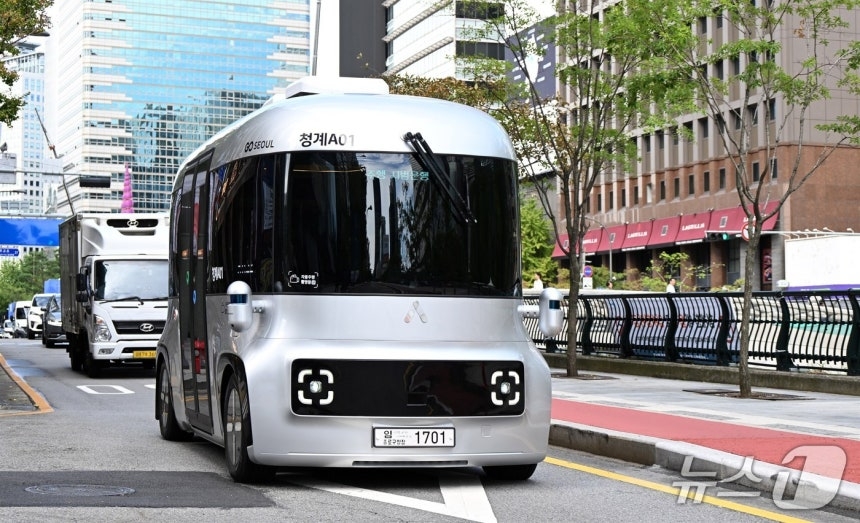
The Cheonggyecheon A01, Seoul's autonomous bus running along Cheonggyecheon Stream, has carried more than 13,000 passengers in its first year of service, cementing its status as one of the stream's signature attractions. The bus switched to nighttime operations Thursday and is expected to begin charging fares next year.
Since launching Sept. 23 last year, the Cheonggyecheon A01 had carried a total of 12,858 passengers as of Aug. 14, covering a cumulative distance of 9,500 kilometers.
Known by the name "Roy," the bus is roughly the size of a mid-size van, with gently curved edges and headlights shaped like a robot's eyes — a look that has drawn the attention of both residents and tourists passing through the area.
Two vehicles operate in rotation along a 4.8-kilometer round-trip route between Cheonggyecheon Plaza and Cheonggyecheon 5-ga (Gwangjang Market), stopping at 11 stations in both directions via Cheonggyecheon 3-ga (Sewoon Sangga). On weekdays, the buses ran 11 times a day from 10 a.m. to 4:50 p.m. at 30-minute intervals, excluding the lunch hour. To account for the stream's narrow roadway, the vehicles travel at around 20 kilometers per hour.
While autonomous buses have been introduced across the country, the Cheonggyecheon A01 holds the distinction of being the first such vehicle built entirely with domestic technology. It was developed by Autonomous A2Z, a leading South Korean autonomous driving company.
The service has been free. Tapping a transit card on the terminal inside the bus registers a fare of zero won, allowing anyone to ride at no cost.
"I sometimes walk along Cheonggyecheon after lunch, and when it suddenly rains or I'm running late getting back, I hop on the autonomous bus if the timing works out," said a 40-year-old office worker who gave only the surname A. "I've ridden it a few times — it's great that it's free, and it actually feels safer than a car with a driver."
Lee Byung-jin, head of business development at A2Z, said the shuttle was built with safety as the top priority, noting that it can brake sharply if a traffic light changes suddenly, making seatbelts essential. "Barring any unusual external interference, the accident rate in the program is close to zero percent," Lee said.
The Seoul Metropolitan Government recorded a handful of incidents involving the Cheonggyecheon A01 over the past year, but all were minor contact accidents caused by other vehicles cutting in — none were attributed to faults in the bus itself.
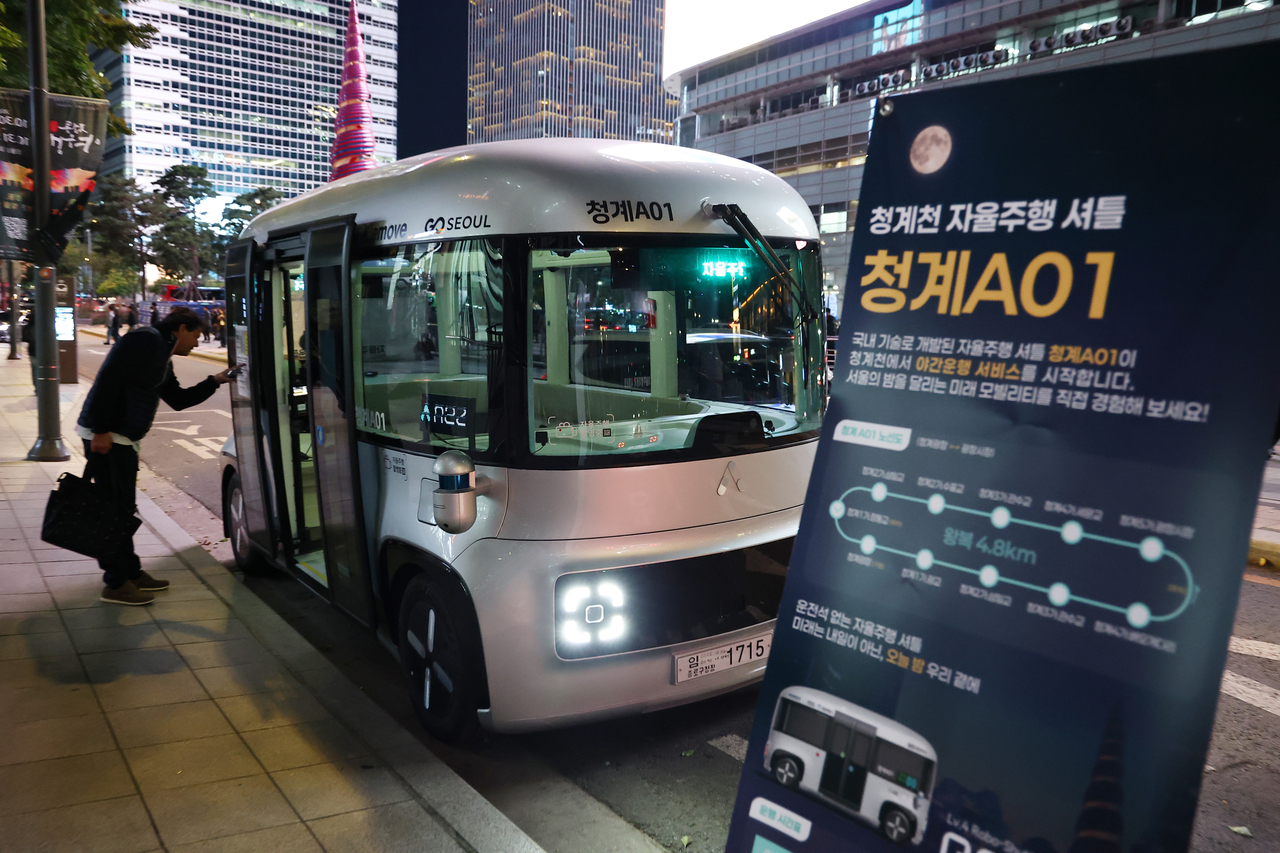
The Seoul Metropolitan Government said it determined that the safety of daytime operations had been sufficiently verified and switched the bus to nighttime service Thursday.
The bus now runs on weekdays from 7 p.m. to 11:50 p.m., departing from Cheonggyecheon Plaza every 30 minutes for nine runs a day, with the last departure at 11 p.m. The service does not operate on weekends or public holidays.
A Seoul city official said demand for nighttime service was expected to be strong, given the large number of tourists who visit the Cheonggyecheon area after dark. "We plan to verify safety through a pilot nighttime operation, just as we did during the day," the official said.
After completing the nighttime pilot, the city is considering converting the service to paid fares next year, with 1,400 won per ride for adults seen as the likely rate. Discounts will apply for holders of the Climate Card and Modoo Card, as with regular public transit.
The Seoul Metropolitan Government plans to introduce 500 autonomous buses by 2030 as part of an aggressive advanced-technology transport policy, aiming to push the city into the top three public transit cities globally within the current mayoral term.
ikson@heraldcorp.com