Lee's first Bank of Korea visit since taking office
Meeting aimed at strengthening policy coordination amid market volatility
Lee calls for spreading growth benefits across economy
Won internationalization, digital finance also on agenda
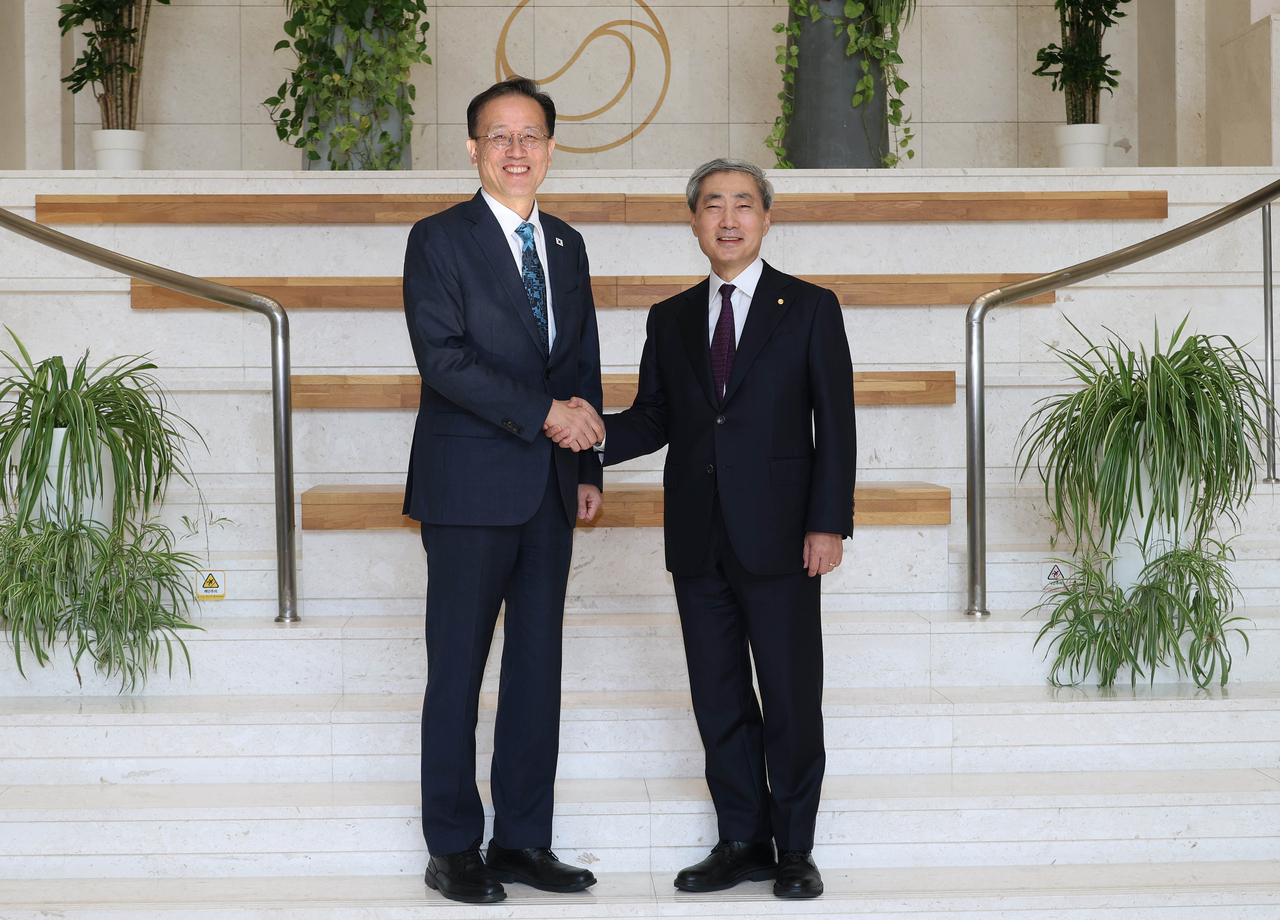
Deputy Prime Minister and Minister of Economy and Finance Lee Hyung-il and Bank of Korea Governor Shin Hyun-song met Monday to jointly assess risks in the financial, foreign exchange and real estate markets, agreeing to take preemptive action. The two also pledged to seek a coordinated approach to economic and monetary policy in pursuit of their shared goals of price stability, growth and financial stability.
Lee visited the Bank of Korea that morning to meet with Shin — his first visit to the central bank, coming six days after he took office on Tuesday. The two leaders moved quickly to meet, recognizing the need for policy coordination as volatility in financial markets intensified, with US Treasury yields surpassing 5 percent, a level widely regarded as a key psychological threshold. Lee arrived wearing a blue necktie bearing a calligraphic rendering of the first characters of "Bank of Korea," signaling his commitment to working as one team with the central bank.
The two assessed that economic indicators such as exports and investment were performing well, driven in part by a semiconductor boom, and that growth momentum was broadening. They noted, however, that external uncertainty remained elevated — including rising interest rates in major economies and geopolitical risks — while domestic cost-of-living pressures continued.
They also agreed that interconnections among the financial, foreign exchange and real estate markets were deepening. The two sides committed to strengthening their cooperation framework to go beyond monitoring macroeconomic indicators alone, taking a comprehensive view of overall economic conditions to identify risk factors early and respond proactively.
At the meeting, Lee proposed that the two institutions "communicate more closely and seek a harmonious approach to economic and monetary policy in the interest of price stability, growth and financial stability." He also called for a stronger cooperation framework to monitor financial, foreign exchange and asset markets in an integrated manner and respond at an early stage.
Forward-looking issues including the internationalization of the won and digital finance were also on the agenda. Lee asked both institutions to "work together to find ways to raise the potential growth rate and ensure the benefits of growth spread throughout the economy."
Shin responded by saying that "macroeconomic stability through price and financial stability must be the foundation for building a sustainable growth base," and pledged that the two institutions would "communicate and cooperate closely." They also agreed to maintain ongoing communication through existing channels, including the market conditions review meeting.
Meanwhile, the Bank of Korea held a market conditions review meeting Monday morning, chaired by Deputy Governor Kwon Min-su, to assess how movements in international financial markets during the chuseok holiday period could affect domestic financial and foreign exchange markets. Kwon said that while stock prices and the dollar had moved relatively little in major economies during the holiday, global government bond yields had risen substantially, driven by shifting expectations for monetary policy.
International financial market uncertainty was assessed to have risen considerably. Around the holiday period, from Wednesday through Friday, US Treasury yields rose 10 basis points on the two-year note and 20 basis points on the 10-year note (1 basis point = 0.01 percentage point). Ten-year government bond yields in Germany and the United Kingdom climbed 14 basis points and 13 basis points, respectively. Over the same period, the S&P 500 fell 0.3 percent and NASDAQ fell 0.6 percent, while the dollar index (DXY) rose 0.4 percent.
Movements in Korean assets were limited. The won weakened 0.1 percent against the US dollar on the offshore non-deliverable forward market. Foreign exchange authorities are stepping up monitoring of NDF transactions, which they view as susceptible to speculative activity that could amplify exchange rate volatility. South Korea's credit default swap premium held at a low level of 23.6 basis points on Friday.
Kwon said that while "domestic economic fundamentals continue to look solid," volatility in domestic financial and foreign exchange markets could increase "depending on how external risk factors develop — including US-Iran negotiations, concerns over fiscal health in major economies, and shifts in expectations for the AI industry." He added that the Bank of Korea would "monitor market conditions closely with a heightened sense of alert."
forest@heraldcorp.com