![Traders watch screens on the floor of the New York Stock Exchange. [AP]](https://wimg.heraldcorp.com/news/cms/2026/09/28/news-p.v1.20260110.022347d6626f43d1bfe6f2aab391a1d6_P1.jpg)
Surging US Treasury yields have climbed to nearly the same level as the earnings yield on the S&P 500, the benchmark for American equities. The gap between 10-year Treasury yields and the S&P 500's earnings yield has all but vanished, while the 30-year Treasury yield now exceeds the index's earnings yield by nearly 0.5 percentage points.
The so-called yield gap — the extra return investors earn for taking on equity risk over bonds — has narrowed to its tightest since 2004, analysts say, sharply diminishing the relative appeal of stocks compared with bonds.
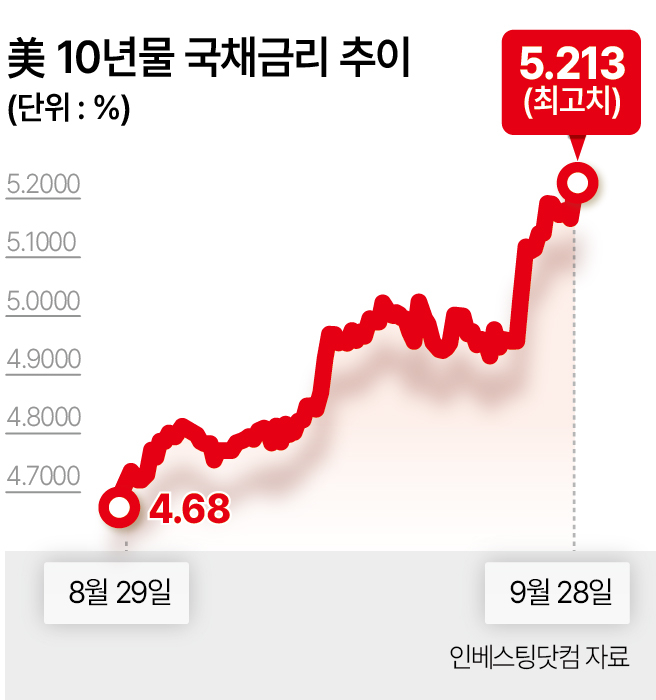
The US 10-year Treasury yield stood at 5.167 percent on Friday (local time), according to the financial investment industry. Hana Securities, drawing on Bloomberg data, put the S&P 500's 12-month forward price-to-earnings ratio at 19.3 times, implying an expected earnings yield of 5.19 percent — leaving the yield gap at roughly 3 basis points (1 bp = 0.01 percentage point), the lowest since 2004.
"The yield gap based on the S&P 500 is 3 basis points, the lowest since 2004," said Lee Jae-man, a researcher at Hana Securities. "The investment appeal of stocks over bonds is on the verge of disappearing." The compression has been driven largely by a rapid rise in Treasury yields: the US 10-year yield surged 41 basis points in September from the end of August.
The yield gap measures the relative attractiveness of stocks versus bonds, typically calculated by subtracting the US 10-year Treasury yield from the S&P 500's earnings yield. It represents a risk premium — the additional return investors can expect for holding equities, which carry greater risk than government bonds.
A wider yield gap signals that stocks offer greater expected reward relative to bonds; as it approaches zero, the incentive to take on equity risk diminishes.
By some measures, the earnings yield on stocks has already fallen below Treasury yields. Using the S&P 500's 12-month forward P/E of 19.94 times cited by the Wall Street Journal, which quoted Birinyi Associates on Friday (local time), the implied earnings yield comes to about 5.02 percent — roughly 15 basis points below the 10-year Treasury yield on the same day.
In simple terms, US Treasury yields — assuming the bonds are held to maturity — have reached a level that matches or exceeds the S&P 500's earnings yield.
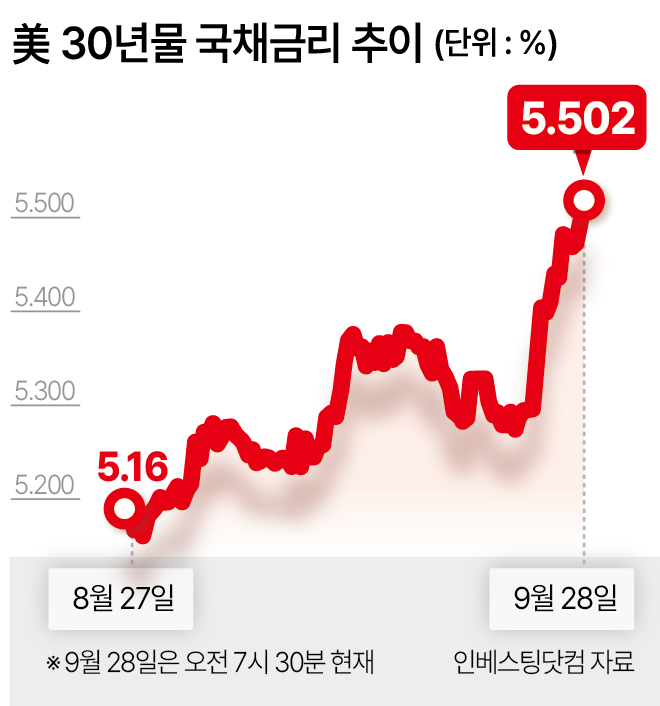
The gap widens further when compared with longer-dated Treasuries. The US 30-year yield stood at 5.50 percent on the same day, about 48 basis points above the S&P 500's earnings yield on the Wall Street Journal's measure. While the yield gap is conventionally calculated using the 10-year benchmark, the broad rise in long-term Treasury yields to levels that rival equity earnings yields is seen as significant.
This poses a meaningful challenge to equity valuations. When US Treasuries alone can deliver yields above 5 percent, investors will demand higher expected returns from stocks as well.
To meet that bar, corporate earnings forecasts would need to rise more quickly, or share prices would have to fall to bring P/E ratios down. Without either, the additional reward for bearing equity risk becomes too thin.
However, analysts caution against assuming that rates in the 5 percent range will immediately trigger a sharp market shock.
When the 10-year yield last topped 5 percent in October 2023, recession fears were still lingering even as long-term rates soared. The current situation differs in that the US economy is holding up relatively well.
When the economy is solid and corporate investment is expanding, rising demand for capital can push rates higher — and in that context, higher rates are not necessarily a signal of economic deterioration.
Above all, AI and data center investment — the core engines driving US economic growth at present — are cited as a factor cushioning the blow from elevated rates.
"The US private sector has consistently maintained growth of around 2 to 3 percent, but since last year, momentum has visibly weakened once AI-related investment is stripped out," said Lee Jeong-hun, a researcher at Daishin Securities. "The sector leading US economic growth right now — particularly AI — is not one that is sensitive to interest rates."
Rate-sensitive sectors such as housing, by contrast, have already been struggling for an extended period. The US housing market has remained in a slump since 2023, and because a large share of existing mortgages are locked in at past low rates, the risk of a sharp near-term jump in household interest burdens is limited even if market rates rise further, analysts say.
The labor market is also holding a balance of low hiring and low layoffs, while employment in manufacturing and construction has remained relatively firm, supported in part by data center investment. "Rate-sensitive sectors were already underperforming," Lee said. "The risk that recent rises in market or policy rates will immediately derail the US economy is low."
What is earnings yield?
Earnings yield is the ratio of a company's earnings to its current share price — the inverse of the price-to-earnings ratio. While the P/E ratio shows how many times a company's earnings its shares are trading at, the earnings yield flips that figure into a rate-of-return form.
For example, if a company earns $1 per share and its stock trades at $20, the P/E is 20 times. Inverted, the earnings yield is 1 ÷ 20 = 5 percent — meaning the company generates $1 in earnings for every $20 of share price.
As the P/E rises, the earnings yield falls; as the P/E falls, the earnings yield rises. When comparing the investment appeal of stocks and bonds, analysts set the earnings yield against the Treasury yield. The gap between the two is the yield gap.

th5@heraldcorp.com