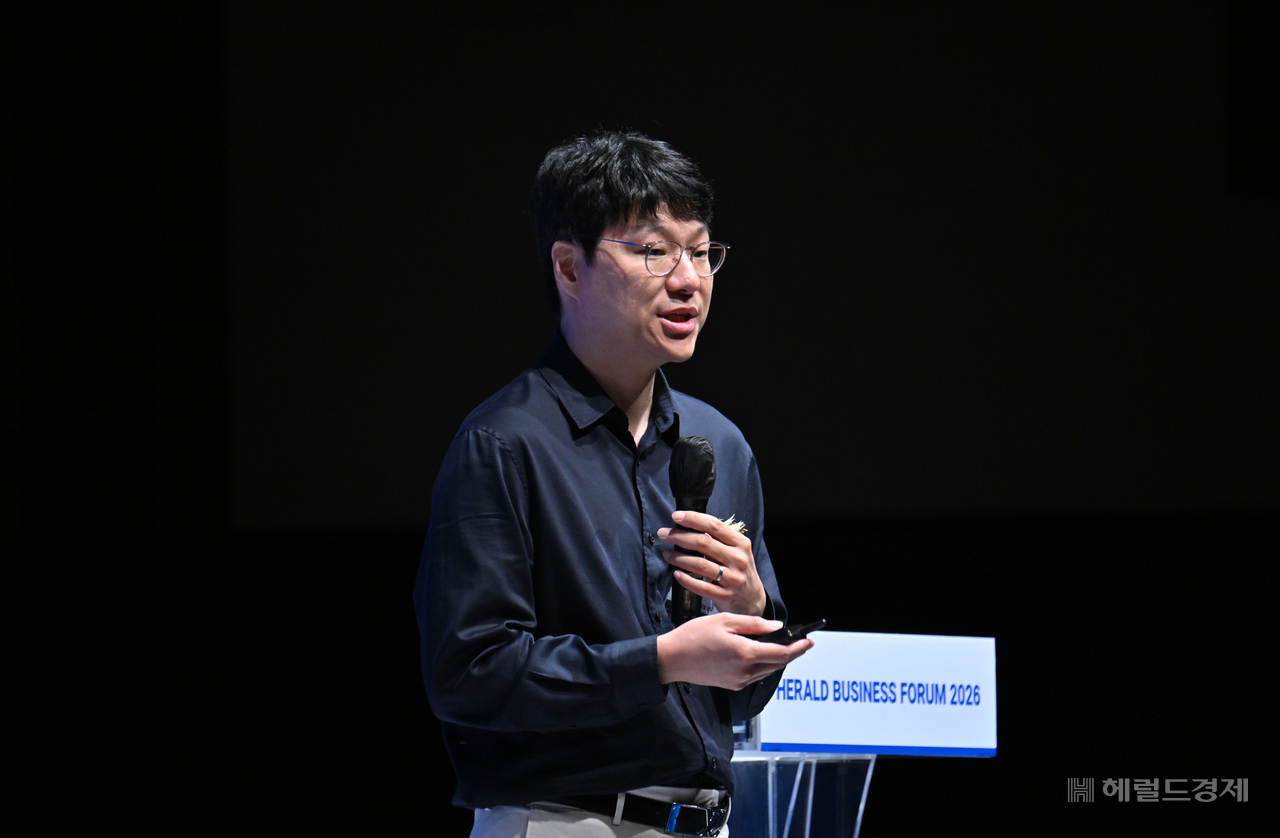
Kim Kyung-ryun, senior vice president of Samsung Electronics' DRAM Development Division, delivers keynote
HBM4E and HBM5 face limits in bandwidth and power efficiency
3D stacking of HBM directly atop processors offers a new path forward
zHBM targets performance gains beyond what conventional HBM can achieve
Co-design from the ground up seen as essential, not optional

"HBM4E and HBM5 are certainly impressive innovations, but overcoming the 'memory wall' requires an entirely new approach. We found that answer in 3D."
Kim Kyung-ryun, senior vice president of Samsung Electronics' DRAM Development Division, said Tuesday at the Herald Business Forum 2026 at the Shilla Hotel's Dynasty Hall in Jung-gu, Seoul, that the goal is to achieve "a leap through zHBM that no single generation of conventional HBM could deliver."
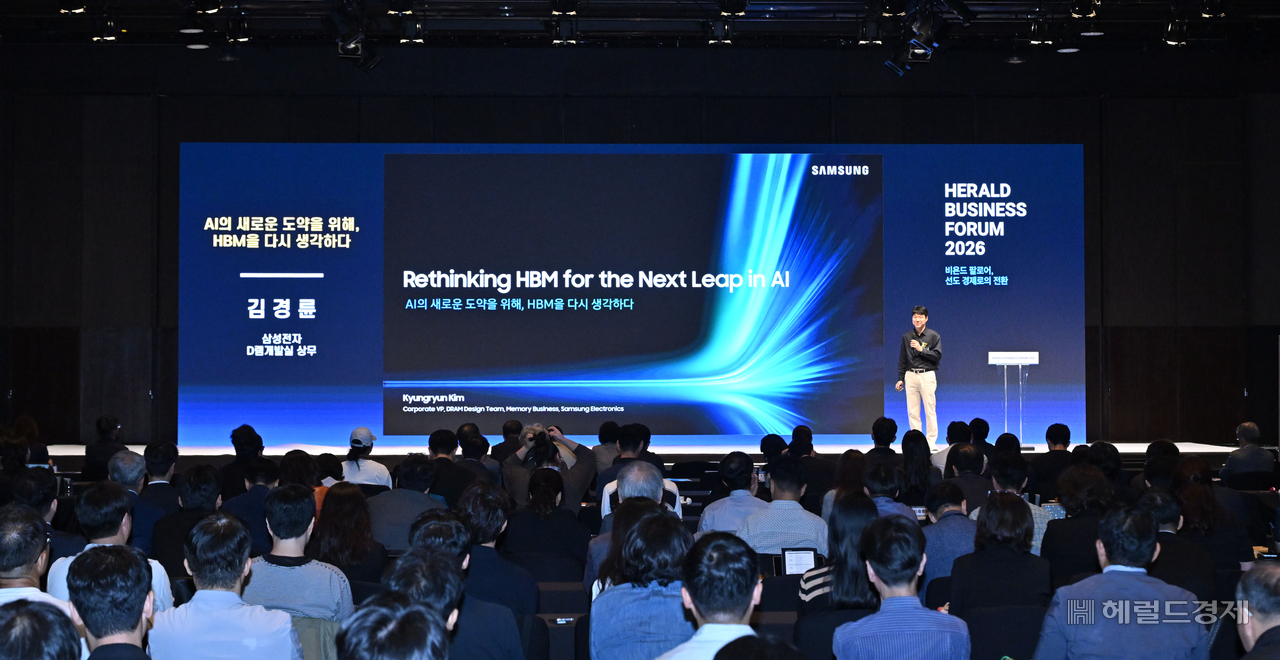
Speaking under the theme "Rethinking HBM for AI's Next Leap," Kim introduced zHBM — a three-dimensional architecture that vertically stacks high-bandwidth memory directly on top of a processor — and said Samsung sees it as the foundation of its next-generation competitiveness.
Samsung Electronics is currently in the sampling phase for HBM4E, its seventh-generation product, while accelerating development of the eighth-generation HBM5. The company is applying its latest process technology to both products, targeting across-the-board improvements in performance and power efficiency.
"HBM5 is targeting significantly higher performance," Kim said. "Compared with HBM4E, we are pursuing goals of more than double the performance, a 20 percent improvement in performance per watt, and about a 20 percent reduction in thermal resistance."
He also said "HBM5 will be the first product to utilize Samsung's foundry 2-nanometer GAA (gate-all-around) process."
GAA is a transistor architecture in which the gate surrounds all four sides of the current-carrying channel, and is widely regarded as a key technology for pushing past the limits of semiconductor miniaturization. Samsung Electronics was the first in the industry to adopt GAA, introducing it at the 3-nanometer node.
"In the conventional 2.5D architecture, the processor and HBM sit side by side, which limits how close the two can get," Kim said. "Changing that structure requires an architectural innovation to overcome the constraints on bandwidth and power consumption."
He said zHBM, which Samsung is developing, "uses a 3D architecture that stacks upward rather than sideways, and we expect it to achieve innovative performance levels that are difficult to reach with conventional 2.5D HBM."
Stacking vertically closes the distance between the processor and the HBM, enabling higher bandwidth and substantially lower power consumption, he explained.
"Where conventional HBM has typically delivered around a twofold performance improvement per generation, zHBM is targeting improvements of four to eight times," Kim said.
"We expect performance per watt to improve by three times and thermal resistance to fall by a factor of 0.1 to 0.6," he added. "Our goal is to achieve through zHBM a leap that conventional HBM simply cannot deliver."
One acknowledged drawback of the 3D vertical stacking architecture is heat dissipation. "It is inherently a structure from which heat is difficult to extract," Kim said. "To address this, we are optimizing stack height and minimizing the number of metal layers."
"With this approach, we believe we can reduce thermal resistance by 0.1 to 0.25 compared with HBM4E and resolve the issue," he added.
Kim said zHBM will drive not only performance and power improvements but also a fundamental shift in how the DRAM ecosystem operates.
"Conventional DRAM products have long been known as commodities — the same product made and sold to everyone. That has been changing gradually with the emergence of customized HBM, but zHBM is something else entirely," he said.
"Because each xPU has a completely different architecture — from physical size to performance requirements — the zHBM stacked on top of it cannot be standardized," Kim said. "Every product has to be built from scratch, which means co-design must happen from the very beginning."
"Without collaboration, zHBM cannot be competitive," he said. "I see the industry moving from commodity to customization, and then from customization to co-design."
"Ultimately, you need a deep understanding of memory, foundry and logic technology all at once," he said. "In that respect, Samsung Electronics, with its comprehensive capabilities across all three, holds a clear advantage."
joze@heraldcorp.com