Samsung SDI strategy executive speaks at Herald Corporate Forum 2026
'Second only to Toyota in solid-state battery patents'
'Supplying cylindrical batteries to 5 Chinese humanoid robot makers'
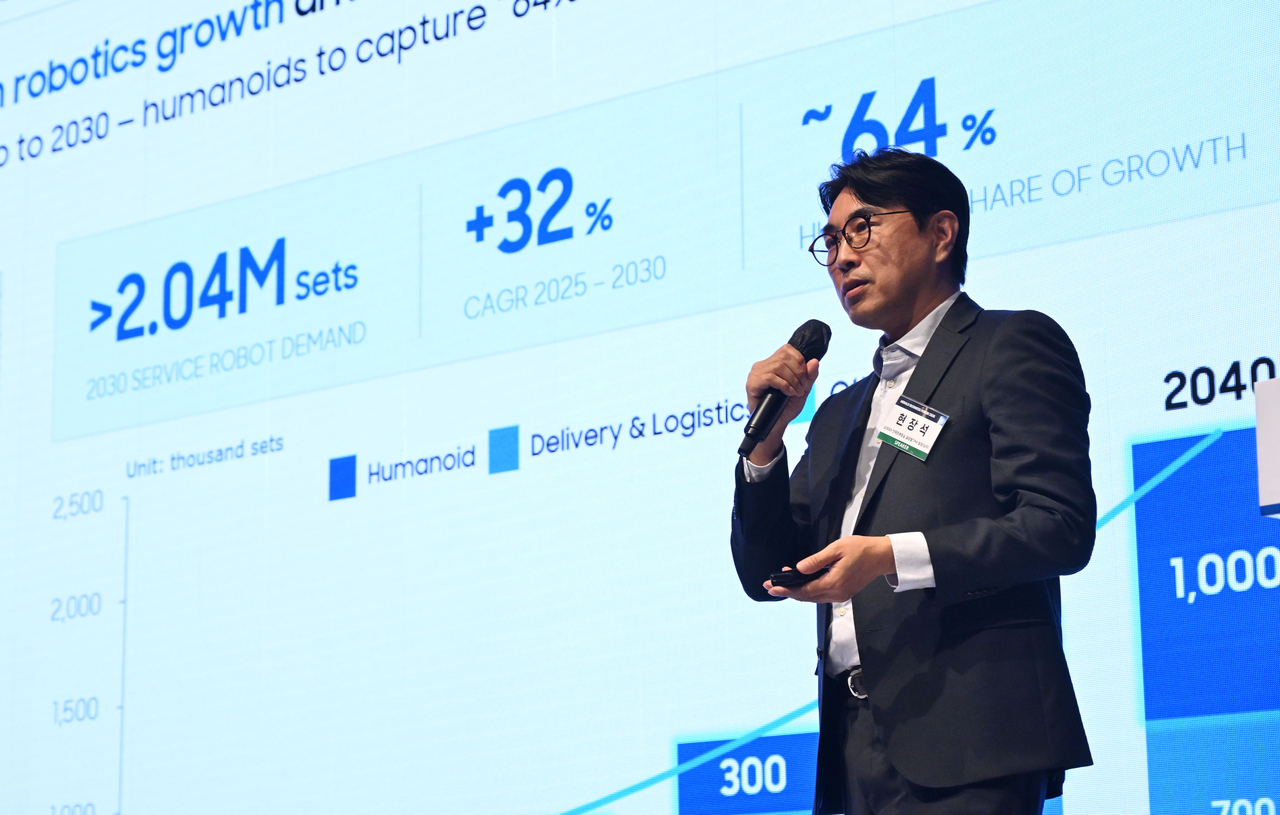
"Next year, you will be able to meet a humanoid robot powered by our 'Solid Stack' all-solid-state battery."
Hyun Jang-seok, head of the Global TPM Team at Samsung SDI's Strategy Marketing Division, made the remarks Tuesday while delivering a lecture titled "The Heart of Physical AI: Battery" at the Herald Corporate Forum 2026, held at the Dynasty Hall of Shilla Hotel in Jung-gu, Seoul. Samsung SDI plans to begin mass production of its "Solid Stack" all-solid-state battery for humanoid robots in 2027, then expand into electric vehicles and air mobility.
Hyun said the humanoid robot market is expected to grow more than 100-fold by 2030. "The strength of humanoid robots lies in their ability to be deployed immediately in factories, homes and other environments built around people," he said. "As tech companies drive advances in AI, robot makers and their customers — automakers — are generating synergies that are propelling the humanoid industry forward."
The growing role of humanoid robots is placing greater demands on the batteries that power them. "We need to pack highly efficient, high-energy batteries into small spaces, making the relevant technologies more important than ever," Hyun said.
From solid-state to humanoids, then EVs and aviation
Samsung SDI said applying all-solid-state batteries to humanoid robots would extend operating time while allowing flexible battery pack designs tailored to the robot's form factor. Safety can also be significantly enhanced as robots work and live alongside people.
All-solid-state batteries use a solid electrolyte instead of a flammable liquid electrolyte. Samsung SDI has further adopted an "anode-free" structure that eliminates the anode entirely, reducing thickness and boosting energy density. According to Samsung SDI, the energy density of its all-solid-state battery exceeds 360 watt-hours per kilogram, compared with less than 320 Wh/kg for conventional lithium-ion batteries.
Hyun cited safety, energy efficiency and space efficiency as the key reasons all-solid-state batteries are needed. Conventional lithium-ion batteries require additional components such as insulation materials to prevent fires, but all-solid-state batteries do not. In electric vehicles, they can extend driving range and improve output performance, while in air mobility applications they can increase flight distance and duration while reducing aircraft weight.
"Ordinary lithium-ion batteries hit their limits at around 4.5 volts, but Samsung SDI's all-solid-state battery can withstand overcharging of more than 10 volts," Hyun said. "Applied to an electric vehicle, it can reduce the weight of a 2.7-ton luxury sedan by more than 200 kilograms and expand the trunk space of a compact sedan by more than 10 percent."
Anticipating the potential of all-solid-state batteries, Samsung SDI in 2023 became the first company in South Korea to establish a pilot production line called the "S Line" and formed a dedicated commercialization team. "We started with commercialization in mind, not just research and development, so we manage the entire process — from development to the production line to the supply chain — in one place," Hyun said.
Hyun also highlighted the company's patent competitiveness. Samsung SDI has filed about 1,200 patents related to all-solid-state batteries, the most among domestic companies. "In the global market, we hold the second-largest number of solid-state battery patents, after Toyota," he said.
'Supplying cylindrical batteries to humanoid makers; targeting solid-state mass production in 2027'
Hyun said Samsung SDI is also ahead in the current robot battery market. The company's 21700 cylindrical battery — 21 millimeters in diameter and 70 millimeters tall — sold more than 150 million cells this year, a significant portion of which are being supplied to more than five Chinese humanoid robot manufacturers, he said.
He listed four requirements for robot batteries: high energy density, high output and fast charging, safety, and design flexibility. "Humanoid robots need high output when jumping suddenly or balancing to avoid falling," he said. "Safety is also critically important, since they share the same space as people."
To meet those requirements, Samsung SDI makes its robot electrodes thinner than those used in electric vehicles and aligns electrode materials using a magnetic field to shorten the travel distance of lithium ions. The anode uses a silicon composite material with more than 10 times the capacity of graphite. The batteries also feature a two-stage safety mechanism that first cuts the current and then vents gas when an abnormality is detected.
Hyun described Samsung SDI as the company responsible for the "energy heart" of the physical AI era. "Our goal is to mass-produce all-solid-state batteries for commercial use in humanoid robots in 2027," he said.
eyre@heraldcorp.com