Fruit fly trader (1): We let a simulated fruit fly brain trade bitcoin — here's what happened
Since the complete wiring diagram of the fruit fly brain was made public, attempts to build a "virtual fruit fly" on a computer have been popping up around the world — running games and simulations on the digital insect has become something of a trend. The Herald Business is publishing a series documenting one reporter's experiment in handing over cryptocurrency trading to a simulated fruit fly brain built from that publicly available connectome. All trades were conducted as simulated transactions, and this series is not intended as investment advice. [Editor's note]
![[AI-generated image]](https://wimg.heraldcorp.com/news/cms/2026/09/29/news-p.v1.20260929.0b917586be994bfaaa41918994ed686f_P1.png)
There is an old joke on Wall Street that a blindfolded monkey throwing darts at a stock listing can match the performance of professional fund managers. The point is that beating the market is that hard.
When The Herald Business loaded a virtual brain — a complete digital copy of a real fruit fly's neural wiring — onto a computer and put it in charge of bitcoin trading, the judgment of roughly 130,000 neurons failed to outperform a single-line automated rule. All trades were simulated, with no real money involved.
The fruit fly is the kind of insect that appears out of nowhere and drives you to distraction, yet it has been science's go-to laboratory animal for more than a century. About 75 percent of human disease-related genes have a counterpart in the fruit fly, making it a workhorse for research into everything from cancer and aging to sleep.
![A fruit fly. [Getty Images Bank]](https://wimg.heraldcorp.com/news/cms/2026/09/29/news-p.v1.20260929.2f824c9c314a46c6b12d606feaf638a0_P1.png)
In 1933, Thomas Hunt Morgan won the Nobel Prize in Physiology or Medicine for using fruit flies to reveal the role of chromosomes in heredity. In 2017, Jeffrey Hall, Michael Rosbash and Michael Young shared the same prize for using the insect to uncover the molecular mechanisms of the biological clock.
Even so, the inside of the fruit fly's brain long remained uncharted territory. The fly's entire genome was sequenced back in 2000, but a complete map of its neural architecture did not exist.
![The fruit fly brain's neural network. [FlyWire]](https://wimg.heraldcorp.com/news/cms/2026/09/29/news-p.v1.20260929.9e6104c4788247b89eb5ec205ea67b7a_P1.png)
The fruit fly brain, laid bare
That changed in 2024, when nine papers published in the journal Nature presented the first complete map of a single fruit fly's brain — all 139,255 neurons and about 54.5 million connections between them.
The exhaustive wiring diagram showing how every neuron connects to every other was named the "connectome." If the neural wiring packed inside a fruit fly brain the size of a poppy seed were stretched end to end, it would run 149.2 meters.
The map was completed by an international research consortium called FlyWire. The team sliced a fruit fly brain into 7,050 thin sections and captured 21 million electron-microscope images.
AI first traced the neurons in those images, while researchers and members of the public — participating in what amounted to a citizen-science game — corrected the errors the AI made. From 2019, the combined human effort spent on proofreading totaled 33 person-years. Sebastian Seung, a professor at Princeton University who led the research, said the project would have taken nearly 50,000 person-years without AI.
![All 139,255 neurons of the fruit fly brain. [FlyWire]](https://wimg.heraldcorp.com/news/cms/2026/09/29/news-p.v1.20260929.9dc6d893c17c4f8aa927a5b03a3dba28_P1.png)
A person-year is a unit calculated by multiplying the number of participants by the duration of observation. Thirty-three person-years represents the amount of work one person would complete working without a break for 33 years, or 33 people working for one year.
Philip Shiu, a former postdoctoral researcher at UC Berkeley, published a paper in Nature on the same day as the FlyWire connectome study. Running the wiring diagram on a single laptop, he predicted which neurons in the fruit fly brain would activate when taste and touch receptors were stimulated. His team's model achieved 91 percent accuracy across 164 predictions verified through experiment.
US startup Ion Systems announced in March that it had connected a fruit fly brain emulation to a virtual body, enabling a virtual fruit fly to walk, groom itself and search for food without reinforcement learning.
Showing the chart to a fruit fly — as a smell
Running the simulation on a home PC — using the FlyWire connectome as the foundation and layering on Shiu's team's settings to make it behave like a real brain — the first obstacle was raw computing speed. An attempt to accelerate the calculations using a graphics card of the kind commonly used for AI workloads backfired: because the card was not purpose-built for this type of computation, it ran 55 to 430 times slower than the CPU, so the central processing unit ended up doing the work instead.
Shiu's team's model uses a "leaky integrate-and-fire" (LIF) approach, which treats each neuron like a bucket with a small hole in the bottom.
Under this scheme, an excitatory signal pours water into the bucket, while an inhibitory signal scoops water out. When the water level crosses a threshold, the neuron fires a signal and the bucket empties; left alone, the water slowly leaks away through the hole.
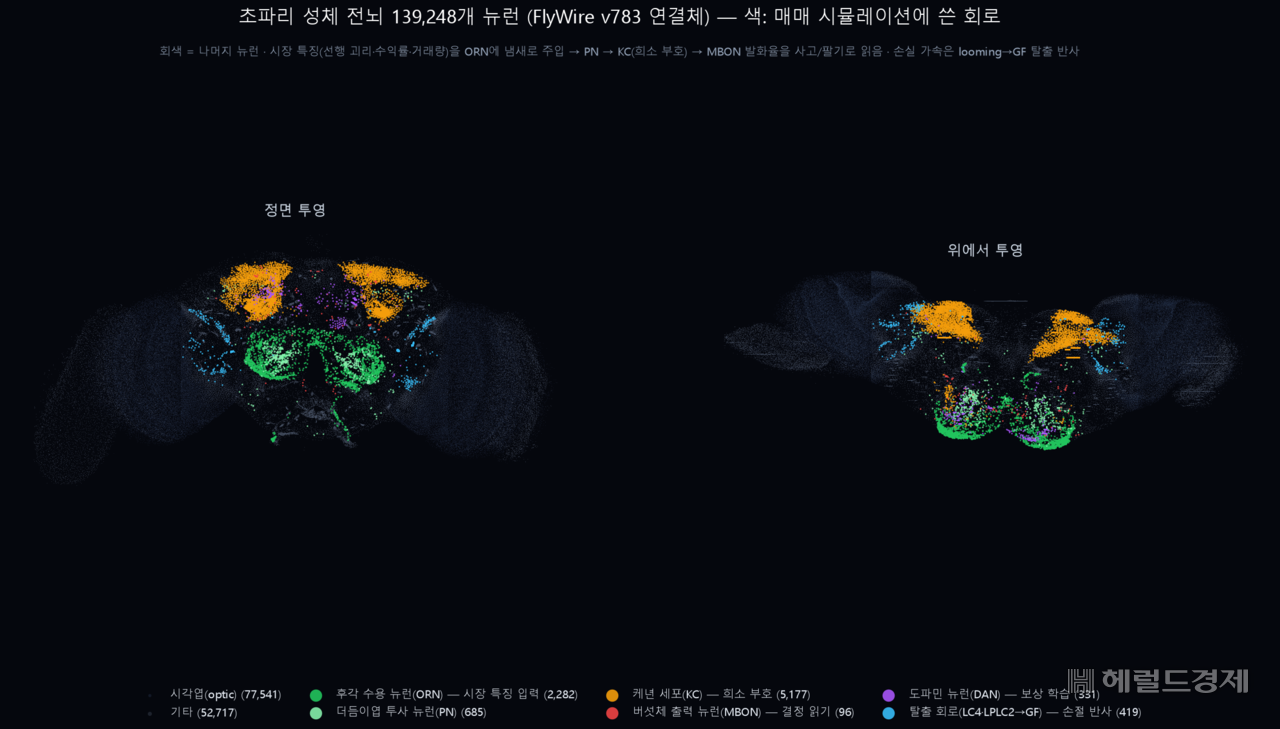
Running all roughly 130,000 neurons simultaneously in this model makes it possible to track where a signal spreads through the connectome when a specific sensory neuron is stimulated — and which neurons it ultimately activates.
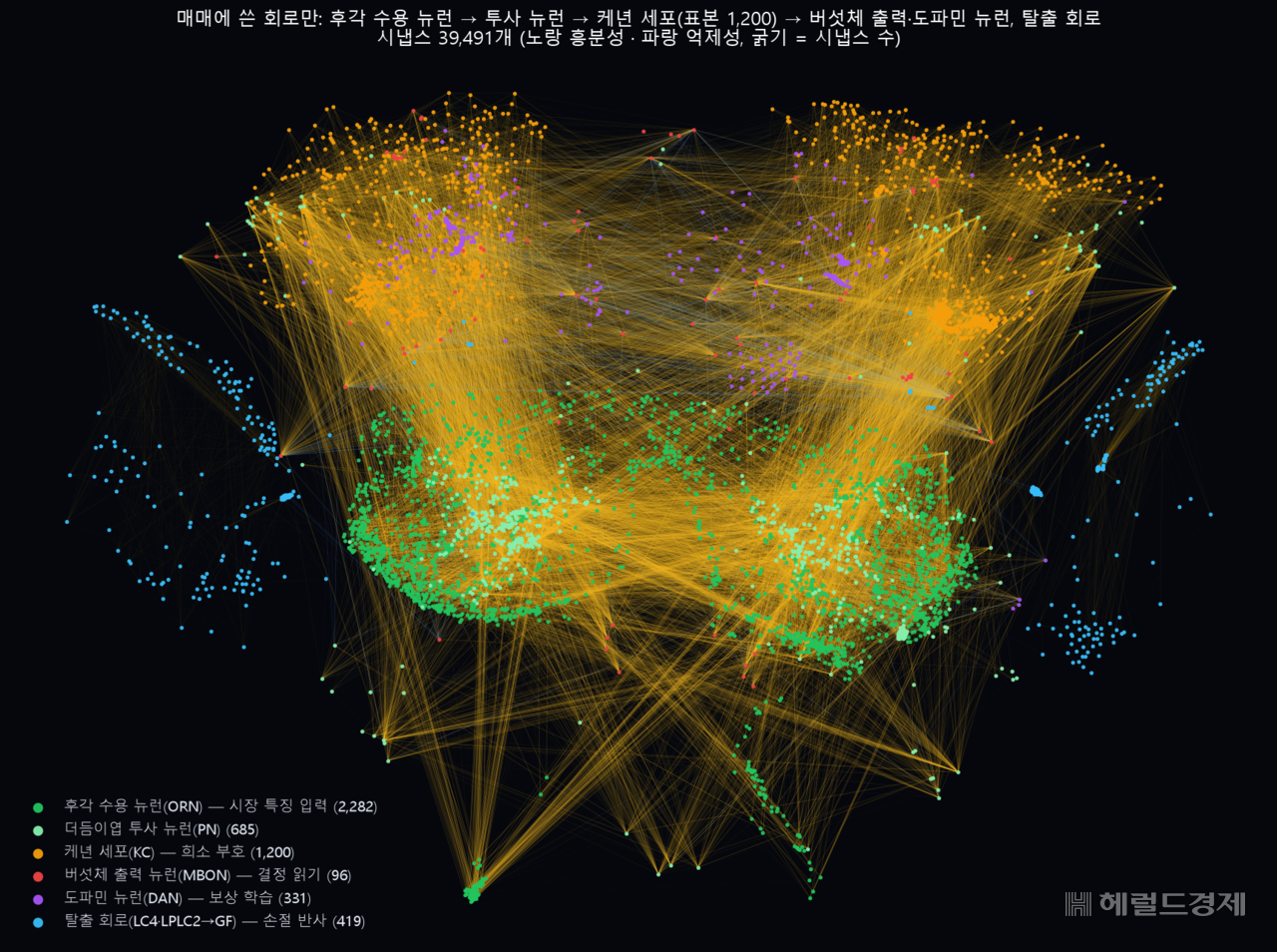
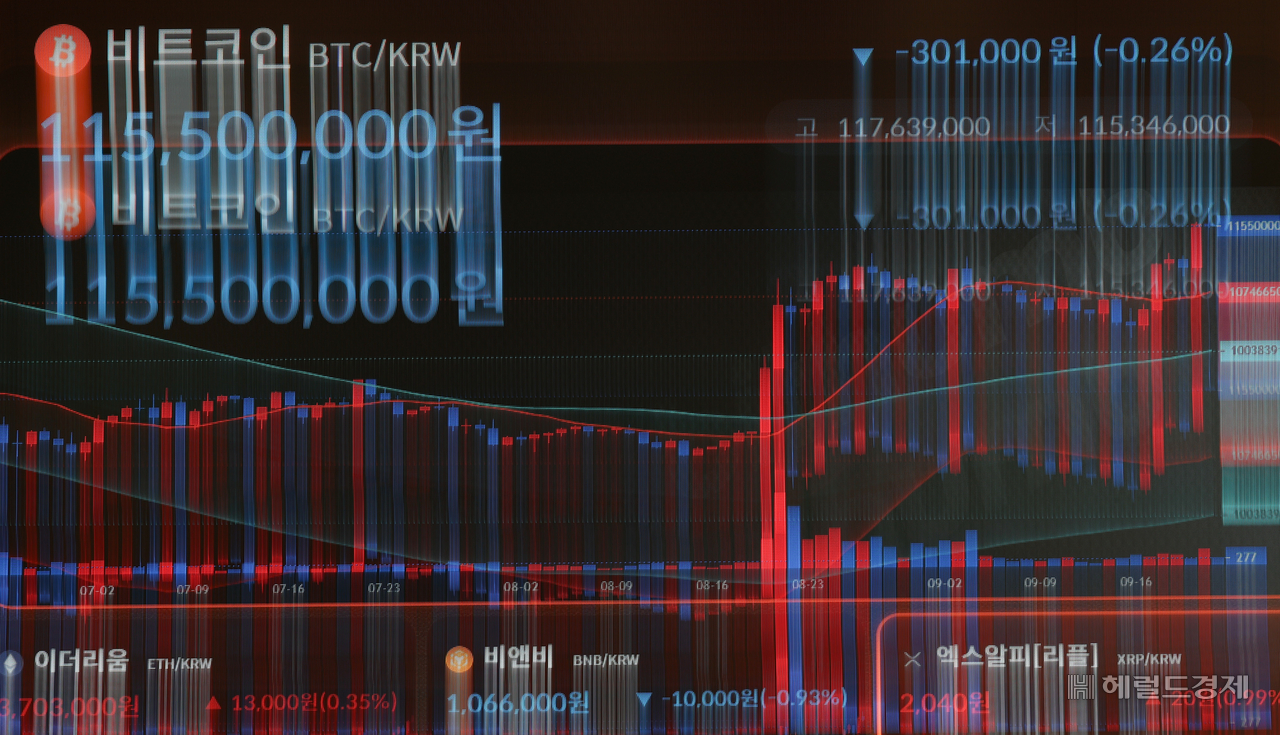
To make market data intelligible to a fruit fly that cannot read a chart, the data were converted into olfactory signals and fed into 2,282 olfactory receptor neurons. The input encoded the price gap between bitcoin on the overseas exchange Binance and on the domestic exchange Upbit. Signals representing price volatility and trading volume were added as separate scent inputs.
The olfactory signals flow into the mushroom body, the fruit fly's center for learning and memory — named for its resemblance to a mushroom.
Inside the mushroom body, 5,177 Kenyon cells receive the incoming scent signals. Because different odors activate different combinations of Kenyon cells, they function as a kind of "scent barcode." The mushroom body reads that barcode and relays it to other parts of the fly's brain.
In a real fruit fly, the mushroom body helps decide whether the fly moves toward or away from a smell. That principle was mapped onto trading: a response that would draw the fly toward a food scent was coded as a "buy" signal, while a response that drove it away was coded as "sell."
A one-line rule beat the fruit fly
The experiment used 15-minute candlestick data for bitcoin. Every 15 minutes, the simulated fruit fly brain "smelled" the latest price gap and decided whether to buy or sell.
Because the fruit fly brain has no capacity to interpret a chart, the experiment fed it a large historical archive of price gaps one by one as scent signals and recorded how the mushroom body responded to each. In the live simulation, each new price gap was matched against that lookup table to determine the trading decision.
The fruit fly brain's performance was benchmarked against three alternatives: simply buying bitcoin and holding it; trading randomly; and a one-line rule that automatically executes a trade whenever the price gap exceeds a set threshold.
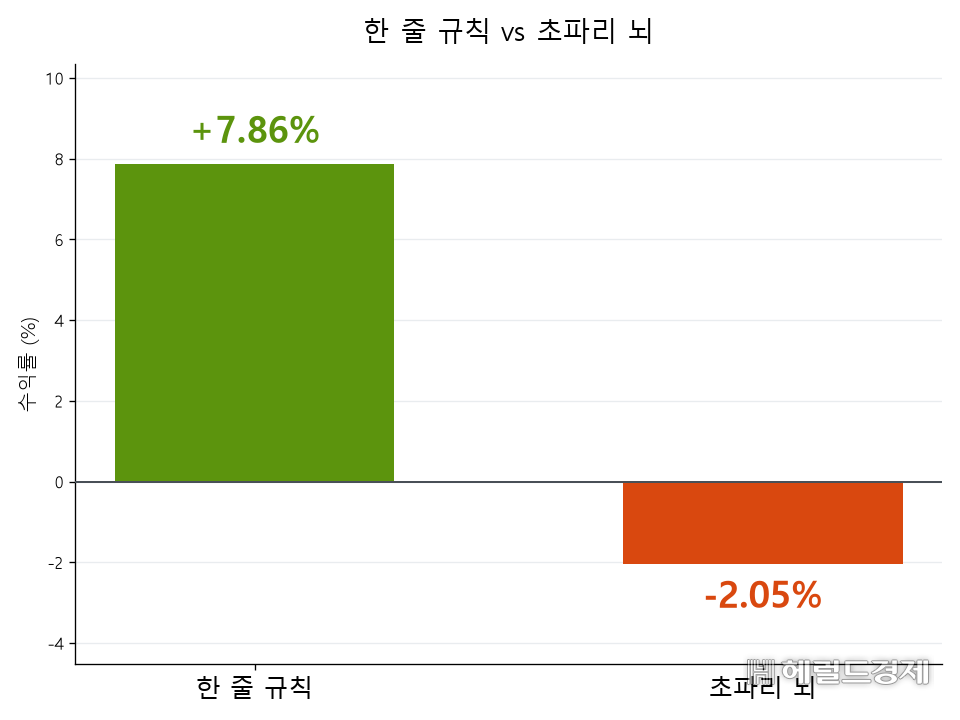
The fruit fly brain failed to beat any of the three benchmarks. Adding a second scent signal encoding price volatility made no difference.
The virtual brain's responses fluctuate slightly even when given identical inputs. To smooth out that noise, each decision was averaged over 16 runs — but the results did not change.
The simple one-line rule, by contrast, returned a gain of 7.86 percent in the simulated trades. The fruit fly brain posted a loss of 2.05 percent.

In bitcoin trading, a single round-trip transaction at market price costs 0.116 percent of the trade value once fees and the bid-ask spread are combined. Every time 1 million won ($740) worth of bitcoin is bought and sold, 1,160 won disappears.
For the fruit fly brain — making a buy-or-sell decision every 15 minutes — to turn a profit, it would need to identify moments when each trade yields more than 0.116 percent. The brain recorded more winning trades than losing ones before fees, but once transaction costs were included, it repeatedly locked in losses.
It should be noted that the method used here relies on a basic model, and it would be a stretch to conclude that a real fruit fly would make the same decisions in the same situation. The way market data were converted into scent signals was also determined by the experimental design; translating the data differently before feeding it to the fly could produce different results.
Meanwhile, a follow-up experiment gave the fruit fly brain feedback — returning trading gains and losses as rewards and penalties — so it could learn directly which signals were profitable.
This series documenting one reporter's experiment in letting a virtual fruit fly brain built from the publicly available connectome trade cryptocurrency will run on Saturdays and Sundays for four weeks.
dbsdn1110@heraldcorp.com