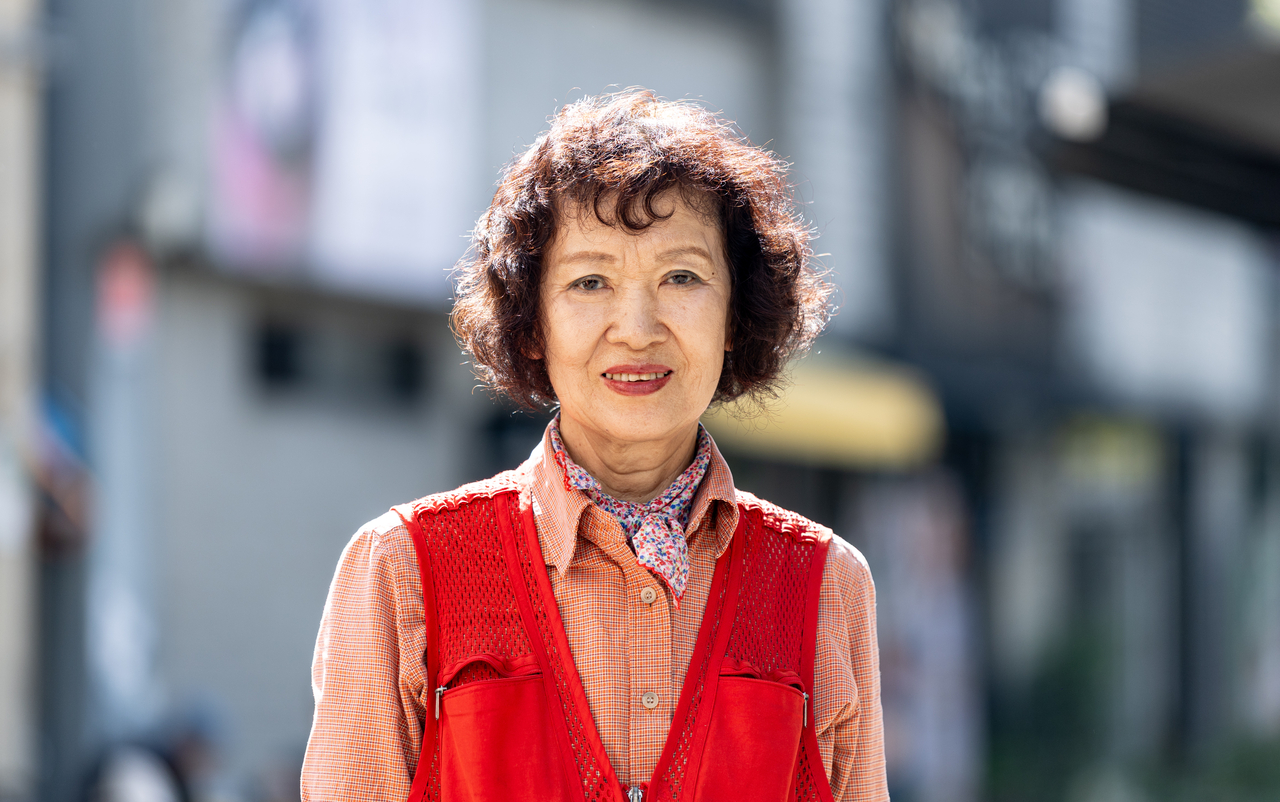
The life of Na Jeong-hye, 72, a resident of the Donui-dong single-room district in Jongno-gu, traces a familiar arc — divorce, career interruption and a lifetime of precarious work. Her story reflects a broader reality: elderly women in South Korea are poorer than their male counterparts, and the statistics show just how wide that gap has grown.
Editor's note: South Korea's elderly poverty rate stands at 2.7 times the OECD average. Older women fare worse than older men. For decades, women were expected to devote themselves to family caregiving and step away from their careers. That interruption eroded their professional standing and made financial independence harder to achieve. Now in old age, many struggle to cover basic living costs. The Herald Business examined how the sacrifices women made in their younger years are now being "billed back" to them in the form of poverty and insecurity.
The alley running from Exit 6 of Jongno 3-ga Station in Jongno-gu, Seoul, toward Nakwon Arcade fills with outdoor diners every evening. When the last customers begin to drift away, Na Jeong-hye's workday begins. Na was born in 1954.
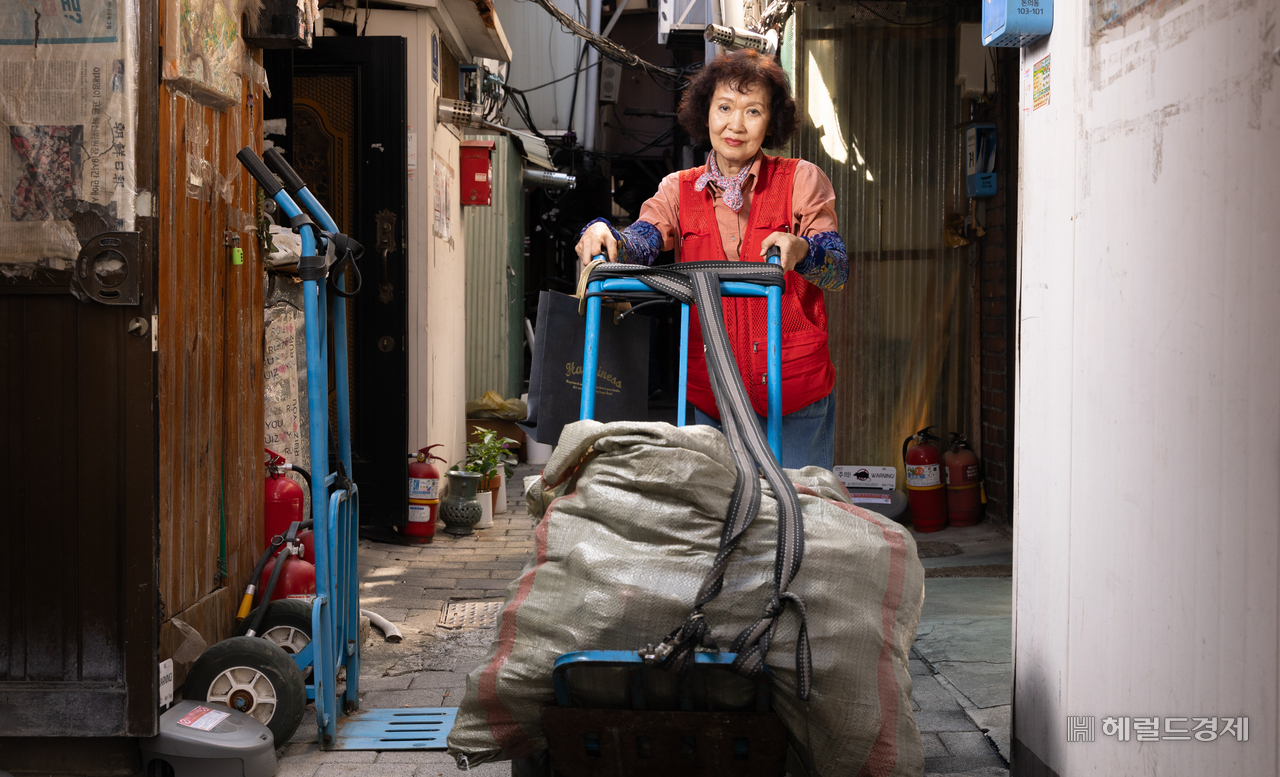
Around 11:30 p.m., after the restaurants close and put out their trash, she picks through the bags for empty cans, bottles and scrap metal worth selling. Speed matters — competition is fierce. On busy nights, more than 10 elderly residents comb the same alley for the same purpose. The work stretches until around 1 a.m.
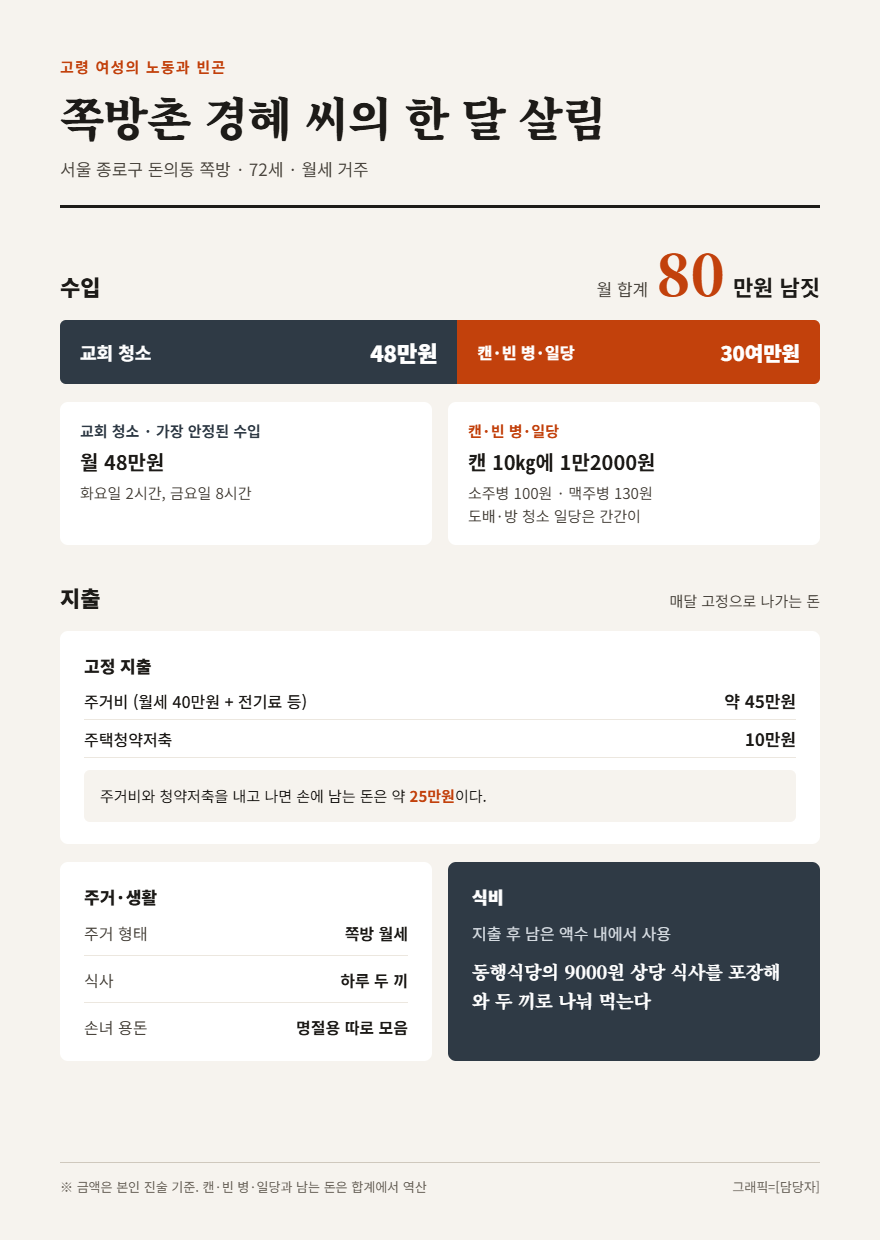
At 6 a.m. Tuesday, Na sorted through the recyclables she had gathered the night before, then loaded the scrap metal and empty cans into two large sacks and hauled them to a scrap dealer. A sack of cans weighing about 10 kilograms fetches 12,000 won ($9). On a good night she collects 18 to 20 kilograms and walks away with around 20,000 to 25,000 won. Soju bottles sell for 100 won each; beer bottles for 130 won. Neighbors who know she collects empties sometimes leave bottles outside their doors for her.
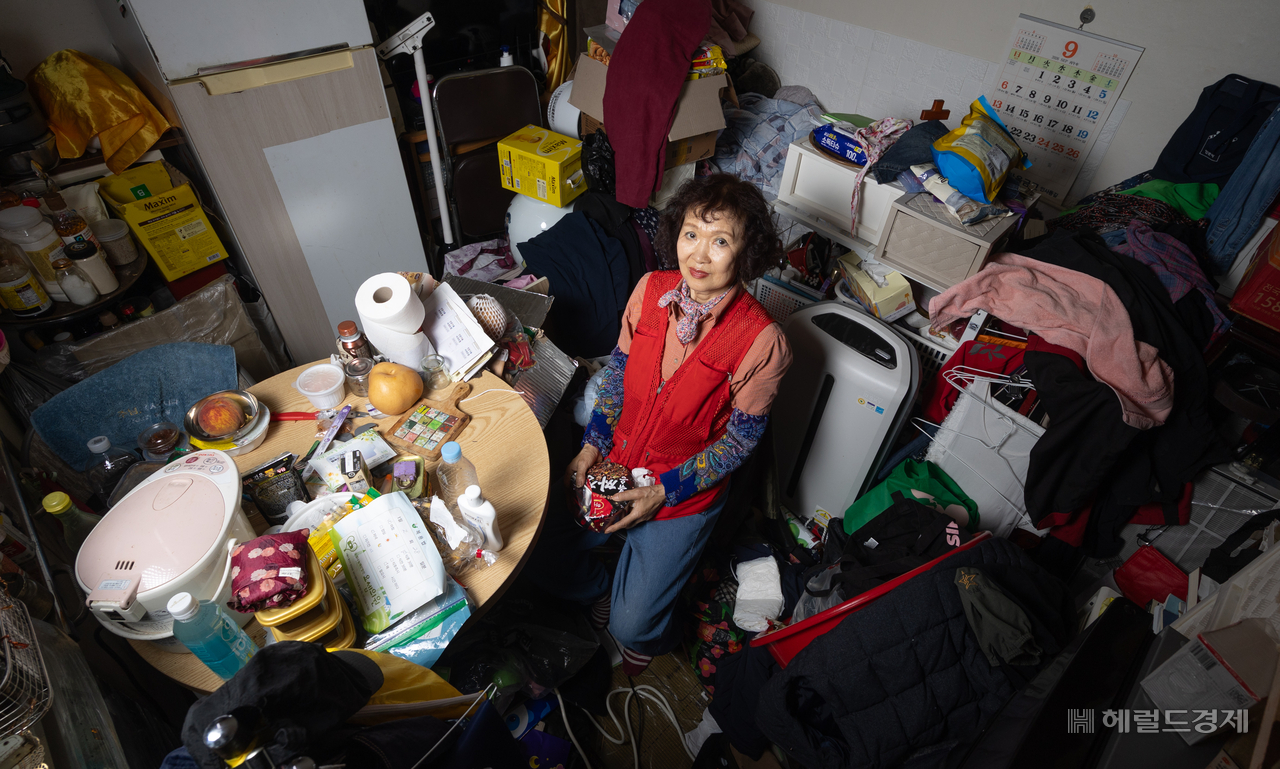
Na eats two meals a day. She picks up food from a community dining hall and divides it into two portions.
Two days a week she cleans a church, earning 480,000 won a month — her most reliable income. Adding occasional day wages from wallpapering and room cleaning, her monthly earnings come to just over 800,000 won.
Her biggest expense is rent: 400,000 won a month. With electricity and other utilities, housing costs run to about 450,000 won. She also sets aside 100,000 won each month for an apartment subscription savings account. Whatever remains, she said, she saves a little at a time to give as pocket money to her grandchildren when they visit for Chuseok or the Lunar New Year.
A bus conductor at 19
"There was nothing I could do with a child in tow. The places I tried to work at wouldn't take me — said I was a woman with a kid."
That is how Na remembers the moment, more than 40 years ago, when her working life was cut short. But she needed money to raise her son, so she had no choice but to chase whatever unstable work she could find. To understand how she came to live in a single-room tenement collecting scrap, it helps to trace what she did before.
Her first job came in 1973, when she was 19: she became a bus conductor. Working 14-hour days, she earned 12,000 won a month — not a small wage compared with other jobs at the time. "I made more than the people working in factories," she recalled.
Around the age of 23, people around her began urging her to marry. She would have preferred to keep working, but marriage was the expected path, and she left her job to wed. A son was born the following year. The marriage was troubled. Her husband turned violent when he drank, and eventually tried to take the money she had been saving for their son's education. Deciding she could not go on that way, she left. Her son was barely four or five years old.
A career cut short after divorce
Na was now a single mother, but there were almost no jobs she could take with a young child.
She tried to return to work as a bus conductor, but getting rehired after a gap proved difficult. She pleaded for a second chance and was turned away.
She had left school early and had no qualifications and no specialized skills. Jobs that would allow her to bring a child along for long hours were nearly impossible to find, and there was nowhere to leave him while she worked.
She considered learning hairdressing, but a childhood accident had cost her part of her right index finger, leaving it shorter than normal and making it impossible to hold scissors.
In desperation, she said, she once walked to the gates of Holt Children's Services with her son, wondering whether she should leave him there. She could not bring herself to walk away. "I thought all sorts of things, but in the end I decided — he's mine, I gave birth to him, so I have to raise him at least through high school. Until then, he's my responsibility."
Working restaurant jobs, Na scraped together 1.8 million won ($1,320) in seed money and set up a tteokbokki stall near an elementary school in Hagye-dong, Nowon-gu, Seoul.
The stall found its footing. When her son entered middle school and she had more hours to work, she closed it and opened an indoor pojangmacha, a small covered food stall.
By her early 40s, she had accumulated about 54 million won — savings from the apartment subscription account and other sources combined. It had taken more than a decade of running her own business as a single mother. For the first time, she could think about buying a home and planning for old age.
That foundation did not last. She lost money working as an insurance agent during the Asian financial crisis, and a loan she had made to an acquaintance was never repaid. The 54 million won was gone, and she was left carrying more than 50 million won in debt.
Starting over with nothing in her 40s, Na moved to Jeju and worked in the kitchen of a shop her younger sibling ran, then returned to Seoul and sold goods on the subway. Later she worked as a street vendor in the Jongno area, selling reading glasses and other small items. Paying off all the debt took seven or eight years. By then she was past 60. Around that time she moved into a single room in Jongno-gu.
Na has a surgical scar on her back. Years of bending over in restaurant kitchens left her with chronic back trouble, she said, and she still takes medication to manage the pain.
"When I was raising my child, I had absolutely nothing — it was so, so hard. If I had to go back to that time, I don't think I could survive it now."
Poorer in old age: 'The result of 30 years of accumulated discrimination'
Na's story is not unusual. Elderly women in South Korea are, as a group, poorer — and the data bear that out.
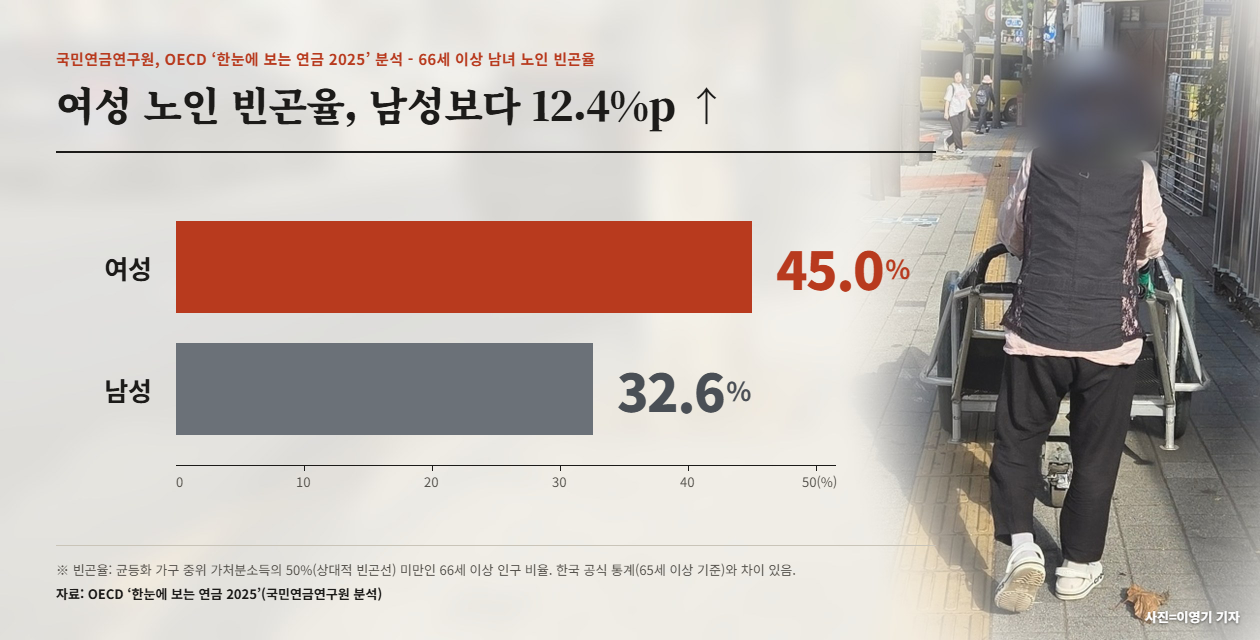
An analysis of OECD "Pensions at a Glance 2025" data published by the National Pension Research Institute in July found that the poverty rate among people aged 66 and older was 45.0 percent for women, compared with 32.6 percent for men.
The gender income gap among workers aged 60 and older, confirmed through an analysis by the Korea Employment Agency for Older Persons, was stark. An examination of 3,000 participants in senior employment programs last year, broken down by gender and five income brackets, showed the depth of poverty among elderly women.
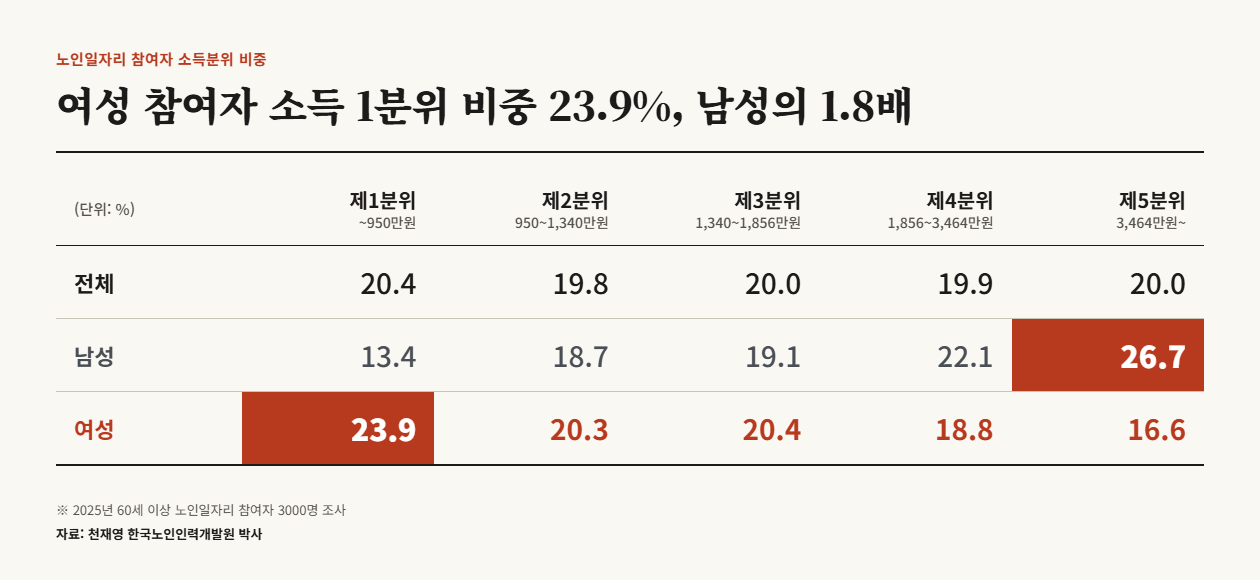
Among senior employment program participants, 23.9 percent of women fell into the lowest income bracket — those earning less than 9.5 million won a year on average — compared with 13.4 percent of men. In the top bracket, those earning 34.64 million won or more annually, women accounted for 16.6 percent and men for 26.7 percent.
A report on elderly women's retirement income and employment support published by the Korean Women's Development Institute in June found that the personal income of women aged 60 to 79 amounted to just 40.4 percent of men's. The average personal income for older men stood at 22.78 million won, while for women it was only 9.2 million won.
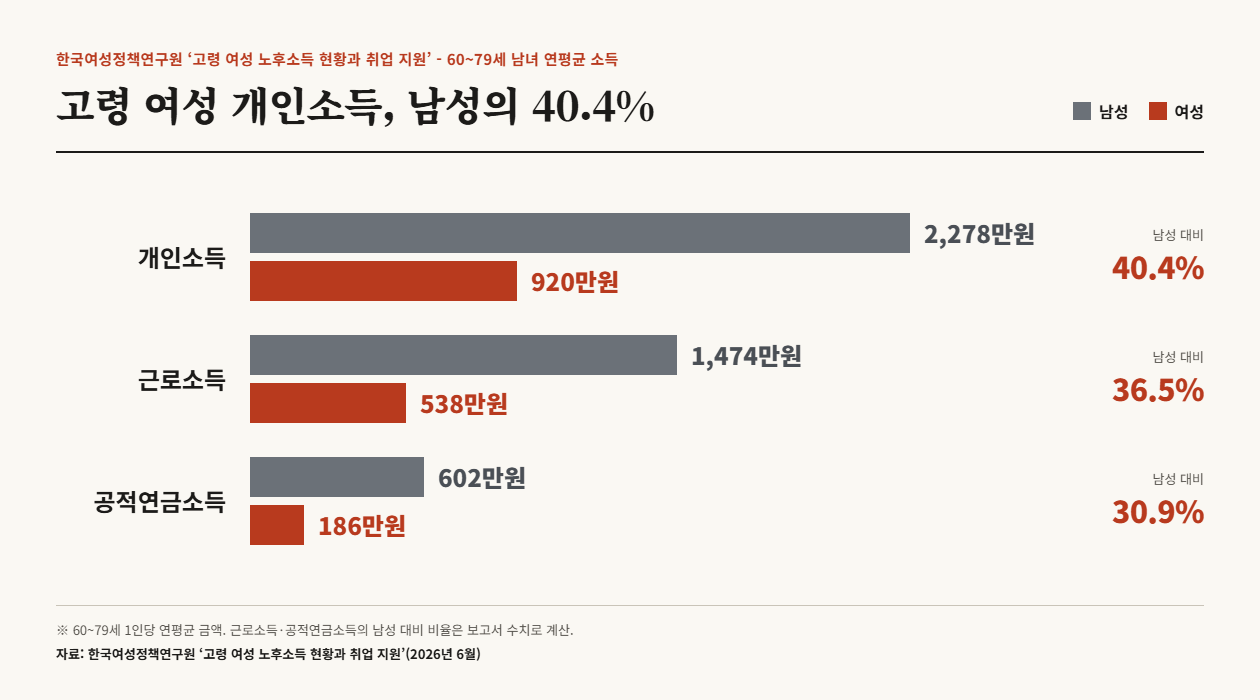
The gap was equally pronounced in public pension income, including the national pension. The average public pension income for men was 6.02 million won, while for women it was only 1.86 million won.
Kim Nan-ju, a researcher at the Korean Women's Development Institute, said the poverty of elderly women is "the result of 30 years of accumulated discrimination." Women who devoted themselves to the home were unable to save during their prime working years, she said, face high barriers to re-entering the labor market and consequently have lower rates of national pension enrollment.
Cheon Jae-young, a researcher at the Korea Employment Agency for Older Persons, said that if elderly women's poverty continues across generations, "we must also consider the rising cost of the social safety net."
kido@heraldcorp.com
20ki@heraldcorp.com
newday@heraldcorp.com
jookapooka@heraldcorp.com