Disbursement rate stands at 8.9% after two months; over half of funds went to a single company
Export-Import Bank cites falling exchange rate for low demand; lawmaker Kim Young-hwan calls for redesign of eligibility criteria

The Export-Import Bank of Korea disbursed only 8.9% of a 300 billion won ($221 million) ultra-low-interest loan program designed to help small and medium-sized enterprises struggling with a high exchange rate, data released Wednesday showed.
The bank said falling exchange rates had reduced demand for the program, but critics say the poor performance from its very first month points to deeper problems with how the program was designed and whether it matches actual market needs.
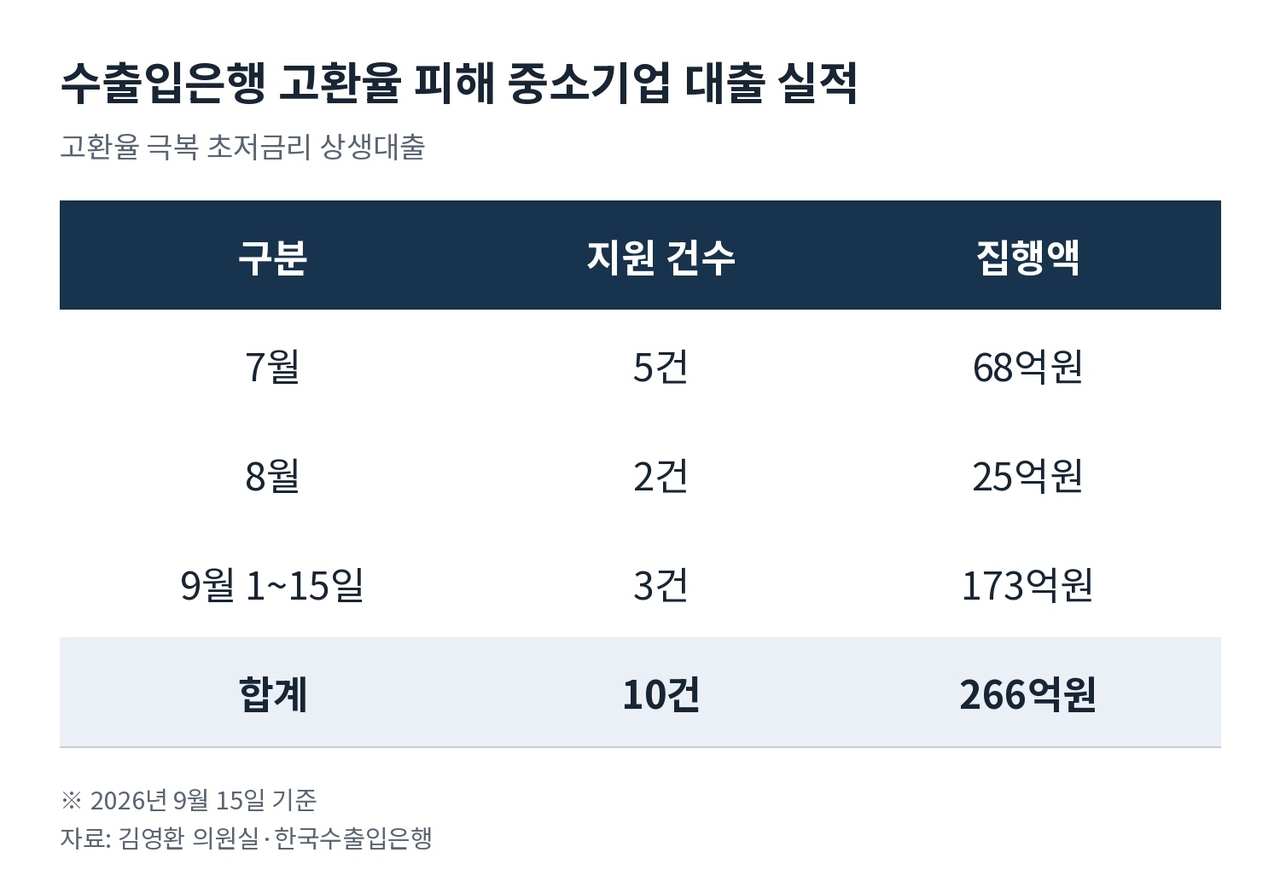
According to national audit materials submitted to Democratic Party of Korea lawmaker Kim Young-hwan of the National Assembly's Finance and Economic Planning Committee, the program — officially called the "high-exchange-rate relief ultra-low-interest co-prosperity loan" — had recorded just 10 disbursements totaling 26.6 billion won as of Sept. 15. Of the total 300 billion won ceiling, 273.4 billion won remains unspent.
The Export-Import Bank launched the product on July 6, when the won-dollar exchange rate stood at 1,539.7 won. It offers import financing with a maturity of one year or less at a rate equivalent to the bank's funding cost — the benchmark interest rate plus a term spread — to ease the payment burden on small and medium-sized enterprises that import raw materials.
Companies can apply by submitting a damage verification letter and supporting documents. The bank also granted liability exemptions to its loan officers to speed up approvals. The average interest rate benefit applied to participating companies was 1.78 percentage points.
Monthly disbursements were modest, however: five cases totaling 6.8 billion won in July and two cases totaling 2.5 billion won in August. Through Sept. 15, three more cases worth 17.3 billion won had been processed, but 15 billion won of that amount went to a single mobility company based in South Gyeongsang Province.
That single loan accounted for 56.4% of total disbursements. Excluding it, the remaining nine cases totaled 11.6 billion won — just 3.9% of the overall program ceiling.
The Export-Import Bank said demand had declined as the exchange rate fell. Kim pushed back, noting that the disbursement rate was only 2.3% even in July, the program's first month, and said the bank should examine not only exchange rate movements but also whether its original demand projections and program design were sound.
The restriction limiting loan use to new import financing was also flagged for review. Under current rules, the product cannot be used to refinance existing Export-Import Bank loans or to switch from loans held at other financial institutions. The application window runs through the end of this year.
"If you promised 300 billion won in support and disbursements were stuck in the 2% range from the very first month, you need to look at the program design before blaming the exchange rate," Kim said. "The bank needs to go back and survey actual demand in the field and fix the program accordingly." He added that the bank should present a concrete redesign plan to ensure the remaining 273.4 billion won reaches companies that genuinely need it.
fact0514@heraldcorp.com