- Pan-government framework spans 15 ministries; over 200 trillion won in national R&D over 5 years
- 'Block funding' introduced for university R&D; evaluation system shifted to qualitative, absolute assessment
- Supercomputer No. 6 with over 8,000 GPUs to power 'K-Moonshot' initiative
The South Korean government plans to channel 4 trillion won ($2.94 billion) next year into seven strategic technology sectors it has designated as future growth engines under the "7 SEED" initiative.
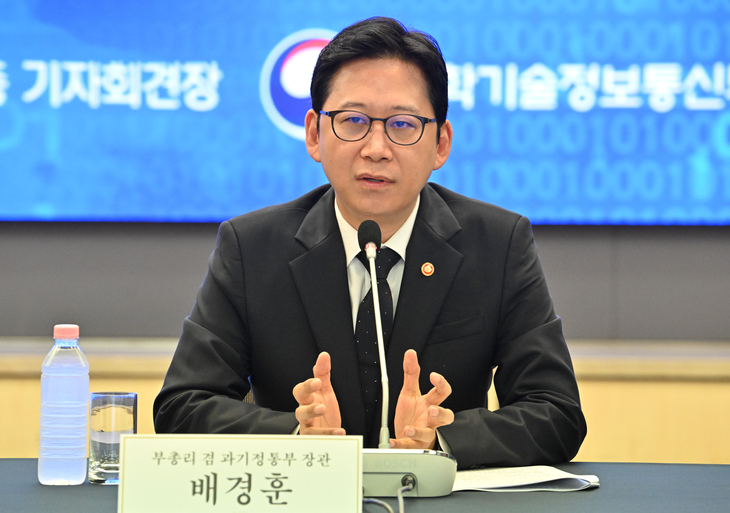
Deputy Prime Minister and Science and ICT Minister Bae Kyung-hoon convened the 13th Science and Technology Ministers' Meeting at Government Complex Seoul on Wednesday, where officials discussed the 7 SEED project roadmap and a broader plan to reform the country's research and development system.
The seven SEED sectors are small modular reactors, nuclear fusion, renewable energy, quantum technology, aerospace, advanced biotech and advanced supply chains. The government will establish a pan-government coordination framework involving 15 ministries, agencies and committees, and commit 4 trillion won based on the 2027 budget proposal.
The government also plans to expand investment-style R&D in which the public and private sectors share risk. It will support deep tech startups and corporate growth through the National Growth Fund, the Science and Technology Innovation Fund and the Fund of Funds, while also pursuing domestic development of advanced research equipment and early positioning in international standards.
The national R&D ecosystem is set for a broader overhaul. Under a medium- to long-term investment strategy covering 2026 to 2030, the government will commit more than 200 trillion won over five years. Large-scale R&D projects worth 100 billion won or more will face tighter pre-planning reviews.
To ease the administrative burden on researchers, the current two-tier R&D evaluation system — split between ministry self-assessments and reviews by the Office for Government Policy Coordination — will be consolidated into a single integrated evaluation. Assessment criteria will shift toward qualitative and absolute measures focused on representative outcomes, with results broken into five grades to guide budget allocation.
University R&D will also be restructured. The government will introduce a new block-funding program that provides research grants to institutions as a whole rather than to individual projects, allowing universities to build research capacity over the long term. Plans also include expanding the ranks of full-time researchers and equipment specialists, and promoting shared use of university research facilities. The government had earlier signaled its intention to introduce block funding when it announced the overall direction of the 7 SEED initiative.
To ensure research outputs move beyond papers and patents and into the market, the government will strengthen technology commercialization. It will expand competitive, stage-gate R&D evaluations that assess commercial viability, broaden demonstration and certification support packages, and link ministry-level technology transfer platforms through an AI-driven data integration system.
The government will also accelerate "K-Moonshot," an initiative that uses AI to tackle major scientific challenges. A portion of the resources from the sixth national supercomputer — equipped with more than 8,000 GPUs — will be allocated to the program, along with the development of sector-specific AI agents and an AI-ready framework for research data held by government-funded science institutes.
"The gap between countries that have secured frontier AI capabilities and those that have not will determine not only their industries and economies, but their future national competitiveness," Bae said. "What South Korea needs right now is not 'speed control' but 'speed accountability.'"
nbgkoo@heraldcorp.com