Samsung AI Forum 2026 held Wednesday
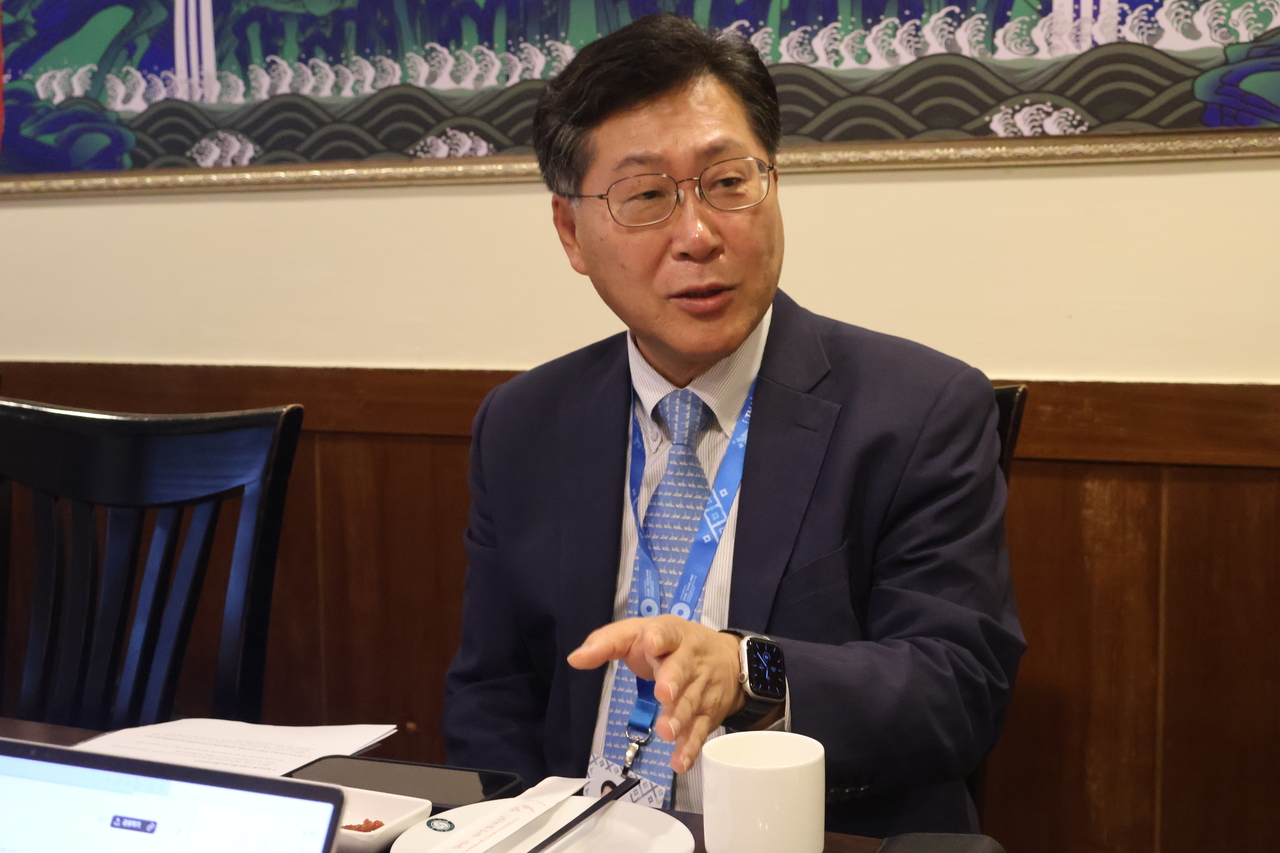
Robotics Lab Head Chris Hauser presents
Samsung Electronics to deploy robots in manufacturing first
Success rates, costs remain commercialization barriers
Home and service robots are the ultimate goal
Focus on robot AI that customers can train themselves
Humanoid robot upgrades to come like smartphone updates
![Chris Hauser, head of the Robotics Lab at Samsung Electronics' RX Business Development Office, presents on the potential and limitations of robot foundation models for large-scale deployment at Samsung AI Forum 2026, held Wednesday at Samsung Electronics' Seocho office in Seocho-gu, Seoul. [YouTube capture]](https://wimg.heraldcorp.com/news/cms/2026/09/30/news-p.v1.20260930.1b82df8aab4546308e6a7aa9db5de38f_P1.png)
"What if robot AI improved to the point where users could customize robots themselves? Samsung Electronics could sell millions of them."
Chris Hauser, head of the Robotics Lab at Samsung Electronics' RX (Robotics Experience) Business Development Office, made the remarks Wednesday while presenting on the potential and limitations of robot foundation models for large-scale deployment at Samsung AI Forum 2026, held at Samsung Electronics' Seocho office in Seocho-gu, Seoul.
Hauser outlined a long-term research direction centered on developing robot AI that customers can train themselves for the tasks they need. The plan is to first validate the technology in manufacturing settings, then use that experience as a springboard to expand into home and service robots.
The presentation marked the first time Hauser had publicly laid out the research direction and future challenges of the office since Samsung Electronics established the RX Business Development Office in July to advance its robotics business.
Hauser, a professor of computer science at the University of Illinois, began by explaining the rationale behind the new unit. "It is a newly established business organization created to more deeply explore Samsung Electronics' interest in the industrial application of humanoid robots and robotics," he said. "We will start by researching use cases for industrial robots in manufacturing settings."
He said Samsung Electronics' extensive factory operations make it well positioned to deploy industrial robots. "We have more than 100 factories and more than 100 product lines," Hauser said. "There are still many tasks that can be automated with robots — logistics, equipment monitoring and inspection, quality assurance, packaging and more."
He added, however, that the ultimate goal of the RX Business Development Office is to develop home and service robots for everyday use. The strategy is to build on lessons learned in factories and gradually expand into consumer robots.
"Samsung Electronics is a very large home appliance company, and we want to be able to sell robots for use in the home," Hauser said. "That is how the initial investment in advanced robotics will pay off."
He cautioned that commercialization barriers remain high despite the efforts of countless engineers. While robots are already running and playing soccer at humanoid robot competitions held in China, the technology must surpass that level before it can be applied in real industrial settings.
"Success and failure come down to millimeters," Hauser said. "Even getting a robot to open a water bottle cap is still a difficult problem."
Consumer expectations also set a high bar. "If you tell a factory owner that a robot has an 80 percent success rate, they will laugh," he said. "To deploy it on an actual production line, the success rate needs to be at least 99.99 percent." Speed is equally important — robots must work as fast as humans.
Cost is another hurdle. Given the expense of doctoral-level engineers, data collection staff and high-end GPUs required for humanoid robot development, even $100,000 is considered affordable, Hauser said. Yet humanoid robots remain too expensive to compete with human workers whose annual salaries range from around $4,000 to $40,000 depending on the country.
Those challenges define the research agenda for the RX Business Development Office: bringing down both hardware and AI costs. The office is particularly focused on developing robot AI that customers can use directly — a key lever for accelerating commercial viability.
"Existing robot AI startups have a business model of developing AI tailored to specific tasks," Hauser said. "With that approach, you can only handle a few tasks a year."
He then said that if robots could be personalized by watching how a person moves their hands and immediately learning those motions, the scale of deployment would expand dramatically. He also predicted that in the future, robots will be able to learn by watching video from smart glasses or smartphones.
By the same token, he proposed an approach that prioritizes reliable performance within a defined range of tasks rather than pursuing broad versatility from the outset.
"Quality needs to be solved before generality," Hauser said. "When you deploy robots in real environments, you get far more data." He added: "Just like upgrading a smartphone — if a robot folds laundry in the first year, it could do the dishes the next year, and by the third year you could add the ability to care for a pet."
jeongwan@heraldcorp.com