Unsolved cases pile up as police struggle to identify suspects
Average of about 210,000 new cases added each year
Only 0.1% of cases ever see investigation resumed

The number of cases classified by police as "managed unsolved" — shelved after investigators failed to identify a suspect — has grown to nearly 4.8 million over the past five years, yet fewer than 0.1 percent of those cases have ever been reopened, newly released data show. Critics say cases once shelved are effectively abandoned, with follow-up investigations rarely materializing.
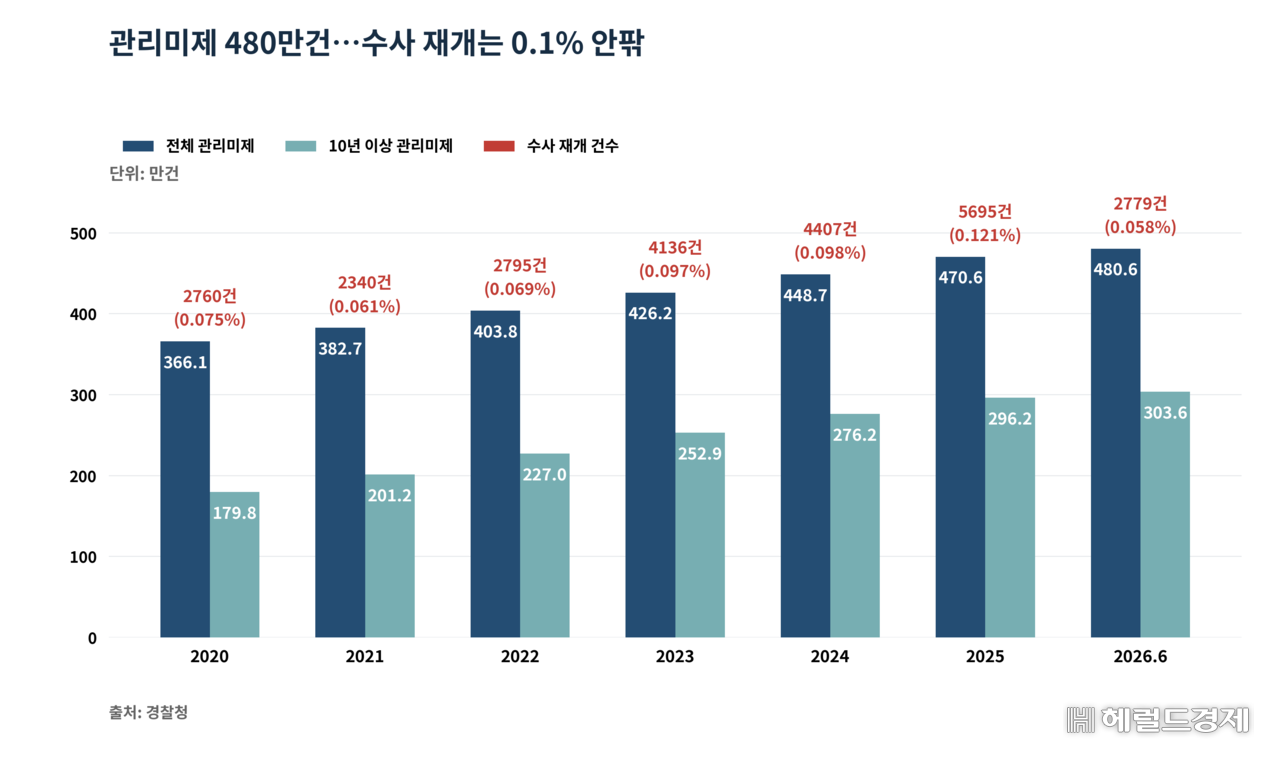
According to data submitted by the Korean National Police Agency to the office of Democratic Party of Korea lawmaker Lee Sang-sik of the National Assembly's Public Administration and Security Committee, the cumulative number of managed unsolved cases stood at about 4.8 million as of June this year — up about 1.14 million cases, or 31 percent, from about 3.66 million when the statistics were first compiled in 2020.
Breaking down the figures by year, the number of managed unsolved cases rose from about 3.66 million in 2020 to about 3.83 million in 2021, about 4.04 million in 2022, about 4.26 million in 2023, about 4.49 million in 2024 and about 4.71 million in 2025 — an average increase of roughly 210,000 cases per year over the past five years.
By contrast, the number of cases in which investigations were resumed remained negligible: 2,760 cases (0.07 percent) in 2020, 2,340 (0.06 percent) in 2021, 2,795 (0.06 percent) in 2022, 4,136 (0.09 percent) in 2023, 4,407 (0.09 percent) in 2024 and 5,695 (0.12 percent) in 2025. Through June this year, only 2,779 cases — 0.05 percent — had been reopened.
The share of cases that have remained unsolved for a decade or more is also growing. Cases classified as managed unsolved for 10 years or longer numbered about 1.8 million (49 percent) in 2020, about 2.01 million (52 percent) in 2021, about 2.27 million (56 percent) in 2022, about 2.53 million (59 percent) in 2023, about 2.76 million (61 percent) in 2024 and about 2.96 million (62 percent) in 2025. As of June this year, about 3.04 million cases — 63 percent of the total — had gone unresolved for more than a decade.
A managed unsolved case is one in which police have been unable to identify a suspect and set it aside pending the discovery of new leads. Article 227-2 of the Criminal Investigation Rules requires officers to continue seeking additional clues to identify suspects even after a case has been registered as managed unsolved. Designating a case as managed unsolved requires approval from the head of the relevant investigative unit, and provincial and metropolitan police commissioners must review the appropriateness of such designations at least once a year at each police station.
Yet with the rate at which managed unsolved cases are reopened remaining vanishingly low and long-term backlogs worsening each year, questions are being raised about whether police are genuinely pursuing new leads and conducting the required periodic reviews.
Unsolved and suspended cases surge — police cite rise of contactless crime
Police attribute the growing backlog of unsolved cases to the shift toward contactless methods in new types of fraud. Fraud cases are accounting for an ever-larger share of managed unsolved cases.
Police track managed unsolved statistics for only four categories of crime: murder, robbery, theft and fraud. From 2020 through June this year, a total of 22 murder cases and five robbery cases were newly registered as managed unsolved. Newly registered theft cases declined steadily, falling from 65,334 in 2020 to 47,347 last year.
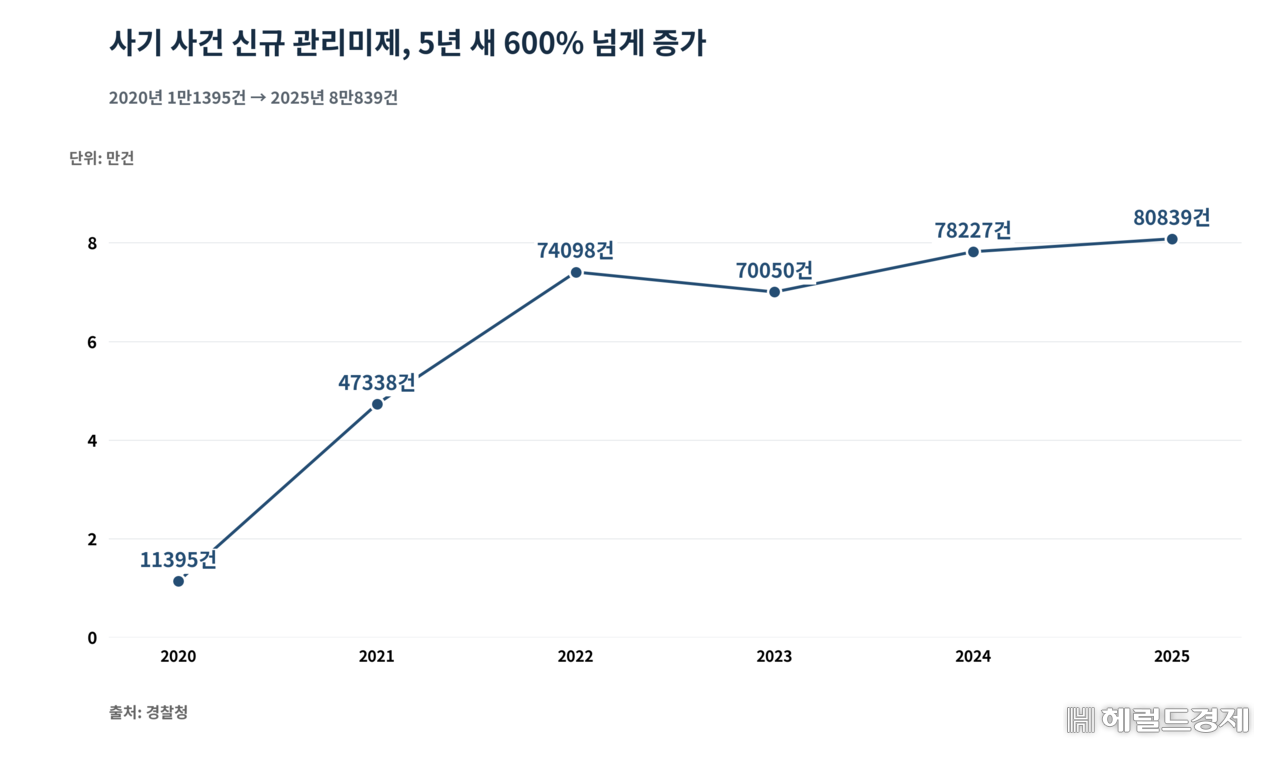
Fraud cases, however, have surged sharply. New managed unsolved fraud registrations jumped from 11,395 in 2020 to 47,338 in 2021 and 74,098 in 2022. The figure dipped slightly to 70,050 in 2023 before climbing again to 78,227 in 2024, then crossing the 80,000 mark last year at 80,839 — a rise of more than 600 percent in five years.
Cases in which police have identified a suspect but suspended the investigation because they cannot locate the person are also rising rapidly. Police said this too reflects the spread of contactless crimes that cross national borders. Newly registered suspended investigation cases grew from 82,195 in 2021 to 77,812 in 2022, 81,852 in 2023, 105,588 in 2024 and 123,286 in 2025 — an increase of roughly 50 percent in four years.
"New phishing crimes mostly occur online, which has made tracking suspects considerably more difficult," a Korean National Police Agency official said. The official added that police operate dedicated teams for major unsolved murder cases and for tracing serious fraud, and pledged that the National Investigation Headquarters and provincial police agencies would work together to upgrade the response framework for unsolved cases.

"As criminal methods evolve, so must investigative techniques," Lee said. "A significant number of managed unsolved cases involve everyday crimes such as fraud, and police must show the persistence and sense of responsibility to see these cases through to the end so that victims are not left without recourse."
arin@heraldcorp.com