Rising US long-term interest rates have become the defining issue in global financial markets. But why have they climbed so fast? Yields have now surpassed the expected return on stocks for the first time in 20 months — a yield gap inversion. The US fiscal deficit is nothing new, and recent inflation data came in below expectations. To understand what really drove September's rate surge, you need to look inside the bond market itself and at the mechanics of hedging.
Bond yields and prices move in opposite directions. Try reading recent developments in the US Treasury market not as a "rate spike" but as a "price crash." Even bonds with fixed maturities and coupons trade at prices that shift constantly. When sell orders pile up — as in the stock market — prices fall, and those falling prices can trigger further selling. Who sold, and why? And what comes next?
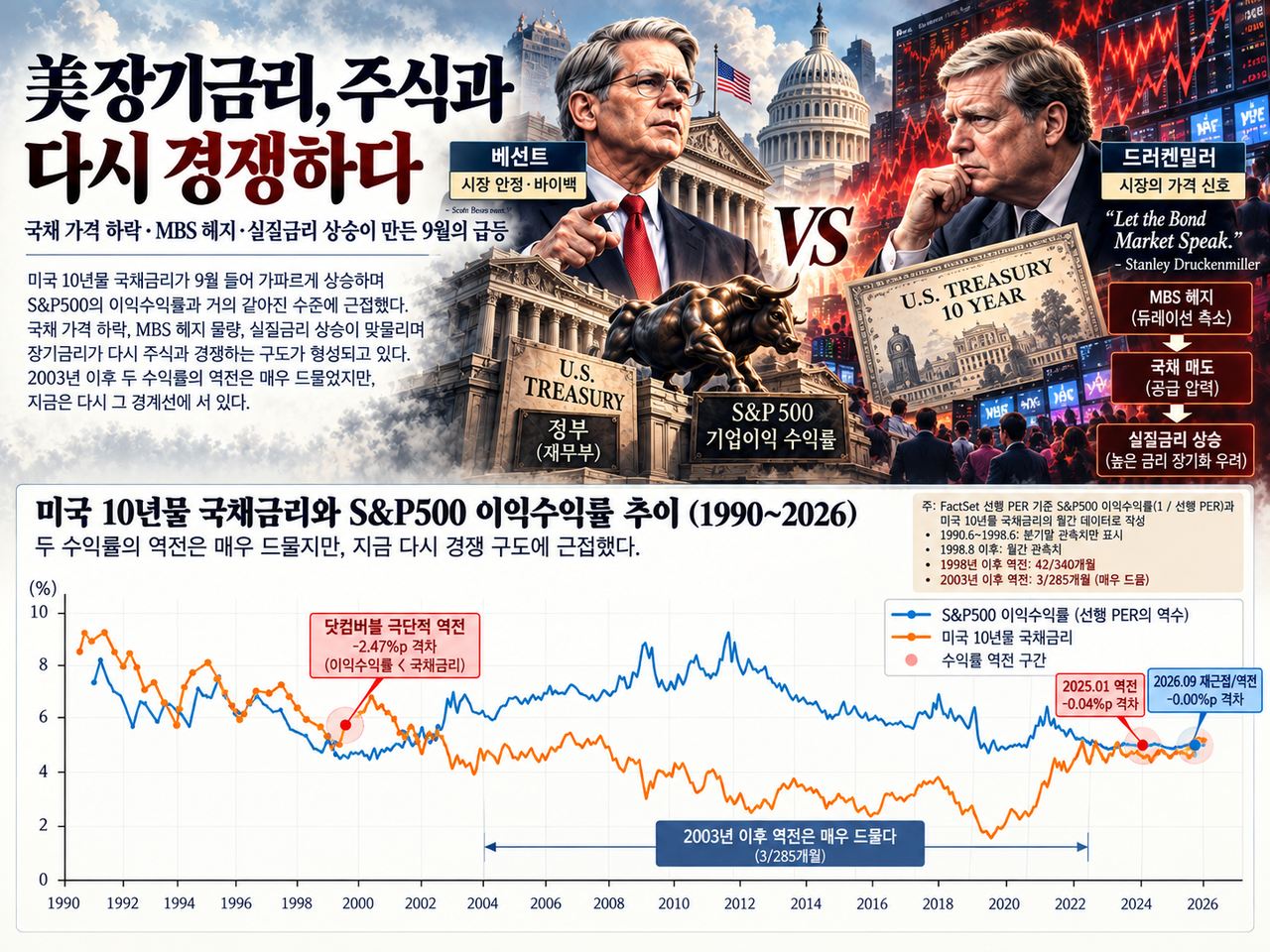
On Aug. 19, US Treasury Secretary Scott Bessent announced a plan to buy back long-term government bonds. The move was designed to absorb selling pressure in the market. When long-term rates rise, the interest cost of issuing new Treasuries increases — so the government's intention was to support bond prices directly and stabilize yields.
On Aug. 24, Stanley Druckenmiller published an op-ed in the Wall Street Journal titled "Let the Bond Market Speak," criticizing any attempt to artificially suppress yields that reflect fiscal and economic realities. The two men once worked together at George Soros's hedge fund — and Druckenmiller is the very investor Bessent has long cited as the foremost expert in macro investing.
Then, on Sept. 9, Bessent told an audience at Southern Methodist University: "I am the house now … bet against me if you want." What did he mean?
Foreign governments, central banks and the Fed step back from Treasuries
According to a Barclays analysis, the split between public-sector and private-sector holdings of US Treasuries was roughly 50-50 in both 2006 and 2016. By 2026, that had shifted to 73 percent private and 27 percent public. Foreign central banks and the Federal Reserve have stepped back, and their place has been taken by private capital — funds, banks and households.
As the Donald Trump administration weaponized the dollar alongside its trade war, major governments pulled back from investing in long-term US Treasuries. The Fed's role has also changed. During the financial crisis and the COVID-19 pandemic, the Fed bought Treasuries and mortgage-backed securities on a massive scale through quantitative easing. As quantitative tightening subsequently shrank the Fed's balance sheet, private investors were left holding more bonds and more interest-rate risk. QT was halted in December last year. Even so, the Fed is reinvesting principal repayments from its MBS holdings not back into MBS but into short-term Treasuries. Fed Chair Kevin Warsh has signaled that unconventional tools like QE should be used sparingly outside of genuine crises. Bessent, who wants lower rates to reduce the government's borrowing costs, and Warsh, who is focused on keeping inflation in check, do not always see eye to eye.
Skittish new investors push back against Bessent
Private investors calculate more complex trade-offs. They weigh not only expected returns but also unrealized losses, funding costs and the yields available on other assets. An investor who borrowed to buy bonds may face shrinking collateral value as prices fall, forcing them to raise additional cash. Even if they believe prices will recover over time, they must first manage the immediate risk.
Hedge funds are the clearest example. As long-term Treasury yields rose, hedge funds emerged as major buyers — but their goal is not to hold bonds to maturity and collect interest. They may leverage their Treasury holdings to maximize returns, exploit price differences between cash bonds and futures, or build offsetting positions to hedge against price swings. Selling Treasury futures is a standard way to reduce exposure to falling bond prices in a rising-rate environment. Because cash and futures markets are linked, these trades feed back into cash prices as well.
Bessent, a former macro hedge fund manager, knows perfectly well that the shift in the Treasury investor base has increased demand for hedging in the long-end market. His warning to the market — don't bet on higher rates; move toward lower ones — was deliberate. His message was: I've gone from running a macro hedge fund to running the house, so don't play against me. Yet long-term Treasury prices fell sharply in September. As Druckenmiller had argued, the market spoke its mind without flinching.
Still, hedge fund selling of Treasury futures alone could not have driven such a steep drop across the vast long-term Treasury market in September. The story changes if MBS investors — an even larger force — were moving in the same direction.
Falling bond prices trigger MBS hedging, pushing rates higher still
The outstanding balance of the US MBS market exceeds $12 trillion, making it the second-largest bond market after US Treasuries at roughly $32 trillion. Of that total, more than $9 trillion consists of MBS guaranteed by the government-sponsored enterprises Fannie Mae and Freddie Mac, and by the federal agency Ginnie Mae. Because these MBS carry low credit risk, US institutional investors hold them in large quantities. Unlike Treasuries, MBS carry prepayment risk — and when long-term rates rise, MBS values fall.
When rates fall, borrowers refinance, paying off higher-rate loans early and returning principal to MBS investors sooner than expected. This shortens the expected holding period — or duration — of MBS. The price change of a bond equals its duration multiplied by the change in yield: a bond with a duration of eight years, for instance, loses roughly 4 percent in price when rates rise by 50 basis points. The standard playbook is to extend duration when rates are falling and shorten it when they are rising.
When long-term rates rise, the likelihood of early repayment on older, lower-rate mortgages declines, extending MBS duration. Selling long-term Treasuries or Treasury futures can shorten the overall portfolio duration. The result is a self-reinforcing loop: rising long-term rates extend MBS duration, prompting Treasury sales to hedge, which pushes rates higher still. Selling begets more selling. The very trades designed to limit individual losses end up amplifying losses across the entire market.
Trend-following hedge funds deepen the move further. The Financial Times reported Friday that quantitative hedge funds using computer models to track market momentum are reaping strong profits from the global bond rout.
September's rate moves offer a clear illustration of these dynamics. From Sept. 1 through Sept. 30, the nominal yield on the 10-year US Treasury rose 50 basis points (one percentage point equals 100 basis points), while the real yield on the same-maturity Treasury Inflation-Protected Security rose 49 basis points. The gap between the two — a gauge of inflation expectations — widened by just 1 basis point. The market demanded almost no additional inflation compensation; nearly all of the rate increase came from real yields. That makes it hard to explain September's sharp rise purely as a reflection of growing inflation anxiety. Selling and hedging activity aimed at limiting losses in the secondary market likely amplified the move. In short, when Bessent told the market "go ahead and try me," the market replied: "Go ahead and stop us."
Yield gap inverts for first time in 20 months — Treasuries now out-yield stocks
Does September's rate surge mean Bessent has lost? Not necessarily. There are early signs that the upward momentum in long-term rates may be fading.
What goes up must come down. As rates rise, the room for further MBS duration extension shrinks. If prepayments have already fallen sharply, there is less scope for them to fall further even if rates climb more — which means less pressure for additional hedging sales.
An analysis of Federal Housing Finance Agency first-quarter 2026 mortgage data by Realtor.com found that 77.9 percent of outstanding loans carry rates below 6 percent. The rate on a new 30-year fixed mortgage stood at 7.28 percent as of Thursday. Most borrowers who locked in low rates have no reason to refinance even if market rates rise further. This suggests the feedback loop — where rising rates trigger more hedging sales — may gradually lose force.
There are also signs of change in how hyperscalers compete with Treasuries for funding. An Aviva Investors tally of bond issuance by Alphabet, Amazon, Meta, Microsoft and Oracle found that of the roughly $170 billion they issued through June 26 this year, more than a third was denominated in currencies other than the dollar — not just euros, but also Canadian dollars, Swiss francs, British pounds and Japanese yen. Their data centers are being built around the world, and borrowing in local currencies to fund local spending reduces foreign-exchange risk while broadening the investor base. As their funding needs spread across more currencies, the pressure they place on the dollar bond market — competing directly with US Treasuries — may ease.
In fact, the absolute level of long-term yields has already moved into a range that looks quite attractive. As of Sept. 25, the 12-month forward price-to-earnings ratio for the S&P 500 stood at 19.2 times, according to FactSet — implying an earnings yield of roughly 5.2 percent. The 10-year Treasury yield closed September at 5.293 percent. On a month-end basis, the expected return on bonds now exceeds that on stocks — a yield gap inversion.
On Thursday (local time), the 10-year Treasury yield briefly touched around 5.34 percent intraday, its highest since 2002, before pulling back to the 5.23–5.24 percent range. A seven-session winning streak for yields also came to an end, with buyers drawn in by the higher returns on offer.
The previous yield gap inversion occurred in December 2024 and January 2025. At the end of January 2025, the 10-year yield peaked at 4.58 percent before falling to 3.97 percent by February of this year.
The inversion before that dates back to March 2003. The US had seen a sustained yield gap inversion from October 1998 through July 2001, during the dot-com bubble.
Stocks offer the prospect of earnings growth, but also the risk of disappointment. Developments in the Middle East and oil prices remain wild cards, but the current level of the 10-year Treasury yield is high enough to make investors reconsider whether holding equities is still worth it.
'The market has spoken. Listen.'
The 10-year Treasury yield ended September up 54 basis points from the end of August. Looking at monthly swings since the low-rate era ended in 2022, that ranks third — behind the 68-basis-point move in September 2022 and the 57-basis-point move in April 2022. In percentage terms, the 11.4 percent monthly change ranks fourth, after April 2022 (24.6 percent), September 2022 (21.6 percent) and September 2023 (12.2 percent). It was a big move — but given that yields are already at their highest since 2002, it does not rise to the level of panic.
In his August Wall Street Journal op-ed, Druckenmiller wrote: "Markets aggregate information that no committee possesses, and that information is transmitted to policymakers through prices." The price he called "the most important in the world" was the US long-term Treasury yield.
On the surge in long-term rates since July that prompted Bessent to intervene, Druckenmiller said volatility had been "contained" and trading "orderly" — diagnosing the move not as a market malfunction but as the mechanism working exactly as it should.
In 1992, Bessent and Druckenmiller worked together at Soros Fund Management, betting against the British pound and making a fortune as Britain ultimately surrendered its effort to defend sterling against the market. In 2012–2013, they read the tide of Abenomics correctly, making large bets on a weaker yen and a rising Japanese stock market — and winning again. One time they stood against a government; the other time they stood with one. The direction differed, but both victories came from reading the interplay of policy and market forces with precision.
In 2026, Bessent has switched from attacker to defender. He wields the formidable power of the Treasury secretary, but this time he finds himself on the opposite side of the market — and struggling. The irony is hard to miss. If Druckenmiller were sizing up the situation today, he might say:
"The market has spoken. Listen."
[Explainer] What are 'convexity' and 'negative convexity' in bonds?
Convexity: Bond yields and prices move in opposite directions. Normally, when rates fall, prices rise by more than you might expect — and when rates rise, prices fall by less. This asymmetry, which works in investors' favor, is called convexity: a cushioning effect that curves upward.
Negative convexity: The reverse situation — where rising rates cause bond prices to collapse while falling rates produce only modest price gains — is called negative convexity, and it is deeply unfavorable to investors. Mortgage-backed securities are the textbook example.
Convexity risk: When rates rise, the expected maturity (duration) of an MBS can lengthen suddenly, magnifying the drop in its price. As institutions sell Treasuries to hedge that risk, they push rates higher still — setting off a vicious cycle.
kyhong@heraldcorp.com