Veterans affairs expert outlines disability pay, injury pension and merit-based compensation
If officer stays on active duty, most financial benefits deferred until discharge
Combat injury allowance stuck at 90,000 won a month for six years
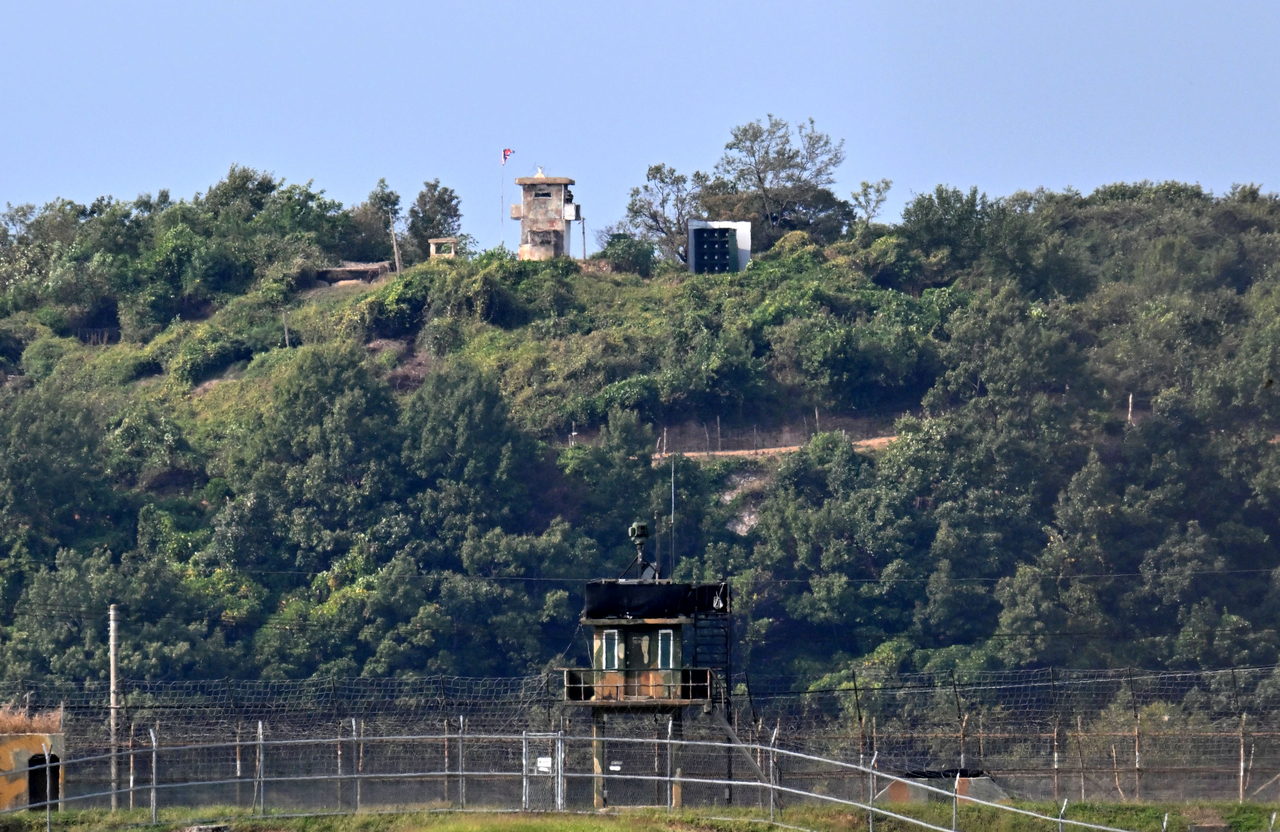
The commander of a reconnaissance battalion from the Army's 25th Infantry Division who lost his ankle in what is believed to have been a North Korean landmine explosion in the western front's demilitarized zone on Sept. 21 could receive a lump-sum disability payment of about 89.25 million won ($65,600) if the injury is officially classified as a combat wound, according to a veterans affairs expert. He would also be entitled to a monthly injury pension and national merit compensation.
The expert said financial compensation alone is not enough and called for "all-around recognition" that includes a special promotion and the option to remain on active duty. Others have noted, however, that because most financial benefits are deferred until discharge for those who stay in uniform, the officer should be clearly informed of both paths.
An Jong-min, head of the National Veterans Affairs Administrative Office, laid out the expected compensation items and amounts in a phone interview Monday, saying, "If the injury was caused by a landmine planted by North Korean forces, it should unquestionably be classified as a combat wound."
The first and most consequential determination is whether the injury qualifies as a combat wound. An said that even if investigators conclude the mine was a stray or a leftover from the Korean War, "search and reconnaissance missions in the DMZ qualify as special-duty injuries under the enforcement decree of the Military Accident Compensation Act, so the officer should at minimum be recognized under that category."
An cited the case of Ha Jae-heon, a retired staff sergeant who lost both legs in the 2015 wooden-box mine incident. Ha was initially classified as having suffered a non-combat duty injury in a 2019 veterans affairs review, but the ruling was reversed to a combat wound after public outcry. "The same thing must not happen again," An said.
The Joint Chiefs of Staff released preliminary investigation results Sunday, saying the explosion occurred about 10 meters south of the MDL and that a North Korean landmine was highly likely to blame. The National Forensic Service found traces of trinitrotoluene (TNT) on the injured soldiers' helmets and body armor. The United Nations Command said Tuesday it had discovered a North Korean anti-personnel mine south of the MDL and determined it constituted a violation of the Armistice Agreement.

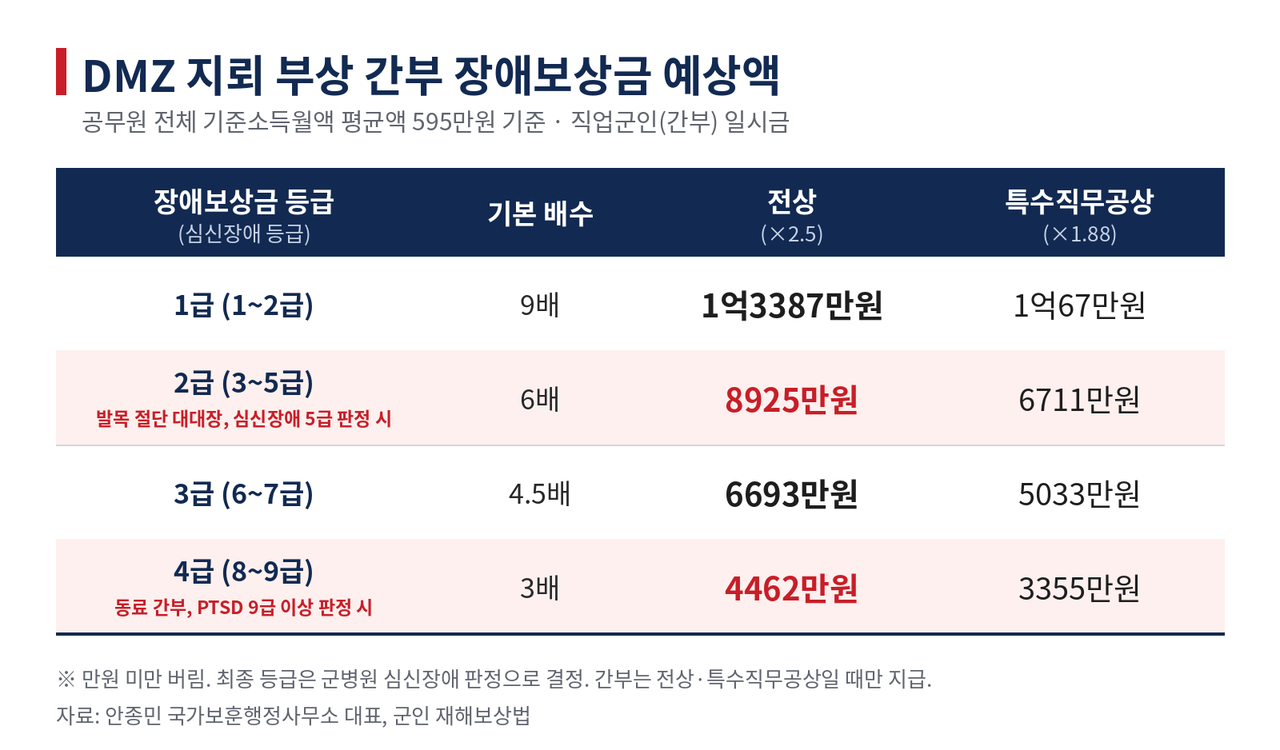
Under An's analysis, if the battalion commander — who lost one ankle — is assessed as having a Grade 5 physical and mental disability, he would qualify for a Grade 2 disability payment, amounting to about 89.25 million won under the combat wound classification. If classified instead as a special-duty injury, the payment drops to 67.11 million won, a reduction of more than 22 million won. Other officers who took part in the operation could also receive about 44.62 million won under the combat wound standard if post-traumatic stress disorder is assessed at Grade 9 or higher.
Officers who retire are entitled to a monthly injury pension on top of the lump sum. The pension is calculated by multiplying the individual's standard monthly income by a grade-specific rate — 39 percent for Grade 5 and 32.5 percent for Grade 7. An noted that the military system allows disability grades to be combined, meaning a Grade 5 physical injury combined with a Grade 7 PTSD rating could result in a combined Grade 3 classification at 45.5 percent.
Under the Act on the Honorable Treatment of and Support for Persons of Distinguished Service to the State, losing one leg below the knee but above the ankle joint corresponds to a disability Grade 5. The monthly compensation for Grade 5 this year stands at 2.12 million won, with an additional 90,000 won combat injury allowance for those recognized as combat-wounded servicemembers. Employment, medical and education support are also available. An said that while the national merit law does not allow Grade 7 injuries to be combined, a PTSD rating of Grade 6, Category 1 could raise the combined grade to Grade 4. "Keeping psychiatric treatment records right now is more important than anything," he said.
An stressed that recognition of honor and continued service matters as much as financial compensation. He said the 25th Division should recommend all soldiers injured in the operation for the Dedication and Honor Medal. He added that the military should actively apply Article 30 of the Military Personnel Management Act and Article 43 of its enforcement decree, which allow a special one-rank promotion for those who render distinguished service to the nation while on duty.
Continued active-duty service is also a key issue. Under Article 53-3 of the enforcement rules of the Military Personnel Management Act, a soldier who risked his own life to save a subordinate or colleague may continue serving on active duty — provided he can walk with a prosthetic limb — after review by a discharge screening committee. The battalion commander lost his ankle in a second explosion as he rushed toward a noncommissioned officer who had been knocked down by the first blast. "If the battalion commander who was injured trying to save his subordinate wants to stay in uniform, the military must open that door for him," An said.
Staying on active duty and receiving financial compensation are, however, on different timelines. Disability payments and injury pensions are disbursed upon retirement following a disability assessment, meaning an officer who remains in service would have those benefits deferred until discharge. The types of duties available to such an officer are also limited by regulation to general administration, research and instructor roles. The structure means that career path and compensation both hinge on the individual's choice.
An also flagged procedural concerns. According to him, the compensation process begins six months before discharge and proceeds in order: a mandatory medical assessment, a review of combat or duty-related injuries, and then an application for registration as a person of distinguished national service. "The unit and the Defense Ministry should not leave it to the individual to navigate the system on their own," he said. "They should proactively lay out every benefit available — both for staying on active duty and for retiring — and make sure nothing is missed."
An also noted that once a person is registered as a person of distinguished national service, the practical difference between a combat wound and a non-combat duty injury turns out to be smaller than many expect. While the military disability payment multipliers differ clearly — 2.5 times versus 1.88 times — for those who achieve national merit status, the gap between combat-wounded and duty-injured servicemembers amounts in effect to just the 90,000 won monthly combat injury allowance. That allowance has remained unchanged since it was raised from 23,000 won in 2021, now six years running. "Is it right that in a country with an annual budget in the 700 trillion won range, the allowance attached to a soldier who lost his ankle to an enemy landmine is 90,000 won?" An said.
An also recalled a 1974 incident in which a joint South Korean-US investigation team examining the first infiltration tunnel — discovered by the 25th Division's reconnaissance unit in November of that year — was killed by explosives planted by North Korea. "That incident left a lesson: wherever an illegal North Korean installation is confirmed, there are always additional hazards," he said. "If the danger was known, the right equipment and procedures should have been in place before anyone went in." He added: "The landmines in the DMZ hide in the soil, but the state's responsibility has nowhere to hide. The government must repay everything — from recognizing the combat wound to providing psychological treatment, restoring honor and securing livelihoods."
rimsclub@heraldcorp.com