12 tasks across 4 areas; MCL concept to be introduced
Military's own power grid demonstration just getting started
Sangmu Base projected at 16.1% energy self-sufficiency
South Korea's Ministry of National Defense has drawn up its first-ever defense energy transition plan to address the growing power demands of high-energy weapons such as laser and electromagnetic systems — but the announcement left out specific details on individual tasks, required funding and implementation schedules.
According to the Defense Ministry, Deputy Minister Lee Du-hee presided over a final review meeting for the plan Thursday at the ministry's Yongsan headquarters in Seoul. About 30 officials from the armed services and related agencies attended. It is the first time the ministry has formulated an energy transition plan at the defense-wide level.
The plan is organized around 12 tasks in four areas. Key elements include securing energy technology for high-efficiency, high-output and low-noise operation of weapons systems; energy standardization; introduction of a Korean-style Mission Critical Load (MCL) concept; establishing military facility design standards through microgrid demonstration projects; and holding regular progress-review meetings.
MCL refers to the load carried by essential equipment and facilities that must remain powered even during emergencies such as blackouts. A microgrid is a small, independent power network that generates, stores and supplies electricity using its own generation sources and energy storage systems (ESS).
The ministry said the plan was drawn up because "managing the power demands arising from the proliferation of high-energy advanced weapons systems such as laser and electromagnetic weapons has become increasingly critical." It also emphasized "mobility" — the ability of units to secure their own power while on the move — and "sustainability," meaning the capacity to continue operations without external support. Deputy Minister Lee said energy security "is national security itself, and a core factor directly tied to the military's survivability and combat power."
However, the ministry's announcement did not include specific details on the 12 tasks, the funding required or year-by-year schedules. The ministry said only that it plans to finalize short- and medium-to-long-term roadmaps based on the plan. The direction has been set, but when and at what cost remains undecided.
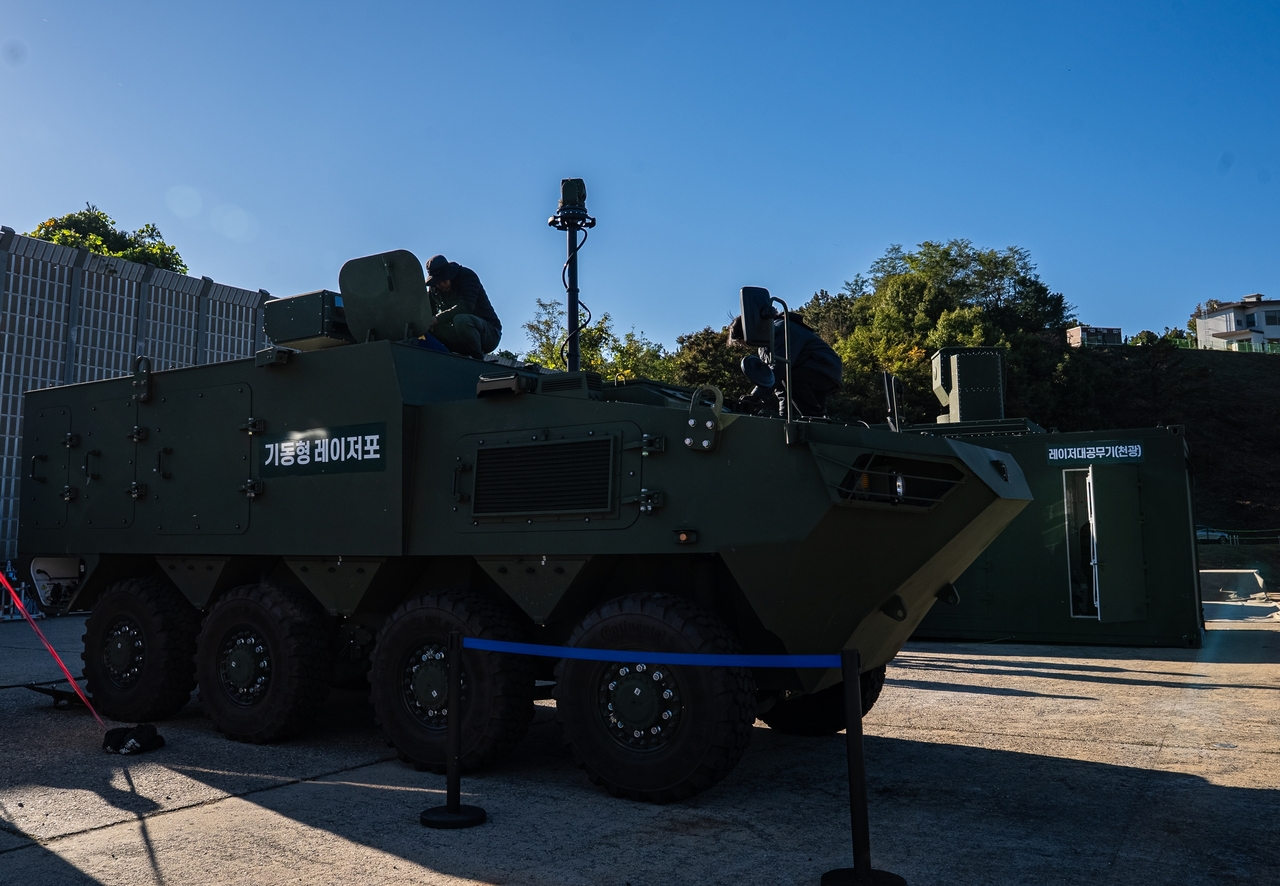
The power burden posed by laser weapons is already a practical reality. Firing the Cheongwang laser air-defense system, which entered service in December 2024, requires not only the laser device itself but also cooling units, power supply units and communications equipment running simultaneously.
A military official cited a 20-kilowatt laser output as an example, saying the entire system requires roughly 120 to 130 kilowatts of power. The government has included the launch of research and development for a Block-II mobile laser air-defense weapon in next year's budget proposal. Funding for the project was increased by 154 million won ($116,000) during the National Assembly's Defense Committee preliminary review last year, but it did not make it into the final budget.
Mobile weapons must secure their own power supply in the field. The military's effort to build a self-sufficient power grid to support that requirement has only just entered the demonstration phase. The Korea Energy Agency has been commissioned by the Army with 20 billion won to construct an integrated microgrid at Sangmu Base in Jangseong, South Jeolla Province. The system combines fixed installations within the base with mobile units that can be deployed to operational areas — an approach the agency described as a first of its kind in South Korea.
According to the agency, the fixed installation consists of 3,015 kilowatts of solar capacity, 9.76 megawatt-hours of ESS and 4 megawatts of diesel generation. The mobile component includes two portable solar units (15 kilowatts each), three vehicle-mounted ESS units (110 kilowatt-hours each), three vehicle-mounted diesel generators (100 kilowatts each) and a mobile power distribution system. The agency will conduct a five-year demonstration after the system is built. Even so, the projected energy self-sufficiency rate for Sangmu Base stands at just 16.1%.
For the plan to have real impact, funding commitments and the scope of application will need to be spelled out. Outstanding questions include which facilities and equipment will fall under the MCL framework and how forward-deployed units equipped with laser weapons will secure their power supply. The Defense Ministry said it will hold regular progress-review meetings to monitor implementation of each task.
rimsclub@heraldcorp.com