Zero decorations revoked among those recommended by the Culture Ministry
Ministry ignored Interior Ministry's review request for 10 years
Honors for Seo Jeong-ju, Kim Ki-chang left intact
Panel to reclaim collaborators' hidden assets set to revive after 16 years
Eleven individuals officially designated as pro-Japanese collaborators received a combined 14 state decorations on the recommendation of the Ministry of Culture, Sports and Tourism — yet not a single one has been revoked, it has been confirmed. Amid continued inaction by government ministries and a persistent gap in the legal framework, a commission tasked with tracking hidden assets of pro-Japanese collaborators is set to resume operations for the first time in 16 years.
![Lee Jae-jeong, chair of the National Assembly's Culture, Sports and Tourism Committee [Yonhap]](https://wimg.heraldcorp.com/news/cms/2026/10/05/news-p.v1.20261005.7a0de677b1234da4a4995305338bc4ee_P1.jpg)
According to data submitted to Lee Jae-jeong, chair of the National Assembly's Culture, Sports and Tourism Committee, by the Ministry of Interior and Safety, 44 of the 1,006 individuals officially designated as pro-Japanese collaborators by the Presidential Commission on Pro-Japanese Collaborators' Activities received a combined 78 state decorations. Of those, only five have been revoked to date, leaving 73 decorations held by 39 individuals still in place.
The Presidential Commission on Pro-Japanese Collaborators' Activities was launched in May 2005 to investigate the truth behind pro-Japanese collaboration. It conducted its inquiry over four and a half years and published its findings in a report in 2009.
The Ministry of Interior and Safety notified relevant ministries of the decoration status on March 18, 2016, and asked them to review possible revocations. The Ministry of Culture, Sports and Tourism received the official communication but never responded. As a result, not one of the decorations under the ministry's jurisdiction has been revoked in the decade since.
Among those whose decorations remain intact are prominent cultural and artistic figures including Seo Jeong-ju, Kim Ki-chang, Kim Eun-ho, Yu Chi-jin and Park Sun-dong. All were officially designated as pro-Japanese collaborators for using their works, writings and performances during the Japanese colonial period to promote conscription or otherwise support Japan's war of aggression.
"It is hard to understand how the Ministry of Culture, Sports and Tourism could receive an official request from the Ministry of Interior and Safety in 2016 to review these decorations and then go 10 years without any response," Lee said. "As the ministry with jurisdiction, it must answer responsibly — what review, if any, did it conduct, and does it genuinely believe these decorations should remain in place?"
Legal constraints have also contributed to the stalemate. The current State Decoration Act limits grounds for revoking a decoration largely to cases where the cited merits are found to have been false, making it difficult to strip a decoration solely on the basis of a pro-Japanese collaboration designation. In response, Lee introduced an amendment to the State Decoration Act last year that would allow decorations to be revoked upon a formal collaboration designation and enable the recovery of related assets and funds. The bill remains pending before the National Assembly's Interior and Safety Committee.
"Because pro-Japanese collaboration is not currently defined as an independent ground for revoking a decoration under existing law, legislative reform is needed to close this institutional gap," Lee said. "All related decorations must be comprehensively reviewed to align with public common sense and historical justice, and the National Assembly must move to establish a legal basis for revoking the honors of pro-Japanese collaborators."
Pro-Japanese assets commission to revive after 16 years, with proceeds from sales now recoverable
![Lee Jae-jeong (right), chair of the National Assembly's Culture, Sports and Tourism Committee and a lawmaker of the Democratic Party of Korea, shakes hands with Culture, Sports and Tourism Minister Choi Hwi-yeong after a plenary session of the committee at the National Assembly on Sept. 16. [Yonhap]](https://wimg.heraldcorp.com/news/cms/2026/10/05/news-p.v1.20261005.bffcfd8bb6774ced8cd23dd2b13c4699_P1.jpg)
While efforts to strip pro-Japanese collaborators of their honorary state decorations remain stalled amid institutional gaps and ministerial inaction, work to track down and reclaim their concealed material assets is about to resume.
The Commission on Pro-Japanese Collaborators' Property is set to relaunch on Dec. 3, 16 years after its first iteration wound down. The first commission, which operated from July 2006 to 2010, ordered the state confiscation of 2,359 plots of land totaling more than 11.13 million square meters belonging to 168 designated collaborators, with an assessed value of 95.9 billion won ($70.5 million) and an estimated market value of around 210.6 billion won. Including assets that had already been transferred to third parties, the total recovery reached 237.3 billion won. However, not all assets ordered confiscated were immediately transferred to the national treasury, as descendants filed 72 legal challenges as of June 23, 2010.
The incoming second commission will build on the first's work, restoring and expanding the investigation of pro-Japanese assets that had gone unfinished and seeking to uncover additional hidden holdings. Particularly notable is a new legal provision allowing the state to recover the proceeds from assets already sold or transferred to third parties that can no longer be reclaimed in their original form — closing a loophole that had limited the scope of past recoveries.
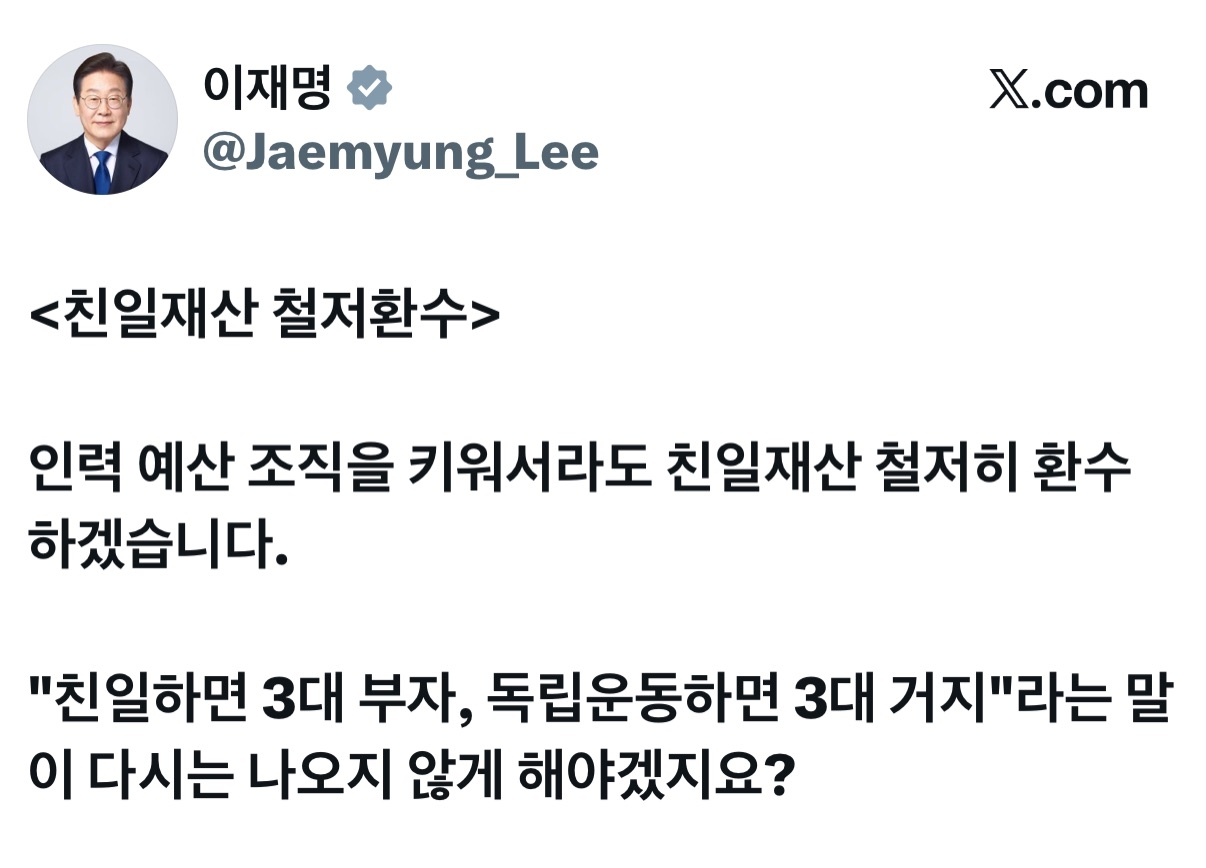
Meanwhile, President Lee Jae Myung posted Monday on his social media account about the resumption of efforts to reclaim pro-Japanese collaborators' assets, pledging to "thoroughly recover pro-Japanese assets, even if it means expanding personnel, budgets and organizational capacity."
terry@heraldcorp.com