Chainalysis East Asia crypto adoption report
July 2025–June 2026 volume up 12.3% year-on-year, surpassing Japan, Hong Kong, China and Taiwan
AI asset share in won trading 19.5 times that of yen; WLD and Sahara AI emerge as new favorites
![Logos of digital asset exchanges. [Each company]](https://wimg.heraldcorp.com/news/cms/2026/10/06/news-p.v1.20261006.00d990009ebd4c758c6fb9bfd081d392_P1.png)
South Korea's digital asset economy reached $449.1 billion over the past year, surpassing China and Japan to become the largest in East Asia, according to a new industry report. AI-related digital assets accounted for roughly 18 percent of all won-denominated trading during the period.
The findings come from Chainalysis's East Asia Virtual Asset Adoption Report, released Tuesday. South Korea's digital asset economy totaled $449.1 billion from July last year through June this year, up 12.3 percent from the same period a year earlier — the largest figure in East Asia, ahead of Japan, Hong Kong, China and Taiwan. Digital asset activity through domestic exchanges also rose 16.3 percent over the same period.
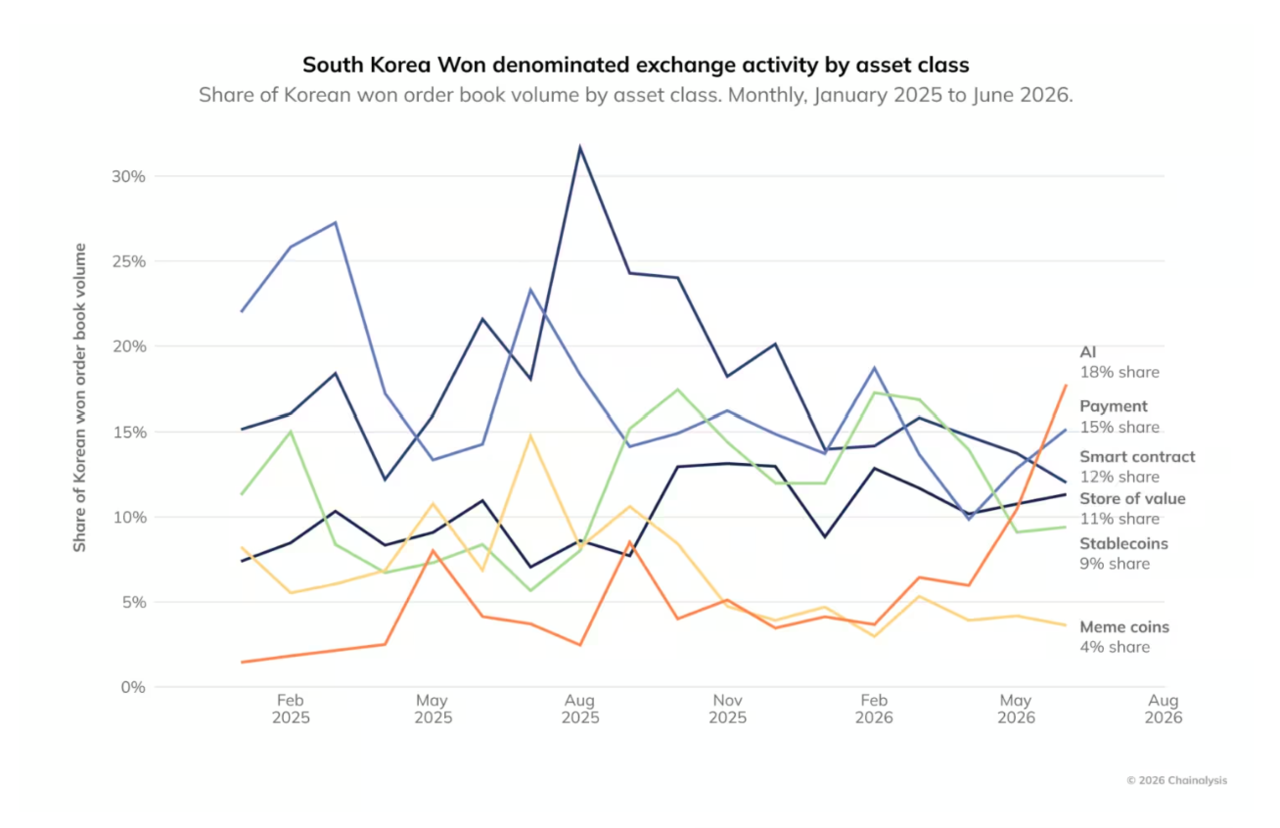
As of June this year, AI-related digital assets held the highest share of any theme in won-denominated trading, overtaking payment tokens such as XRP.
The preference for AI-related assets stood out even against other currency markets. The share of AI assets in won-denominated trading was 19.5 times that of yen-denominated trading. AI assets also made up a smaller share of trading in Brazilian real, British pound and euro markets than in won.
The leading tokens within the AI category shifted from year to year. Virtuals Protocol and Kaito dominated last year, while Worldcoin and Sahara AI have taken center stage this year. By trading volume, Worldcoin led at $7.41 billion, followed by Sahara AI ($3.2 billion), Virtuals Protocol ($2.7 billion), Bio Protocol ($2 billion) and Near Protocol ($1.7 billion).
Chainalysis noted that South Korean retail investors showed a tendency to rotate quickly among preferred AI-related assets and to trade more actively than investors in other markets.
The report identified expanded corporate participation and taxation as key variables for the South Korean market going forward. Domestic banks and brokerages have set up dedicated digital asset units and are running pilot projects in stablecoins, tokenization and custody, but corporate investment for profit-seeking purposes has yet to take off in earnest. Chainalysis said the entry of corporations into the market, along with a digital asset income tax set to take effect next year, could reshape how both retail and institutional investors participate.
Kwon Jun-hyuk, head of Chainalysis Korea, said South Korea is a market defined by active retail investor participation, with a strong appetite for AI-related digital assets and rapid shifts in preference clearly on display. "As corporate and institutional participation expands going forward, the domestic market is expected to become more diverse," he said, adding that Chainalysis would contribute to building a safer and more transparent market environment through reliable blockchain data and analysis.
Chainalysis separately noted in a recent report that the scale of potentially taxable digital asset activity in South Korea stands at around 15 trillion won ($11 billion). That figure is roughly 144 percent of the government's fiscal deficit of $7.5 billion last year.
kyoung@heraldcorp.com