Treatment method chosen based on each patient's heart wall thickness and nerve location
New era of hyper-personalized arrhythmia care
Arrhythmia Center chief On Young-geun: 'Individualized treatment now possible for every patient'

Arrhythmia refers to a condition in which the heart loses its normal rhythm and beats irregularly. The type of arrhythmia varies depending on how the heart beats abnormally, and among the most common is atrial fibrillation — a form of arrhythmia characterized by an irregular pulse that typically accompanies conditions such as hypertension, heart failure and valvular disease.
Atrial fibrillation is one of the conditions whose prevalence rises sharply with age, occurring when abnormal electrical signals fire repeatedly in the atria as they lose elasticity through aging. As South Korea rapidly enters an aged society, the number of patients with atrial fibrillation has been growing accordingly.
The core danger of atrial fibrillation is that it can cause blood clots to form inside the heart. These clots — solidified masses of coagulated blood — can grow large enough to travel through the arteries and spread throughout the body. When they reach the brain's blood vessels, they become a leading cause of stroke.
Drug therapy is the first line of treatment for arrhythmias including atrial fibrillation. When symptoms persist despite medication, physicians conduct a comprehensive assessment of the patient's age, underlying conditions, type of atrial fibrillation and heart size before proceeding with catheter ablation or cryoballoon ablation.
More recently, hospitals have been racing to adopt pulsed field ablation (PFA), a new medical technology for treating atrial fibrillation. South Korea's new medical technology assessment regime, introduced in 2007, evaluates the safety and clinical efficacy of emerging treatments and diagnostic procedures. PFA works by positioning a catheter at the site where atrial fibrillation originates and ablating the tissue using a pulsed field, suppressing the abnormal signals. Compared with conventional radiofrequency catheter ablation and cryoablation, PFA minimizes damage to surrounding tissue, offering greater precision and safety. Its shorter procedure time and significantly lower rate of complications have been cited as key advantages, and it is already widely used in arrhythmia treatment in the United States, Japan and Europe.
Severance Hospital cardiology professor Jeong Bo-young said at the time that a patient diagnosed with atrial fibrillation in early 2003 had continued to experience symptoms such as palpitations and chest tightness despite drug therapy, and underwent PFA without any notable complications in under an hour. Four additional atrial fibrillation patients subsequently received PFA at the hospital.
Severance Hospital said atrial fibrillation is the most common arrhythmia, causing irregular blood flow that leads to clot formation and stroke. The hospital noted that prevalence reached 1.5 percent of the total population in 2015, roughly double the 0.7 percent recorded in 2006, and that the condition affects about 10 percent of people aged 60 and older — a figure projected to exceed 3.5 percent of the overall population by 2030 as the country ages. The hospital also explained that radiofrequency catheter ablation, the most widely used conventional procedure, applies heat via high-frequency current to destroy the tissue causing atrial fibrillation, while cryoballoon ablation uses freezing thermal energy. Both methods carry the risk of heat transfer to surrounding structures such as the esophagus and phrenic nerve, and both typically require more than two hours, placing a significant burden on patients. PFA, by contrast, minimizes damage to surrounding tissue and dramatically shortens procedure time, the hospital said, adding that the technique has received US Food and Drug Administration approval and is actively used in the United States, Japan and Europe, with its safety validated through more than 120,000 procedures.
Professor Jeong, who led the procedures, said PFA uses pulsed field energy rather than thermal energy to create microscopic pores in the heart, selectively destroying only the target cardiomyocytes while preserving surrounding tissue. "Each cardiac tissue type has a different electrical field threshold, and pulsed field energy uses a targeting method that eliminates only the intended tissue at a specific field intensity," he said. "This allows procedure time to be cut by more than 20 to 40 percent compared with conventional methods, reducing the burden on patients and significantly lowering the risk of complications such as esophageal or phrenic nerve injury." He added that PFA is an advanced technology whose safety and efficacy in treating atrial fibrillation have been confirmed worldwide, and that its introduction in South Korea would allow patients to receive treatment more safely — with more patients set to benefit as the elderly population grows.
Samsung Medical Center cardiology professor On Young-geun also successfully performed PFA at the time. PFA uses high-energy electrical pulses to selectively and precisely eliminate only the cardiomyocytes generating the abnormal electrical signals that cause atrial fibrillation. The two PFA devices currently approved in South Korea are Medtronic's PulseSelect and Boston Scientific's FaraPulse; Samsung Medical Center used the Boston Scientific product.
Clinical results for PFA to date have been encouraging, according to the hospital. Recent data showed that 87.9 percent of patients in a PFA group maintained normal heart rhythm for one year, with 90.8 percent of paroxysmal atrial fibrillation patients sustaining normal rhythm — findings that have raised expectations for the technique's effectiveness. The complication rate was reported at 0.7 percent across more than 125,000 patients worldwide, compared with 2 to 6 percent for conventional treatments, underscoring its safety profile.
The initial PFA procedure at Samsung Medical Center was observed by Professor Julian Chun of the Cardiovascular Center Bethanien in Germany, a globally recognized authority in arrhythmia, who shared extensive clinical experience with the hospital's arrhythmia team. Professor On said the adoption of PFA had made it possible to offer atrial fibrillation patients the most advanced treatment available, and pledged to build on the experience of performing the first procedure alongside an international expert to strengthen cutting-edge arrhythmia research and showcase South Korea's arrhythmia treatment capabilities to the world.
Building on that progress, Samsung Medical Center announced Wednesday it had performed South Korea's first dual energy ablation (DEA) procedure for atrial fibrillation. DEA is considered an advanced arrhythmia treatment that can deploy both PFA and radiofrequency ablation (RFA) through a single catheter.
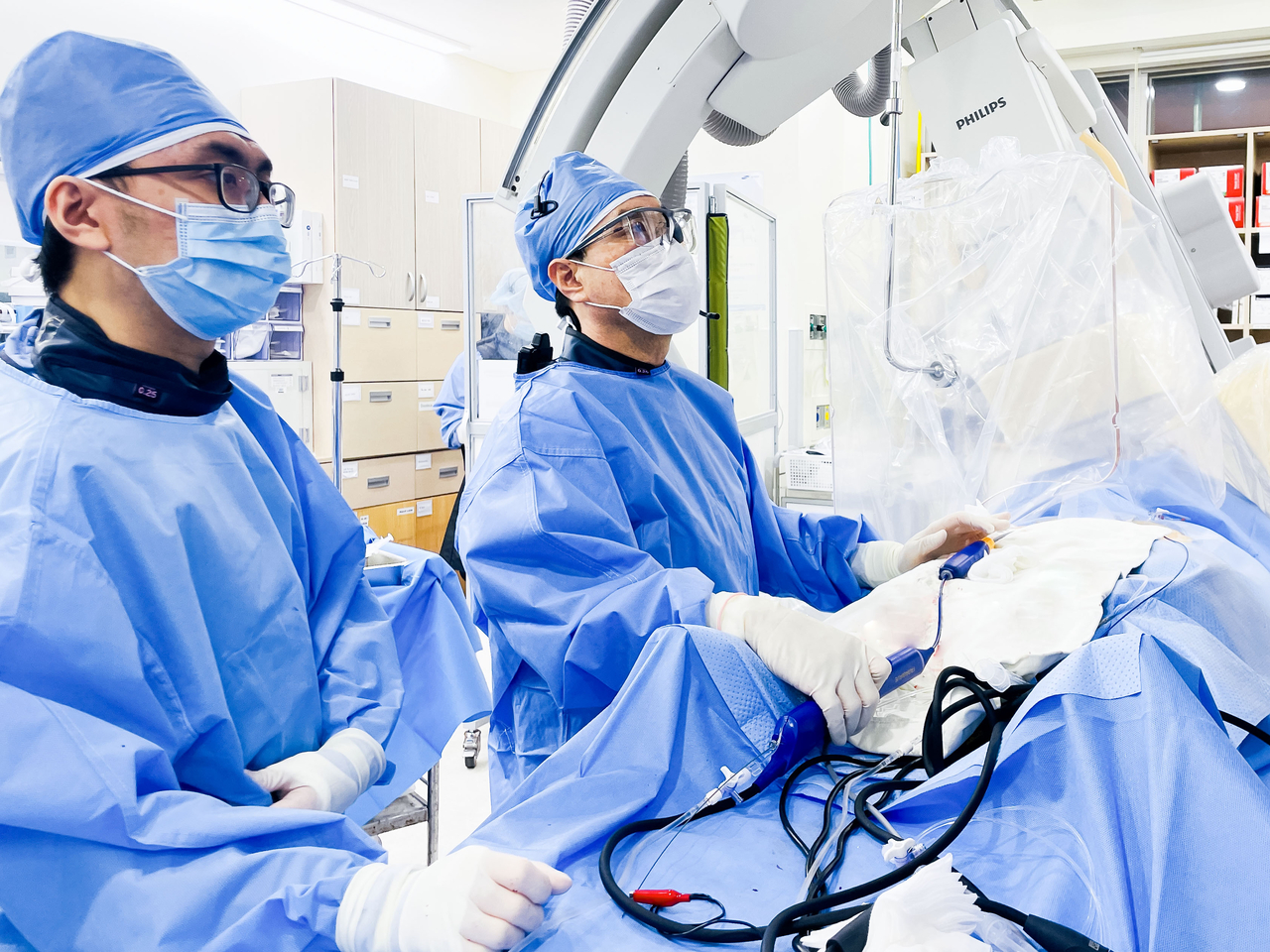
DEA's key advantage is that it allows physicians to select the most appropriate energy modality for each patient's condition and treatment goals during the procedure, enabling more flexible care. For example, when treating heart wall tissue close to the esophagus or phrenic nerve, PFA can be used to minimize damage to surrounding structures; when the heart wall is thick or energy needs to penetrate deep into the tissue, RFA can be applied instead.
On Young-geun, chief of Samsung Medical Center's Arrhythmia Center, said the combination of conventional RFA and PFA — considered a next-generation arrhythmia treatment — makes it possible to build more flexible and individualized treatment strategies for patients. "We will continue to drive innovation in arrhythmia treatment and work to provide patients with an even better care experience," he said.
kty@heraldcorp.com