Interview with CEO Lee Kyu-bok
Semiconductor reliability testing and failure analysis firm
Custom HBM, SoCAMM and CXL drive growing verification demand
RF equipment exports, space semiconductor testing open new growth fronts
40 years of reliability evaluation technology rooted in Hyundai Electronics
Company targets more than 100 billion won in sales next year
There are countless companies in the world — but what do they actually do? Some split, some merge, some rebrand. Some launch new ventures; others wind down businesses they have run for years. This series brings you the dynamic stories behind companies, told through on-the-ground reporting and data analysis.
![QRT has provided semiconductor reliability testing and failure analysis services to customers worldwide for more than 40 years, drawing on decades of accumulated experience and technology development. [Provided by QRT]](https://wimg.heraldcorp.com/news/cms/2026/10/07/news-p.v1.20261007.738890c4e3254a89acb060a52fdb8c61_P1.png)
![QRT CEO Lee Kyu-bok [Provided by QRT]](https://wimg.heraldcorp.com/news/cms/2026/10/07/news-p.v1.20261007.aa154294180f43cdb0f4719087e4b781_P1.png)
"This year marks the first chapter of QRT's second leap forward. We will begin generating meaningful sales from reliability verification equipment tailored to global customers' needs — covering AI, RF, space and defense semiconductors — while accelerating our acquisition of core analysis technologies spanning advanced chips, 2.5D and 3D packages, and glass substrates. On that foundation, we will deepen our network with global companies."
QRT has spent more than four decades providing semiconductor reliability testing and failure analysis services to customers around the world. The company exposes chips to extreme conditions — high and low temperatures, humidity, vibration and radiation — to assess their lifespan and stability, then uses transmission electron microscopes and X-ray equipment to trace the root cause when problems emerge. In short, QRT is the company that stamps semiconductors with a final seal of approval before mass production begins.
"Once a semiconductor has been designed, fabricated and turned into a product, you have to verify whether it is safe to mass-produce," CEO Lee Kyu-bok said. "If there is a problem, figuring out where it occurred and why is our job."
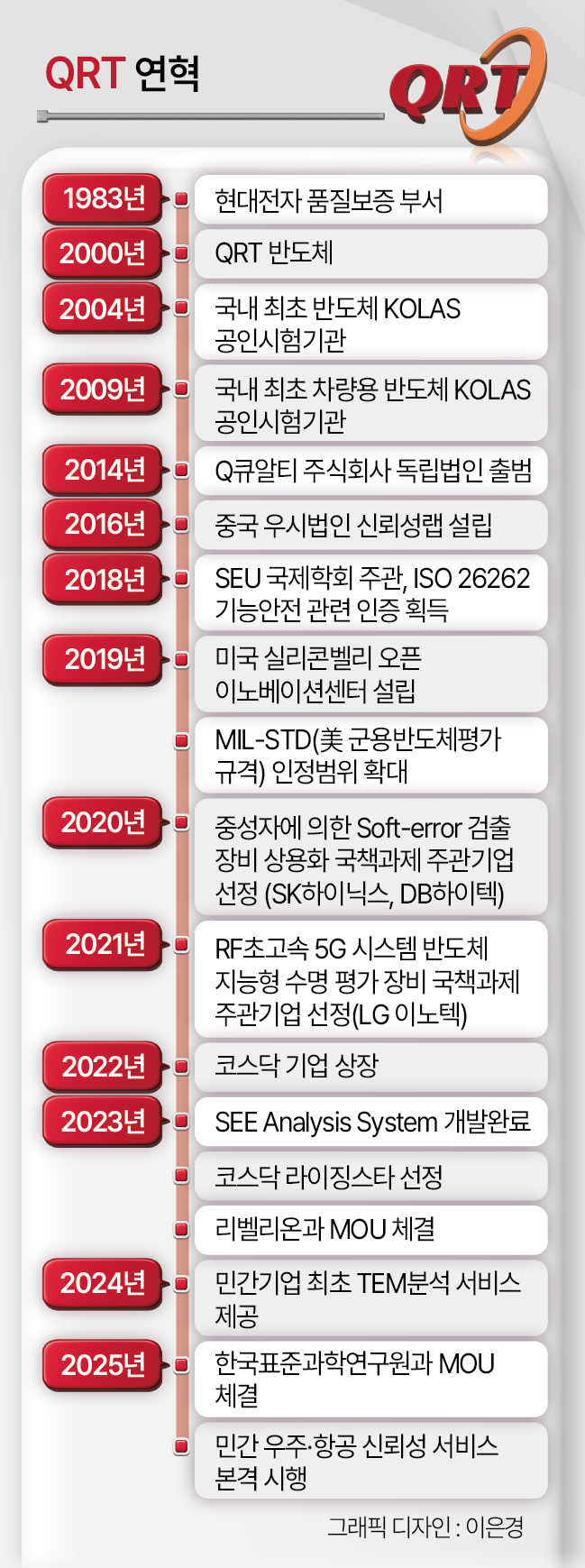
QRT traces its origins to the semiconductor quality and reliability evaluation unit of Hyundai Electronics — now SK hynix — in 1983. After passing through Hynix Semiconductor and SK hi-ENE, it was spun off as an independent company in April 2014. Today it maintains working relationships with more than 2,200 domestic and foreign electronics and IT firms, including SK hynix and Samsung Electronics. The company says that even excluding one-time clients, it has around 1,000 active customers.
Beyond HBM: memory diversification into SoCAMM and CXL
Verification scope expands to AI accelerator cards and full servers
Memory market growth creates new opportunities for QRT
The AI-driven surge in demand for HBM has sharply increased demand for the reliability testing and comprehensive analysis services that QRT specializes in. Because HBM stacks multiple memory chips vertically, microscopic defects at bonding interfaces can affect performance and longevity — and QRT is focused on developing analysis technology to detect those defects quickly.
As AI accelerator makers and big tech companies push for increasingly customized specifications, reliability testing must be repeated for each new product variant. The broader shift in the semiconductor market — a growing variety of memory types and a rise in ASICs, or application-specific integrated circuits — also works in QRT's favor.
"As major big tech companies increase their demand for custom HBM, we expect demand for reliability analysis of those products to keep rising," Lee said. "The more new segments emerge — such as SoCAMM and Compute Express Link, which address memory bottlenecks — the more customers will come to QRT."
AI data centers represent another new market. Where QRT has historically verified individual chips or memory products, the company now plans to extend its scope to AI accelerator cards and full server units.
"A single AI server can hold four or eight data cards, and going forward we need to be able to test an entire card assembly at once," Lee said. "Servers are expected to run for five or ten years, and we are working out how to verify scenarios where a single faulty component shortens the lifespan of the whole system." He said the company plans to enter that market soon.
Glass substrates, which are attracting attention as a next-generation semiconductor packaging material, represent yet another new analysis frontier. The material undergoes a Through Glass Via process in which microscopic holes are drilled through glass using lasers — a step that can introduce hairline cracks — and the thickness and flatness of the metal layers formed afterward must also be examined with precision.
QRT has recently begun receiving actual glass substrate analysis requests. Using transmission electron microscopes and other tools, the company is analyzing hairline cracks around TGV structures as well as coating thickness and surface flatness.
A quantum leap into space, aerospace and defense
Reliability testing equipment emerges as new growth engine
RF chip testing equipment supply 'imminent,' CEO says
![QRT has developed technology to verify and analyze the effects of various forms of space radiation — including heavy ions, neutrons and protons — on semiconductors. [Provided by QRT]](https://wimg.heraldcorp.com/news/cms/2026/10/07/news-p.v1.20261007.a214459641944f5c8f44bb5ff5343cbd_P1.png)
Space, aerospace and defense is another sector where QRT sees significant room for expansion. In the space environment, intense radiation can cause semiconductors to experience "soft errors" — momentary data corruption or malfunctions triggered by radiation strikes. That is why chips destined for satellites must pass far more rigorous verification than their ground-based counterparts.
"In space, radiation inflicts various types of damage on semiconductors, so we verify whether chips can withstand that environment by working with domestic and overseas test facilities," Lee said. "The range of products going into low- and medium-orbit satellites — memory chips, image sensors, signal-processing chips — is also diversifying."
QRT has built up technology to verify and analyze the effects of various forms of space radiation — heavy ions, neutrons and protons — on semiconductors. The company is also developing a global network that partners with overseas radiation testing institutions to conduct evaluations and deliver consolidated results alongside domestic test facilities.
Over the longer term, QRT has its sights set on verifying entire satellite systems, not just individual chips. In the 6G era, satellite communications are expected to become a core infrastructure element, and the company believes that will generate growing demand to certify the reliability of entire systems — not just the semiconductors inside them — before launch.
QRT is also building out an equipment business by leveraging the technical expertise accumulated over decades of reliability testing. Know-how gained from testing NAND flash-based storage devices and RF semiconductors has been translated into proprietary reliability testing equipment. Exports of RF reliability testing equipment to European defense companies have already begun, and the company is pursuing additional customers in the United States and Japan.
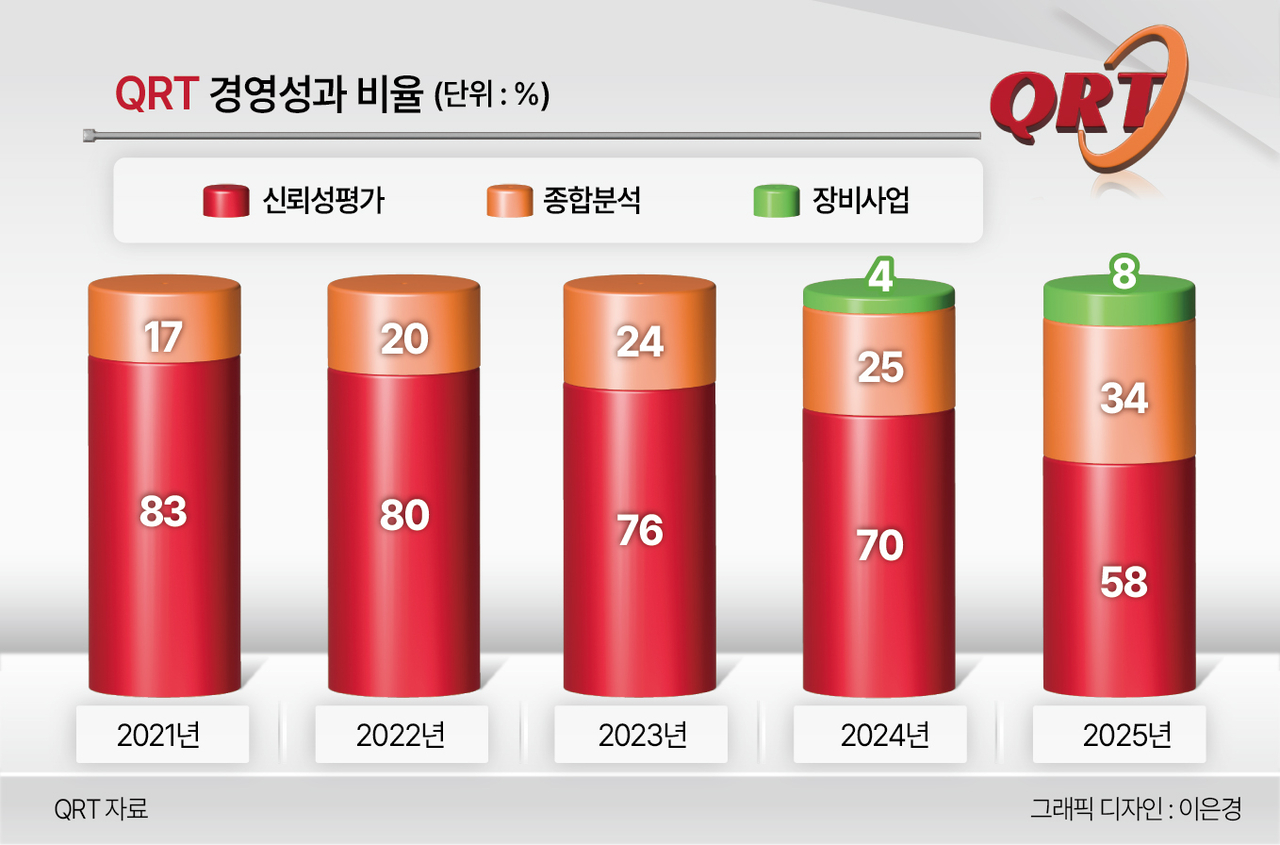
While the existing reliability testing and comprehensive analysis services provide a stable revenue base, the equipment business is a new pillar that could lift the company's overall scale to the next level. With individual units priced anywhere from hundreds of millions to tens of billions of won, a ramp-up in equipment sales is expected to give earnings a meaningful boost.
"We are already conducting RF chip reliability testing with one major US fabless company, and the supply of RF chip reliability testing equipment is imminent," Lee said.
From SK hynix to the world
Expanding footholds in Yongin, Wuxi and the US
Sales target: more than 100 billion won next year
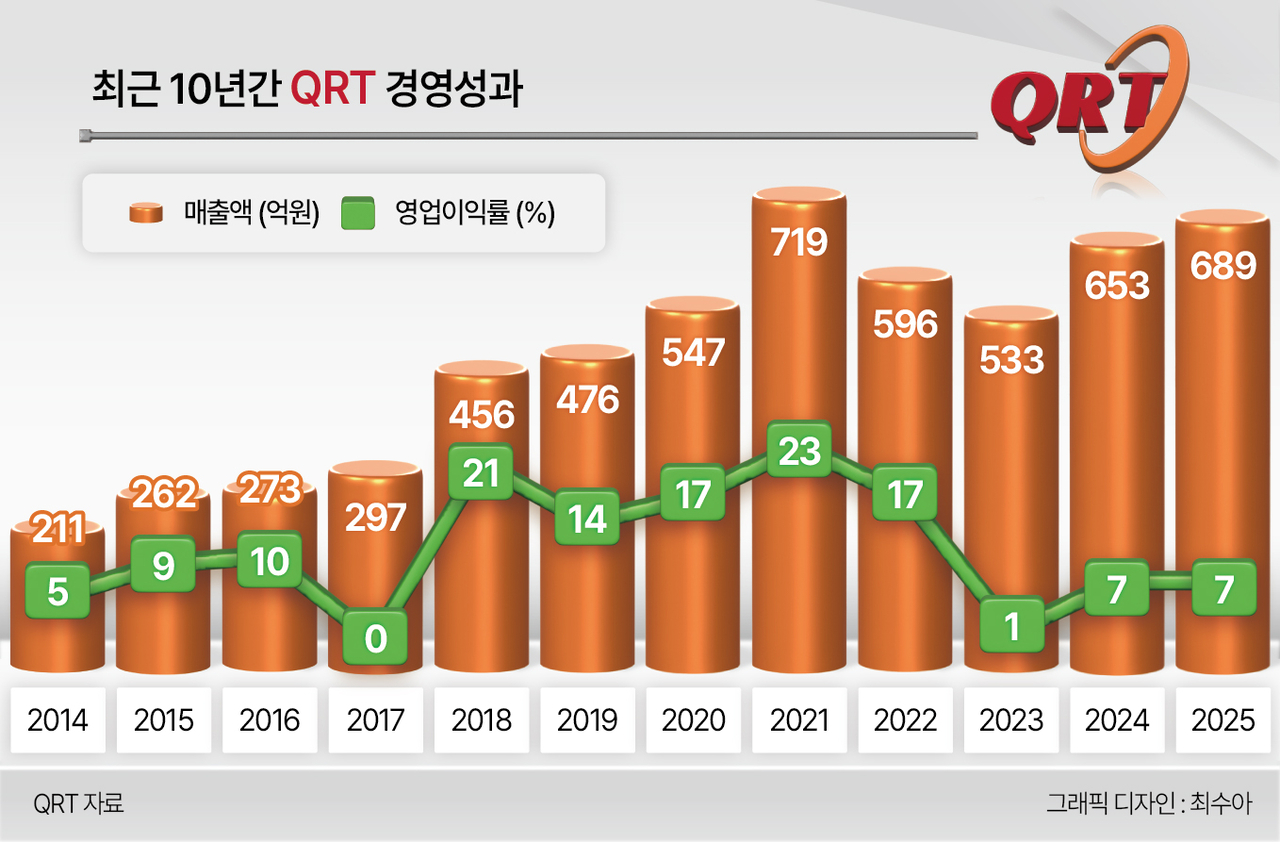
QRT is accelerating customer diversification alongside its business expansion. Because the company grew out of SK hynix's reliability evaluation organization, SK hynix-related revenue once accounted for the overwhelming majority of its sales — but as QRT has broadened its business and customer base, that share fell below 50 percent starting in 2024, the company said.
"Having a strategic customer account for a large share is meaningful in itself, but our ultimate goal is a structure where SK hynix represents about one-third and other customers make up the remaining two-thirds," a company official said. "Diversifying both customers and business lines is essential for stable growth."
Domestically, QRT is establishing a new base near the Yongin semiconductor cluster, where SK hynix is building large-scale production facilities, to position itself for the next wave of growth. The move is a preemptive response to the anticipated increase in reliability testing and analysis volume once the new fabs begin full-scale operation.
The company envisions the site as more than a facility to handle test volumes from existing clients — it aims to develop it into a hub where fabless companies and materials, components and equipment firms can collaborate and share resources.
QRT also expresses confidence in the role it plays in the domestic market, noting that few companies in Korea can handle both large-scale semiconductor reliability evaluation and precision failure analysis under one roof.
"If domestic semiconductor verification becomes difficult, companies ultimately have to turn to overseas analysis institutions and wait a long time to get their tests done," Lee said. "And because they have to show their products under development and analysis results to those overseas institutions, there is also a risk of proprietary technical information leaking outside."
"Supporting domestic semiconductor companies so they can resolve the reliability verification and analysis they need without leaving Korea is also an important role for QRT," he added.
Overseas, QRT is using its bases in Wuxi, China, and California as bridgeheads for expanding its global customer base. In Wuxi, the company operates a lab that performs reliability testing on locally produced products; in California, it is targeting advanced semiconductor companies in AI and RF. The strategy is to extend the 40 years of verification expertise built up in the Korean market to overseas customers, reducing dependence on any single client or the domestic market.
Earnings are returning to a growth trajectory. QRT's sales rose from 21.1 billion won ($15.7 million) in 2014 to 71.9 billion won in 2021. Growth stalled after that amid a semiconductor industry downturn, but revenue climbed back to 65.3 billion won in 2024 and 68.9 billion won last year.
This year, the company is targeting annual sales in the 80 billion won range — which, if achieved, would surpass the previous record of 71.9 billion won set in 2021 and mark the highest sales in the company's history. Next year's target is more than 100 billion won. The plan is to accelerate growth by layering new businesses — AI servers, space and aerospace, and equipment — on top of the existing semiconductor reliability testing and comprehensive analysis operations.
"If solid demand for our existing reliability and comprehensive analysis services is combined with the new businesses, we expect earnings growth of more than 20 percent next year compared with this year," Lee said. "We will push for rapid growth in the global market by raising the share of overseas customers to around two-thirds of total revenue."

go@heraldcorp.com