Preliminary Q3 results show operating profit up 782% on-year
Samsung surpasses Nvidia to retain top global ranking by quarterly operating profit
Sales hit record 195 trillion won; operating margin reaches 55.1%
Memory chips alone generated 110 trillion won in three months, offsetting weak consumer electronics
Samsung Electronics has become the first technology company in the world to surpass 100 trillion won ($74.4 billion) in quarterly operating profit.
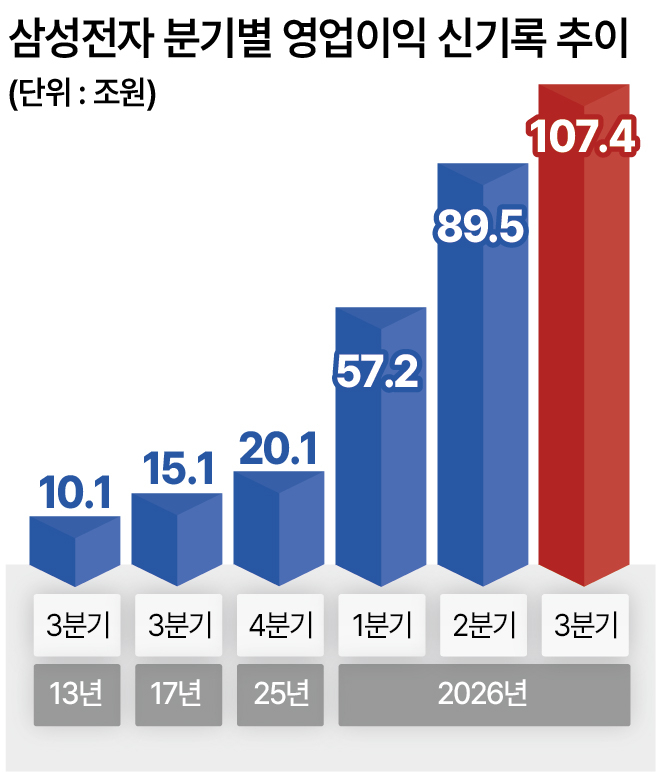
The company announced Thursday that its preliminary operating profit for the third quarter came in at 107.4 trillion won, up 782.5 percent from the same period a year earlier. The result marks the fourth consecutive quarter in which Samsung has set a new all-time high for quarterly operating profit.
The figure is not only the largest in the company's history but also the first time any technology company globally has crossed the 100 trillion won threshold in a single quarter.
The result comfortably exceeded Nvidia's operating profit of $63.73 billion for the second quarter of its fiscal year 2027 (May through July), allowing Samsung to retain its position as the world's top company by quarterly operating profit.
Samsung's third-quarter sales also set a record at 195 trillion won, up 126.6 percent from a year earlier, though the figure fell short of the 200 trillion won some analysts had projected.
The operating profit margin for the quarter came in at 55.1 percent, surpassing the previous record of 52.2 percent set in the second quarter.
Markets had initially expected Samsung's third-quarter operating profit to exceed 120 trillion won, but analysts trimmed their forecasts in recent weeks after the won-dollar exchange rate fell sharply. Having surged past 1,500 won per dollar in the second quarter, the rate dropped into the 1,300-won range in September.
Because Samsung receives payment for semiconductor exports in dollars, a weaker won-dollar rate reduces the won value of those revenues, making an earnings impact unavoidable. The results announced Thursday were broadly in line with the lowered market expectations.
Segment-level details were not disclosed, but semiconductors are by far the driving force behind the milestone. Consumer electronics divisions — including smartphones, home appliances and televisions — are estimated to have collectively posted losses in the quarter, while the semiconductor business alone is believed to have generated more than 100 trillion won in operating profit over the three months.
Assuming the non-memory segment — System LSI and foundry — posted a loss in the mid-1 trillion won range, the memory chip division is estimated to have single-handedly delivered close to 110 trillion won in profit, carrying the company's overall results.
Securities analysts attribute the record performance to the HBM business gaining full momentum alongside a supply crunch in the broader memory chip market, which pushed DRAM prices up 15 percent and NAND prices up 18 percent in the third quarter.
The Device Experience (DX) division, which handles finished consumer products, is estimated to have seen its losses widen further in the third quarter. Analysts point to the dual impact of rising component costs — including memory chips — and the hit from the weaker exchange rate. The division's trajectory stands in stark contrast to the semiconductor segment's rapid quarterly growth, with its slump showing no signs of ending.
The Mobile Experience (MX) division is estimated to have posted a loss of around 1.5 trillion won in the third quarter. The unit had typically recorded a profit of around 3 trillion won in the third quarter, when it launches new foldable phone models, but it is believed to have extended its losing streak after falling into a 700 billion won deficit in the second quarter — its first such loss since the company's founding.
The home appliances and television businesses are also estimated to have recorded losses of between 700 billion won and 800 billion won in the third quarter, weighed down by rising component costs and sluggish sales.
Samsung Display, the subsidiary supplying OLED panels for Apple's first foldable phone, the iPhone Duo, and the new iPhone 18, is expected to post an operating profit of around 1 trillion won. Harman, the audio and automotive electronics subsidiary, is estimated to have earned around 400 billion won in operating profit, roughly in line with its third-quarter result last year.
joze@heraldcorp.com